I. Ni Zan Once Wrote the Verse, “Laughing to Scorn the Work of Spring”
Ni Zan once wrote two lines of verse: “Laughing to scorn the work of spring, peering close at heaven’s craft — so marvellous it could scarce be painted.” When he wrote this, Ni Zan grew ever cleaner; his pictures are sparse and pale — a cold forest, a few stubborn rocks; a single rock, a single tree suffices to achieve a richness within extreme minimalism. He opposed heaven’s craft and the marvellous; the deeper, the simpler. The void is not empty; within death hides life. Pu Xinyu said of him that “the pines and rocks beneath his brush all possess a stern, unyielding bone” — the keen eye of a connoisseur. In truth, the more spare, pale and desolate the painting, the more it is an achievement outside the painting, like a cultivation of extreme difficulty.
Li Youyi has also responded to Ni Zan’s paintings; their temperaments are alike, and his recent works of the last two years have come ever more to resemble a rite of “clarifying the mind” (cheng huai), reinterpreting, in the language of Western modern art, a traditional artistic spirit akin to the “dry-wood Chan” (ku mu chan). The pictures gradually turn inward, paring away form and dispensing with flashy brushwork as one cuts off deluded thoughts; partial blank space and cursory, sketch-like strokes (yi bi) are like seeing one’s original mind. Buddhism speaks of the “patience with the unborn” (wu sheng fa ren), the capacity to maintain an inward-turning state — withdrawing from the dusty world into the inner mind, then returning from the inner mind to the cosmos. This in itself is already an experiment: empty mountains with no one, water flowing and flowers opening, all sounds silenced. These recent works are of one lineage with Ni Zan’s “desolate cold” (huang han) in spiritual temperament; the grey-cool tones, the empty spaces, the eroded textures together conjure a post-industrial “desolate-cold” realm. This is a more universal loneliness and sense of estrangement concerning the existential plight of modern man, yet its source can undoubtedly be traced to the spiritual core of classical Chinese literati painting.
Over these years Li Youyi’s works have kept their reverence for the traditional spirit; the aura of the pictures grows ever grander, the brushwork and texture ever deeper and heavier, and the painting touches ever more on the profound, essential questions of the medium. Though his paintings belong formally to Western modern art, their inner spirit and aesthetic logic are deeply entwined with China’s native cultural genes. This shows a thing: amid today’s flood of images, a return to painting’s own formal language and spiritual core still holds boundless charm and possibility.
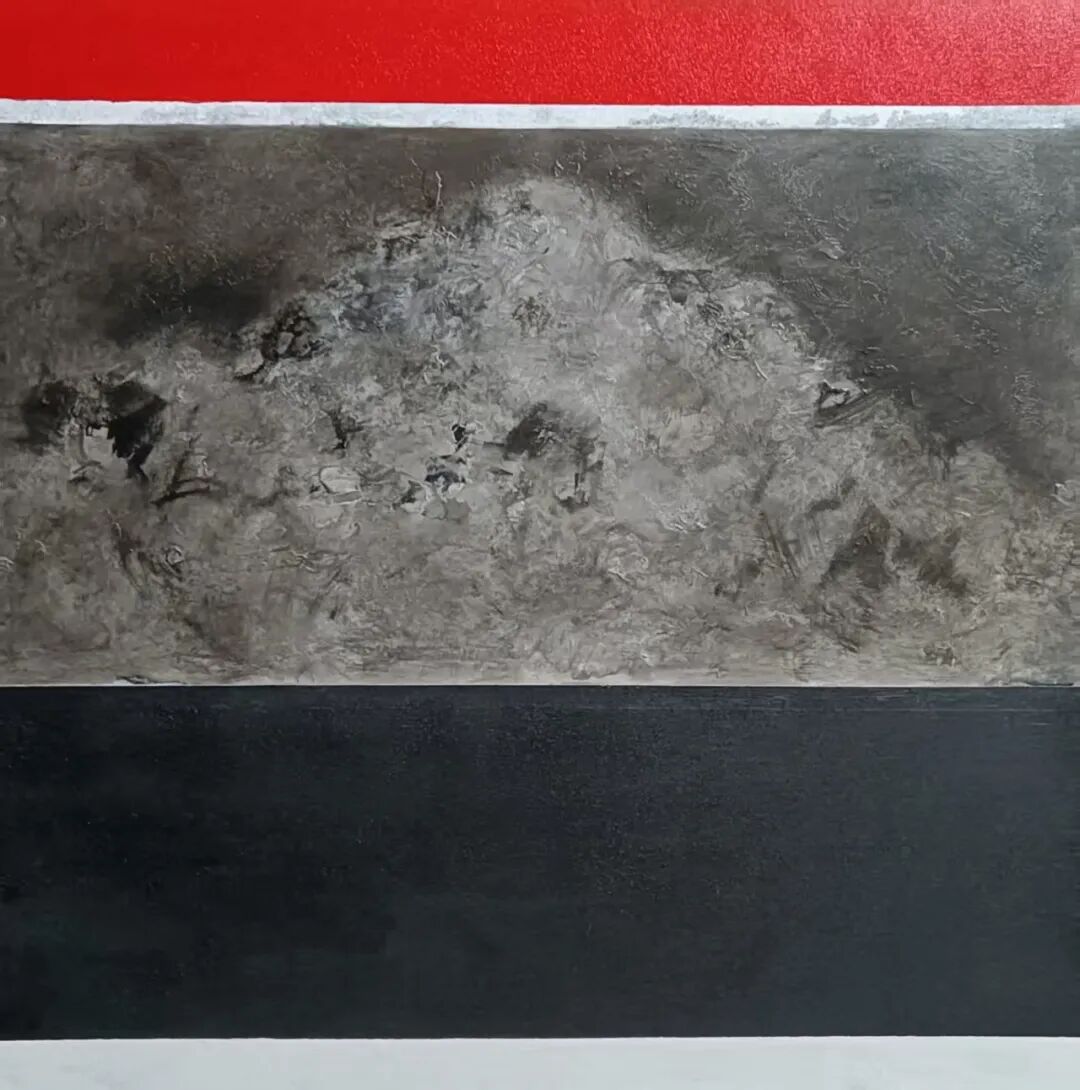
The Guanzi says, “The cosmos embraces heaven and earth” (zhou he you tuo tian di); Zong Baihua said that a universe full of musical sensibility is the artistic realm of Chinese painters and poets. In traditional Chinese art time and space are conjoined — there is no isolated spatial image; every image unfolds in time, and the life-sense of time fuses with the artistic image, then floats and sinks within time to create the unity of time and space, time governing space. The vitality embodied in time’s flowing sense is the spiritual core of traditional Chinese art. It is clear Li Youyi understands this: his paintings fuse grand structure, sensuous brushwork and deep materiality; the coarse texture, the freehand (xie yi) descriptive language and the composition constitute the flowing sense of his work. These elements creatively translate the core spirit of traditional aesthetics into the contemporary; in a sense the tradition is no more — his paintings, with a resolute posture toward the future, carry out a thorough, root-and-branch contemporary reconstruction of the Chinese traditional spirit that once esteemed the life-sense of time and space.
Li Youyi’s works occupy a non-realist sphere, unlike traditional painting’s pursuit of the illusion of three-dimensional space; he emphasises the canvas’s “planarity” (ping mian xing), rooted first in the core conception of modernist painting. Vast colour fields, texture and non-realist depiction block the viewer’s attempt to “see through” the picture, forcing attention onto the picture’s own colour, composition, material and detail; looking closely, one gradually feels the flow of time and space within. The philosopher Cassirer said, “For myth there is no time itself, no eternal duration, no regular recurrence and continuity — only the construction of individual contents; the whole of time is divided by boundaries like the bar-lines of music.” The viewer’s cognition of time is intuitive, lacking an objective sense of regular time, so one can only attend to the “present bar”; time develops by means of “bars” (jie), and man “follows the bars”.
Therefore, before Li Youyi’s works we feel only the traces of time. These works are neither simulation of the real world nor encoding and decoding of specific social signs, but a material site deliberately constructed, as if washed by immense stretches of time. Especially the coarse, heavy, erosion-laden texture refuses the currently fashionable smooth, rapid and easily reproduced image paradigm, and lets the work touch a deeper meaning — the objecthood (wu xing) of the oil painting. In those mountains Li painted after Old Eagle Mountain, “mountain” is shaped by modelling paste, oil paint and other mixed media through piling, scraping, covering, sanding and a series of operations that simulate and accelerate the physical process of “time’s passing”, becoming a spiritual “ruins” landscape. From these “traces” the viewer can sense a site where “objecthood” is weighty.
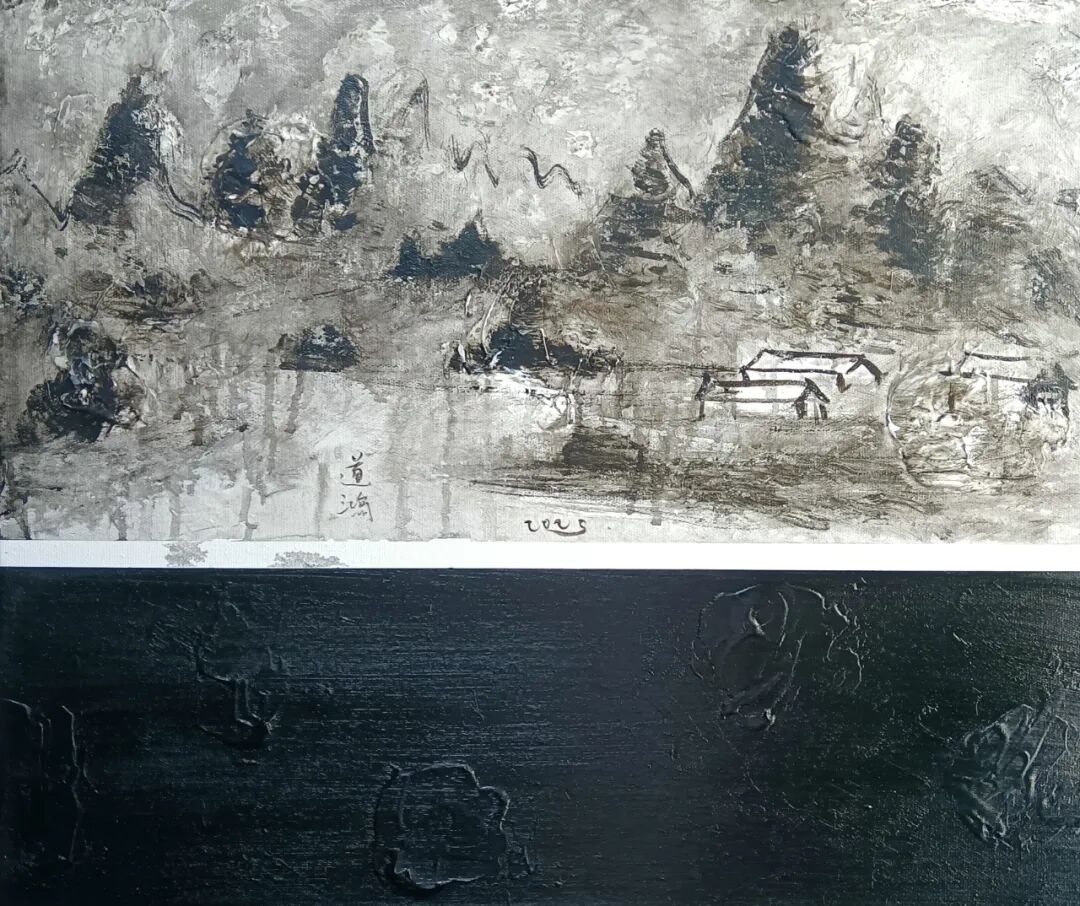
Worth mentioning: the texture in Li Youyi’s paintings has special significance. In 1956 the artist Antoni Tàpies wrote in an essay: “From the very beginning I attached great importance to the texture of painting… Now I find that those textural qualities can reflect many complex intentions: enclosure, the fading of passion, ruins, silence and death.” Tàpies mixed non-traditional materials such as sand and marble dust with oil to create surfaces mottled and heavy like wall plaster; his tenet that “matter, form, language and concept are inseparable” resembles the conception of texture in Li Youyi’s works. Both emphasise that painting is not merely a visual illusion but a physical presence with its own weight, density and tactile quality.
It is precisely in this trend that Arthur Danto insightfully singled out the significance of “texture”, saying “texture is elevated from a tool imitating reality to a sign of art’s self-certification; the physicality of piled pigment is itself a declaration, proclaiming the existential value of painting as an independent entity.” His framework of the “end of art” brought the linear narrative of art history to a close and turned creation toward plural exploration; it is against this background that texture no longer serves realism but becomes a sign of art’s self-certification. Looking again at Li Youyi’s recent works, which have undergone repeated coating, smearing, scraping and wiping so that “matter” rises and subsides on the plane, one readily feels this temporal sense of “objecthood”.
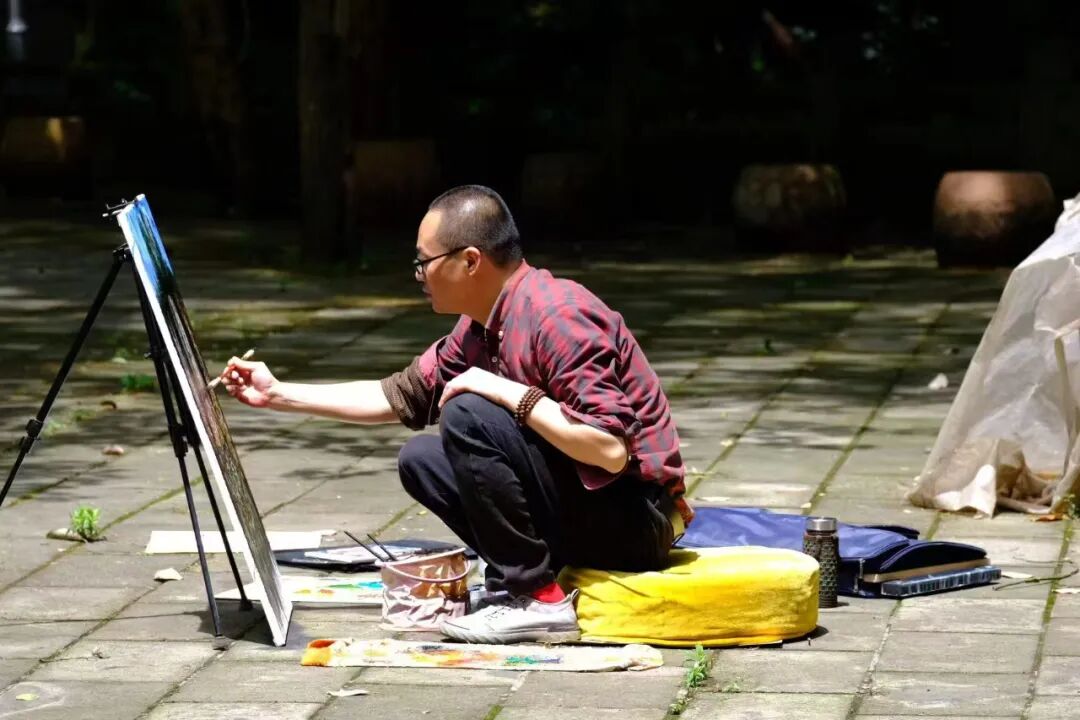
The sense of time exists, but how does time become sensible? Deleuze said the eye has an apt tactile function. He called a mode of perception in Western traditional art from Greece to the Renaissance that transcends conventional linear perspective “haptic vision” (tactile visuality) — an intermediate state between visual space and manual space, emphasising the body’s role in perception.
For example, in Li Youyi’s paintings colour forms a random tension within its knots; he replaces value relations with tonal relations, arranging colour upon the “plane” of modern painting to form a tactile space. This requires close viewing, for this spatial experience differs from traditional visual space, emphasising the body’s direct contact and the density of matter, creating through the juxtaposition of colour a tactile sense of volume. Therefore the tactile space is smooth, fluid, dominated by close-range material and texture; Li Youyi’s works, through their rich textural variation, force the viewer’s gaze into a “close-range nomadism”, which fundamentally continues the “time” attribute of traditional painting mentioned above. For in the painting it is no longer capturing an instant’s impression but compressing a long “evolutionary time”. Each layer of pigment laid down is a “sedimentation”; each scraping is an “erosion”; a more silent, tenacious “material vitality” — closer to the immutable core of matter itself — is thereby manifested, reminding us that this is first of all a “painted painting”; pigment here is not merely the bearer of colour but an entity that can itself be shaped and perceived — and this is the “sense of time” in his work.
Li Youyi’s works have consistently upheld a spiritual lineage of “monumentality” (ji nian xing). As I wrote earlier, “he did not destroy or dismantle any traditional formal matrix, yet recreated through borrowing, successfully transforming it into a personal discourse and gradually forming a discursive system for the translation of China’s native visual sign-language” (see “Li Youyi: ‘Deconstructing’ the Monumentality of Traditional Painting”). Over these years his works have consolidated and activated this “monumental” pictorial experience. Özlem Deniz has conducted targeted research on the experience of “monumentality”, saying: monumentality arises from two psychological experiences — “the sublime” (chong gao), which evokes awe, and “order” (zhi xu), a mandala-like spatial structure that activates the collective unconscious. Li Youyi says his works carry “a sense of peeling murals, a visual wish to commemorate vicissitudes and reclaim monumental strength”; the “vicissitudes” (cang sang) appear in the picture’s intricate yet ordered sense of order — using images to reveal the order existing amid diverse phenomena, the laws and intensities governing each part constituting order, such as the picture’s texture and the “generalised form” to be mentioned below. The “sublime” appears in a split between meaning and image — as Hegel says, “the absolute domination of idea over phenomenon” — which in the language of oil painting has but one outlet: the wild and primitive, manifest in the depiction of objects and the mode of expression. Its essence is the contrast between the individual and the vast cosmos, between delicate sensation and rough, unrestrained paint, between simple primitive vision and rich symptoms; the “sublime” and “order” are precisely the viewer’s conflict — a revolt against the finitude of human vision, cultural situation and social development, and an infinite thirst for cultural belonging and the vast cosmos. At this level Li Youyi’s works are always a scientific, solid systematic construction, continuing and expanding the objecthood of “monumentality”.
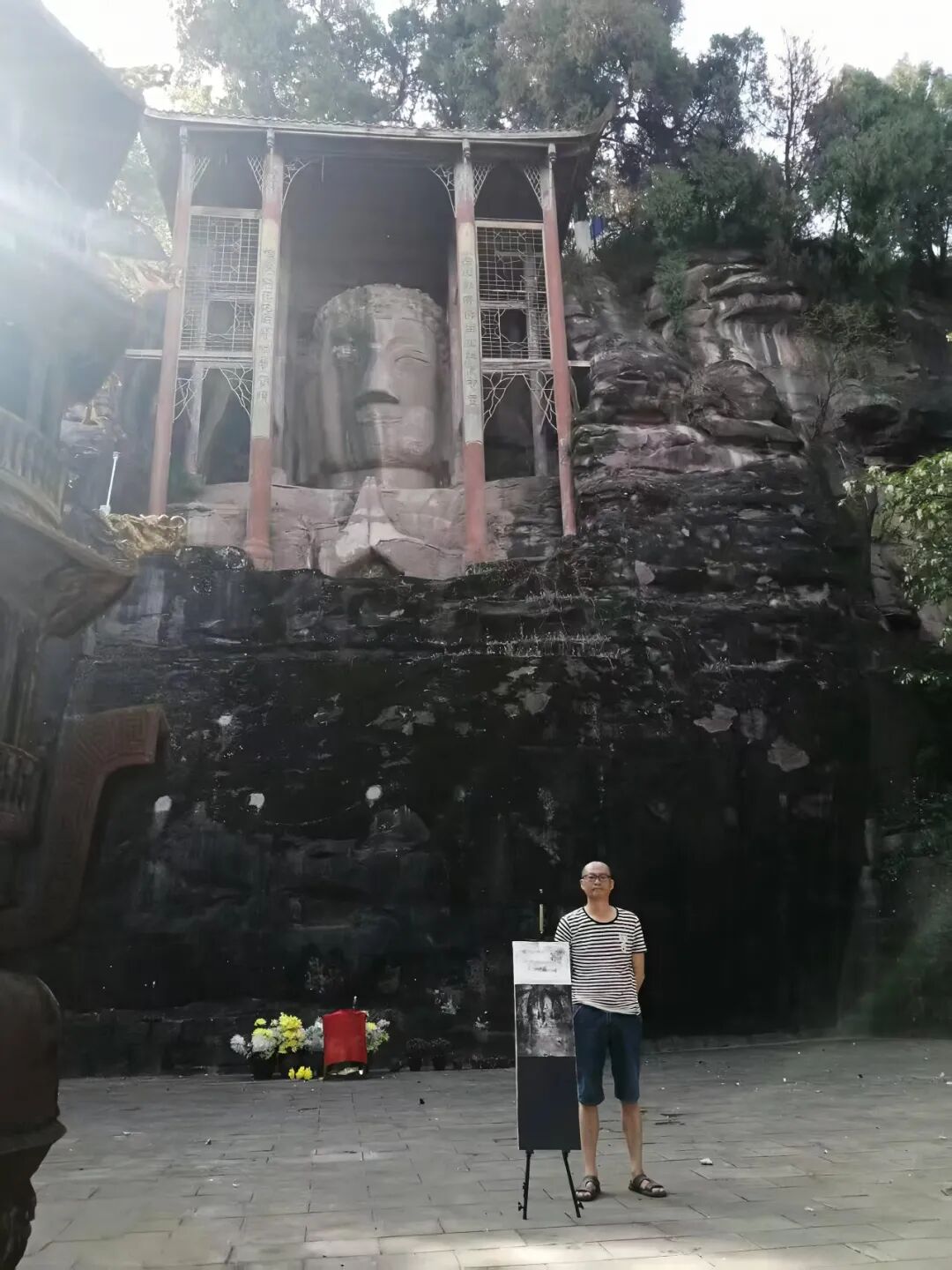
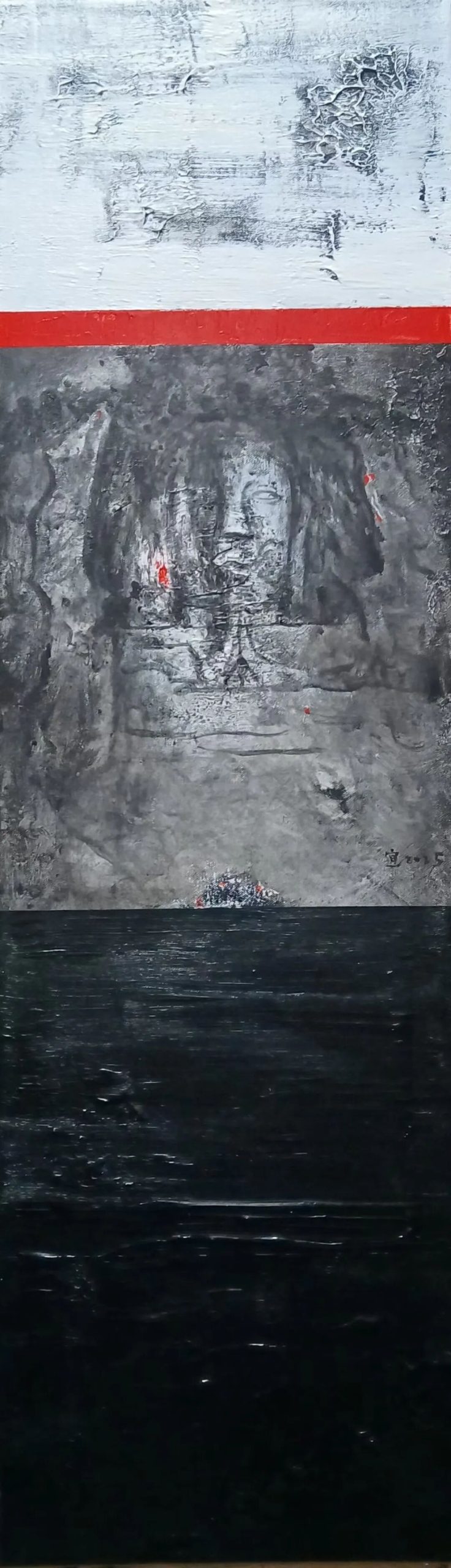
Below: Li Youyi | Renshou Great Buddha | mixed media on canvas | 2024
II.
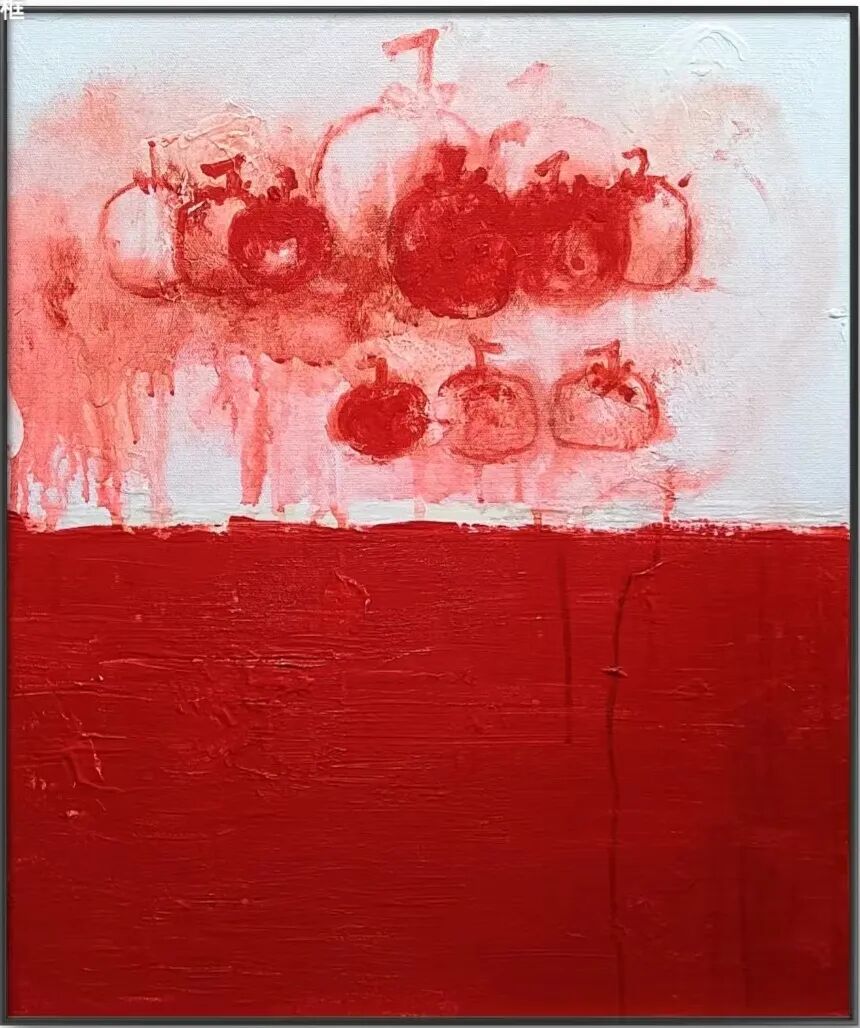
If the conception of texture in Li Youyi’s works constructs, through “objecthood”, a “sense of time” close to traditional painting, then his colour constructs another “post-memory” (hou ji yi) psychological atmosphere. In this group of works the dominant palette remains highly unified: large areas of cool grey, neutral grey, ochre, burnt umber and grey-blue, interspersed now and then with white and black. This extremely restrained colour, on the semiotic level, signals first a resistance to “vivid” colour; at the same time it is not an imitation of real colour but the result of a high degree of purification and conceptualisation. This restraint endows his colour with stronger inner tension and symbolism.
Speaking of colour’s specific reference, the semiotician Umberto Eco said that colour signs do not exist naturally but are products of cultural encoding; colour is a conventionally established cultural sign whose meaning depends on social context. Li Youyi’s works illustrate precisely this: the various orientations of black, white and grey form the picture’s keynote; this colour tendency, almost that of Eastern ink painting, creates an atmosphere at once profound, tranquil and faintly desolate. Black under his brush is not merely shadow or background; it often appears as large, heavy, textured areas bearing weight, mystery, solemnity, even a certain oppressive or unknown emotion, while some grey, brown and blue colour fields, stripped of the narrativity of concrete events, retain only a universal emotional keynote of passing and loss. This can be seen as a silent resistance to contemporary China’s high-speed development and its constant “mechanism of forgetting” that replaces the old with the new; his pictures are “colour monuments” erected for those vanished traditional cultural memories.
Within this, Li Youyi often introduces a highly distinct, saturated symbolic colour, most prominently red, usually appearing as straight lines, squares or irregular colour patches. This is a strategic “break”, especially amid the solemn, still, even somewhat sorrowful atmospheric field, creating another intense visual focus. Li says this red derives from the folk colours of prayers for fortune and “hanging red”. Sociologically, across the whole body of work, the significance of these bright colours as “punctum” (ci dian) lies not in their symbolism itself but in the way they, with a posture of “rupture”, activate the psychological tension of the entire picture, keeping the “ruins” from sinking into total nihility and becoming a field full of contradiction and questioning. As Roland Barthes says: “The punctum is the element that disturbs the arrangement. It is something contingent, and it is precisely this that pierces me.”
In Li Youyi’s oil paintings, the use of brushwork is a major source of his artistic expressiveness. His brushwork is not fine and traceless but full of power, calligraphic quality and expressive freedom — whether broad smearing, short forceful pauses, or unrestrained, drenching sweeps, all manifest the artist’s emotional investment and bodily participation in the act of creation. In many works, for instance, we can clearly see the tracks of brush or palette knife moving across the canvas; these strokes are sometimes rugged and bold, like axe-cleaving and knife-cutting, giving the picture a hard, resolute texture, and sometimes lingering and winding, like broken firewood, conveying an inner tangle and conflict. At a deeper level, this emphasis on the expressiveness of brushwork, on the one hand, echoes the tradition of Western Expressionism, and on the other hand shares the ingenious correspondence of Chinese traditional painting and calligraphy’s regard for “brush and ink” (bi mo). Although the brushwork of oil painting and the brush-and-ink of guohua differ in conception, the creative states they pursue behind them — “mind and hand in accord”, “intention before the brush”, “clarifying the mind to contemplate the Way” — are commensurate. Thus Li Youyi’s brushwork is not merely a means of form-making but a record of his emotion like an electrocardiogram; it is a sincere reverence for, translation of and echo of traditional Chinese culture.
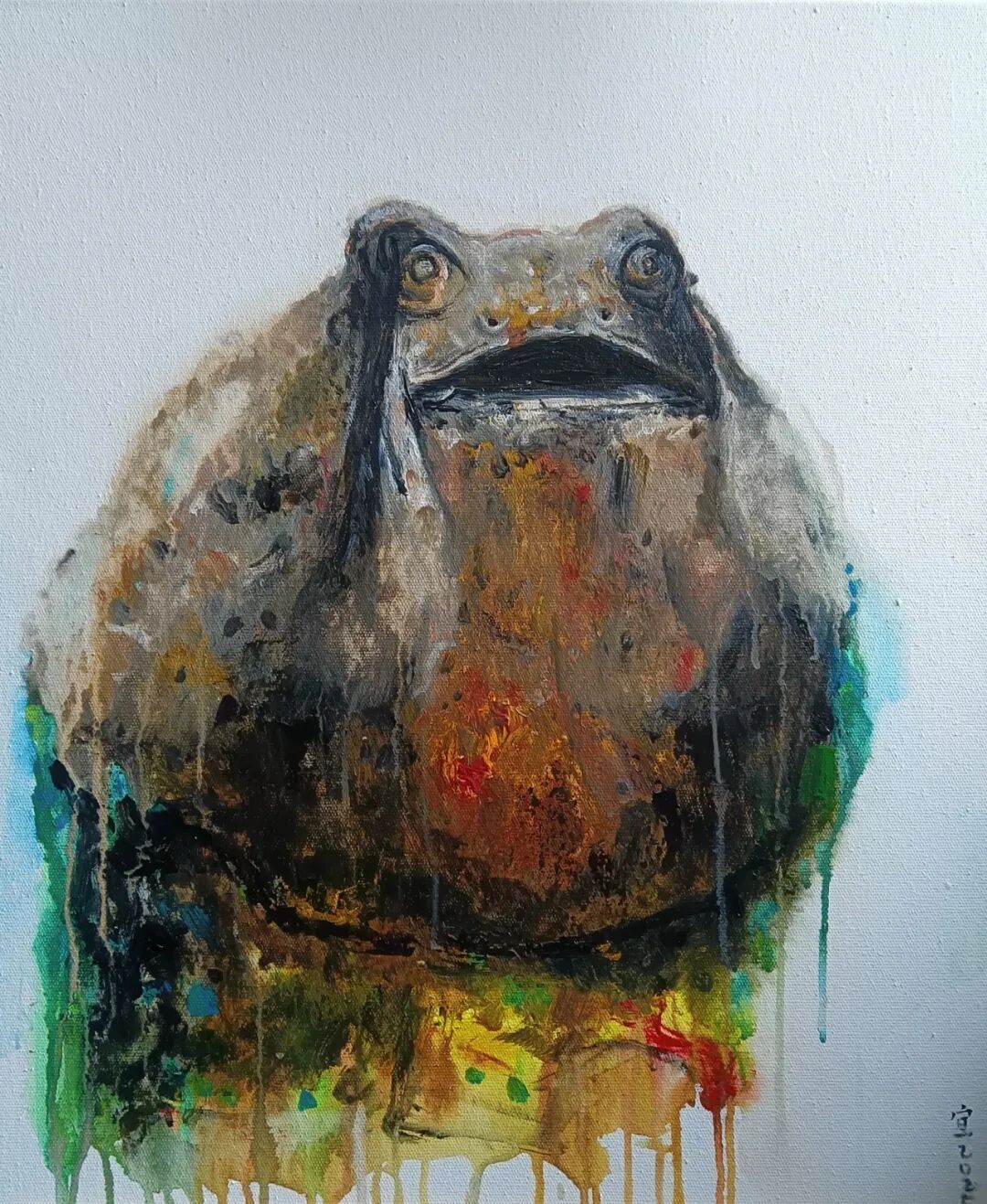
In these works we seldom see deliberate prettifying or over-management; on the contrary, a candid, direct, even slightly raw picture is the more revealing. This sense of “rawness” (sheng) is not technical immaturity but a deliberate artistic pursuit; it avoids the perfect illusion of Western tradition, breaks the over-rigid composition and deliberate control of academicism, and escapes the rut of guohua. The picture occasionally bears traces of natural flowing or dripping, some blank spaces, some piled colour fields and even texture, which heighten its liveliness. Some works depicting cats, toads, Buddhist images and persimmons seem to pursue an “archaic clumsiness” (gu zhuo). Looking closely, the pictures are “clumsy” beyond realistic proportion yet wholly suited to the exaggeration needed to display movement and force; at such moments “dynamism” (qi shi) and “archaic clumsiness” are seamlessly one, as Li Zehou said: “The archaic-clumsy is not roughness but the necessary bearer of the beauty of dynamism; through exaggerated form it activates the sense of movement.”
Li Youyi should be clear that in this exploration of Eastern native aesthetics he keeps breaking through with a “punctum” of distinct native significance, attaining a level of “following one’s heart’s desire” (cong xin suo yu) within tradition. In the six or seven years I have consistently followed Li Youyi’s art, I have witnessed this gradual process of “following the heart’s desire” — the pictures grow ever more flavourful, ever more relaxed; ever more “clumsy” yet casting off the false to reveal the true, removing and breaking those things that make the picture greasy. Step by step he sheds the ostentation of technique to reach the truth of the inner mind. From his angle, the archaic-clumsy is indeed an “old” (lao) realm, but by no means decay — rather a naïve simplicity after sedimentation; its significance lies in both breaking through established formulae with an experimental language and not yet being alienated by technological rationality. While paying homage to tradition, Li Youyi constantly pursues the true root of tradition — that native vitality of Chinese art.
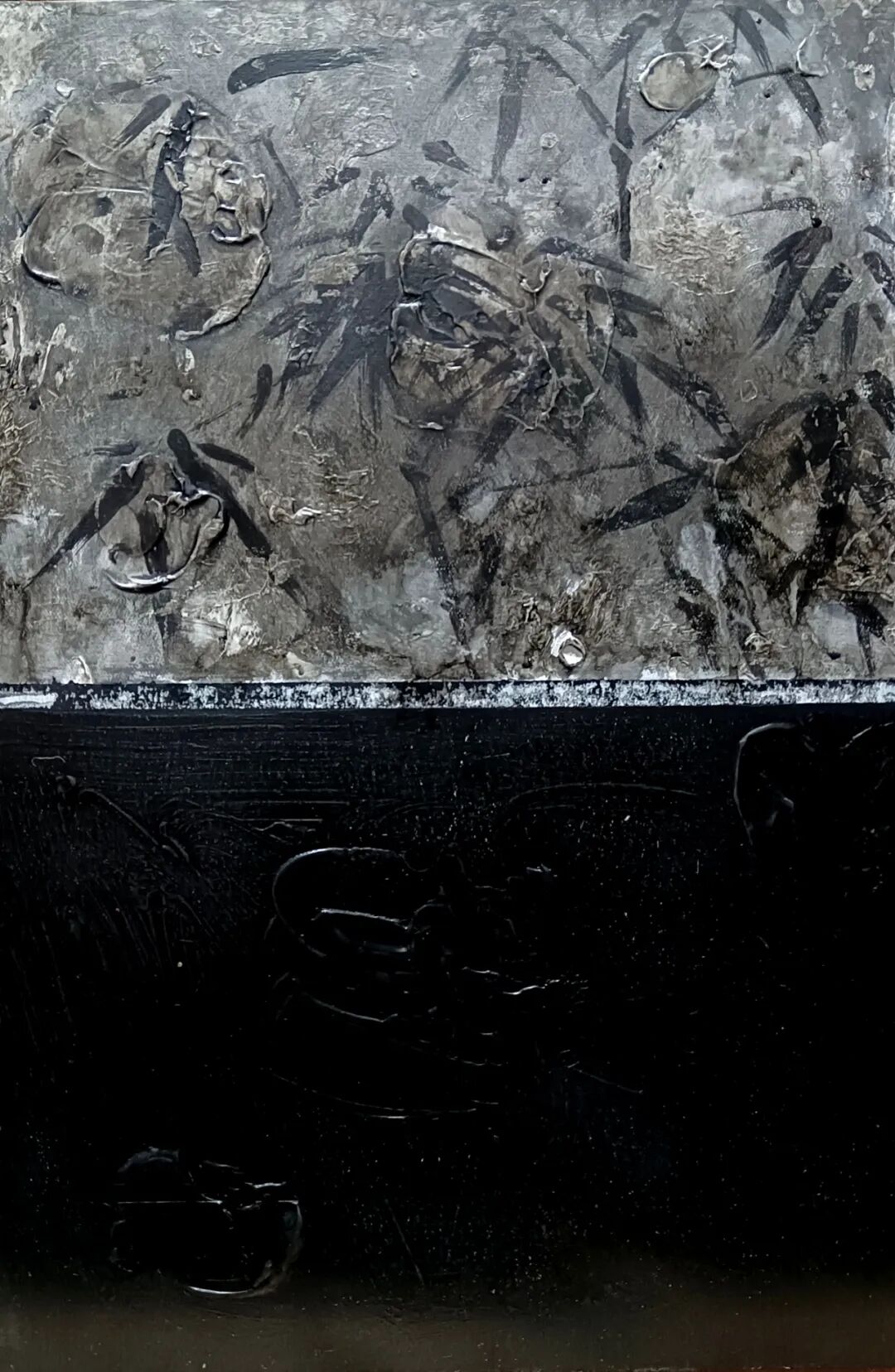
The last point is in the handling of pictorial space: Li Youyi’s division of the picture carries a narrative or symbolic orientation, unlike the purely formal division of Rothko, Newman and others. He says this formal division borrows the mounting format of traditional album leaves (ce ye) in painting and calligraphy, which is itself an element of Eastern native narration. In his works paying homage to the imagery of Muqi’s “Six Persimmons”, rows of simplified persimmon signs are placed above a dividing line, while below lies a large area of black or dark colour; this composition makes the persimmons no longer carefully arranged objects in a traditional still life but more like floating, scrutinised cultural signs or life-metaphors. The binary black-and-white division points to many existences of Chinese native culture — the cosmology of the “Diagram of the Supreme Ultimate” (Taiji tu), the qian-kun view of the “Book of Changes” (Zhou yi), the folk-ritual view of life and death, and so on; the confrontation between the black “earth” and the white-grey “heaven” endows these everyday things with a transcendent, monumental import.
Li Youyi distils highly generalised forms — the temporal sense of texture, objecthood, archaic-clumsy detail, the “punctum” signs and colour of distinct native significance, and composition — which form a new tension through which he propagates the spirit of native traditional culture. He does not re-present subject matter but express form; yet form is not merely abstract visual relation but opens, upon the semi-abstract image, a new spiritual force. For within those images, the features of Old Eagle Mountain, Buddhist images and various depicted objects and pictorial elements carrying traditional allusions, when seen by the viewer, all convert into a formal tension that, directly through visual perception, evokes that solemn and ancient civilisational consciousness.
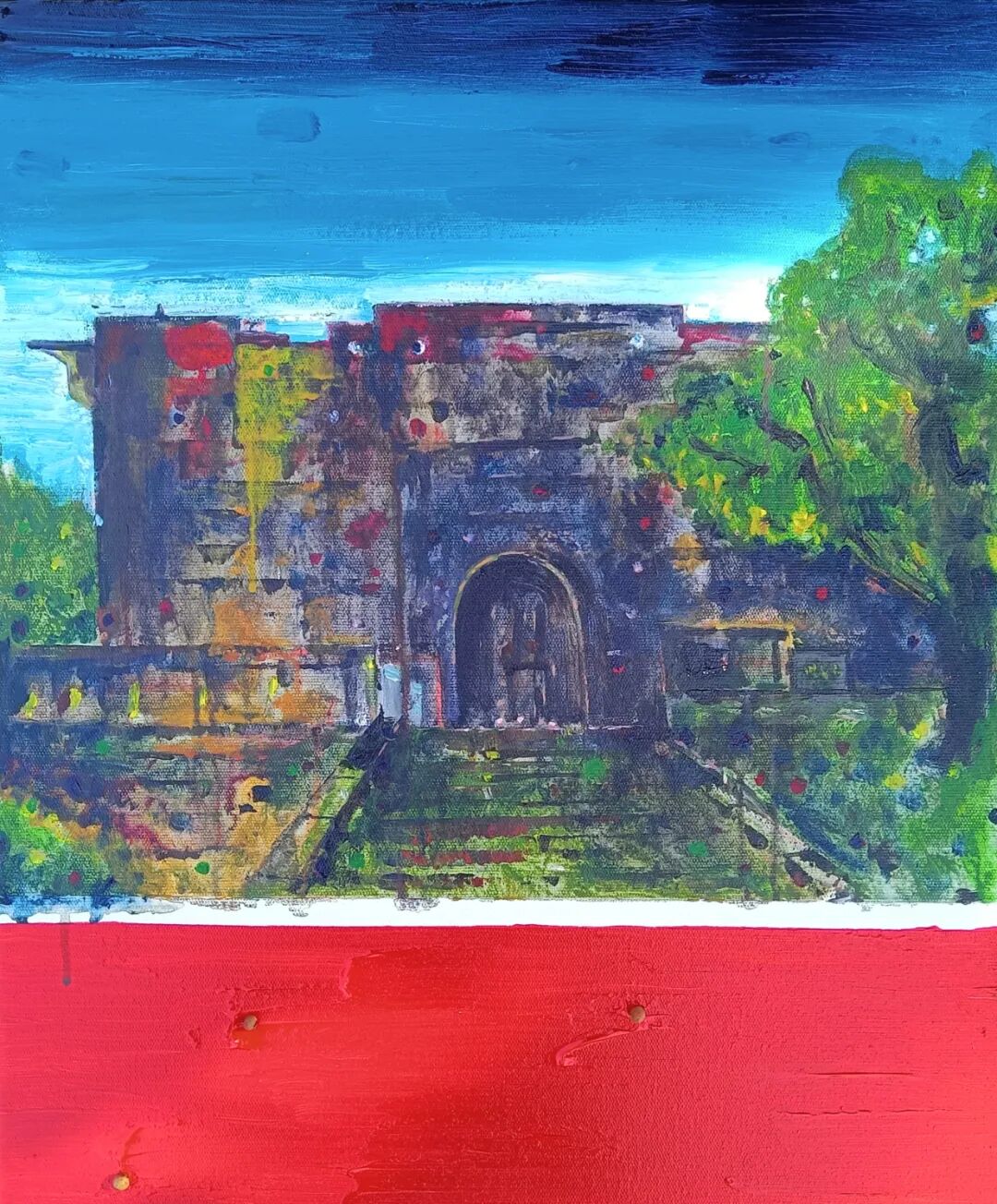
III. Facing an Age Defined by Artificial Intelligence
Facing a “contemporary” defined by artificial intelligence, digital images, virtual reality and accelerated culture, Li Youyi’s creation constitutes a unique, reverse response. He did not choose to chase, parody or criticise these new media forms with art, but to use an extremely “ancient” and “slow” manner to set off, in reverse, these contemporary symptoms.
This inward, slowing artistic choice has its root not merely in conceptual speculation but in the necessary manifestation of a spiritual temperament; it ultimately shapes Li Youyi’s artistic temperament: a deep, restrained, unfashionable steadfastness. And the origin of this steadfastness is precisely his father. As an ordinary man who lived through all the historical storms of China in the 1960s and 70s, especially the tides of the Cultural Revolution, that generation’s “suffering” and resilience have been internalised as a silent strength and a plain philosophy of life. The artist’s father bears everything in the most unadorned way, in wordless silence; this tenacious state of life, like an invisible gene, is planted deep in the artist’s blood, making Li Youyi naturally draw close to those coarse, heavy object-bound textures, for within them is a father-like silent character; it also makes him consciously withdraw from the era’s clamour and the ostentation of technique, sinking into a “casting off the false to reveal the true” realm of “clumsiness”.
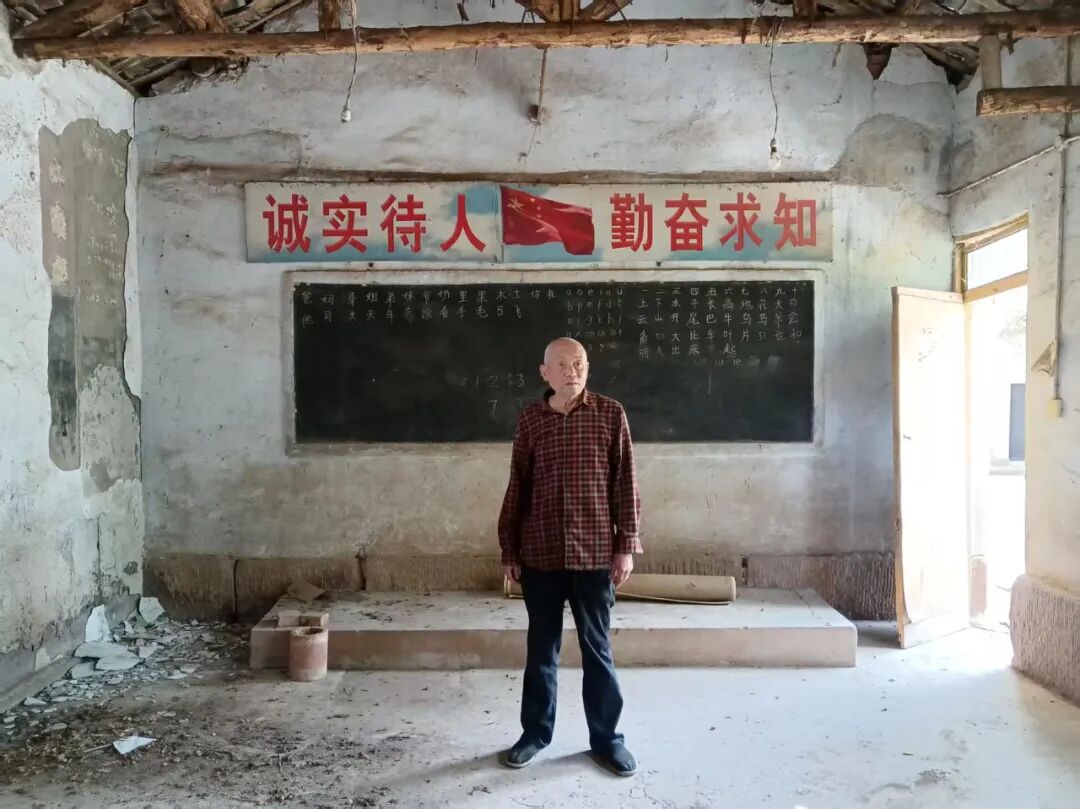
Therefore the rock-like stability and the weathered, time-washed sense of vicissitude in Li Youyi’s pictures are not only a retrospection of a cultural memory but a tribute to and echo of the life-spirit of his father’s generation. It is the father’s mountain-like, tranquil life itself that endows the artist with the enduring strength to face the ostentatious head-on and explore inward.
From another level, his work is a resistance to “speed”. Its constructive creative process is time-consuming and labouring, running counter to today’s logic of pursuing efficiency. At the same time he resists “smoothness”; the rugged, uneven surface of the work opposes the refinement, convenience and gloss of the commercial convenient environment, reawakening the viewer’s bodily memory of “texture”. The sociologist Philippe Vanini has written on “convenience”, saying “convenience is a cluster of values centred on accessibility, speed and ease, whose essence is a cultural hegemony that masks social inequality”; he describes convenience as a “ratchet effect” that can only climb one way and cannot reverse — also the reality of contemporary society’s daily renewal and development.
Therefore the contemporary significance of Li Youyi’s works lies not directly and wholly in the illustration of contemporary issues in content, but also in the questioning, by its very “mode of creation”, of contemporary society’s logic of “convenience”. With a silent, material presence it offers a mode and field for mooring and reflection to an increasingly dematerialised, de-temporalised world, keeping art from proliferating, as Vanini puts it, into “accessibility, speed and ease”.
In a highly persuasive manner Li Youyi successfully bridges the historical gulf between Western modernism’s emphasis on “objecthood-consciousness” and Chinese classical aesthetics’ pursuit of “poetic mood” (shi xing yi jing). In the modernisation of Chinese art through the twentieth century, artists long explored the subject of “nationalising oil painting”; early attempts mostly stayed at the level of Sinicising subject matter or freehand brushwork. Li Youyi keenly realised that the context of contemporary art permits, even encourages, the extreme excavation of the medium’s materiality. He was no longer content to “paint” texture with pigment, but let pigment’s own properties become the subject of creation. Through this he liberates the “texture-strokes” (cun fa) of landscape painting from a descriptive brush-and-ink formula into a generative material construction.
Therefore the “mood” (yi jing) in the painting is no longer a poetic ambience floating above the picture, but the temporal flow immanent in the material texture itself. The “desolate cold” (huang han), “vast obscurity” (cang mang) and “still solemnity” (jing mu) felt by the viewer arise directly from the tension of the states and field presented by matter itself, not from associations with some external landscape within the traditional linguistic sphere. Thus he resolves a creative dilemma: how, within a wholly non-figurative, even anti-painterly “material construction”, to still generate a “poetic space” with clear Eastern cultural orientation and profound philosophical content. He proves that extreme “objecthood” and subtle “mood” are not mutually exclusive but can be mutually grounded and generative. This tentatively offers oil painting’s future development an effective path that both deeply continues tradition and thoroughly embraces the contemporary. Art must in the end respond to the age we inhabit. Facing a “convenient” society in which all things can be easily copied, consumed and forgotten, Li Youyi has chosen a path of turning inward, slowing down, and seeking in matter itself. His works are not only an inquiry into what painting is, but a questioning of our state of existence: as the world accelerates toward a dematerialised future, how shall we lodge those heavy, coarse memories and emotions that constitute the essence of our life? Li Youyi gives no answer, but with his painting he constructs a field ample enough to bear these profound reflections.
Daxiong
Written on 19 June 2025, Caochangdi, Beijing
订阅艺术评论
订阅即赠《2024中国当代艺术关键词》内部思考笔记 PDF
每周免费获取最新当代艺术批评与研究