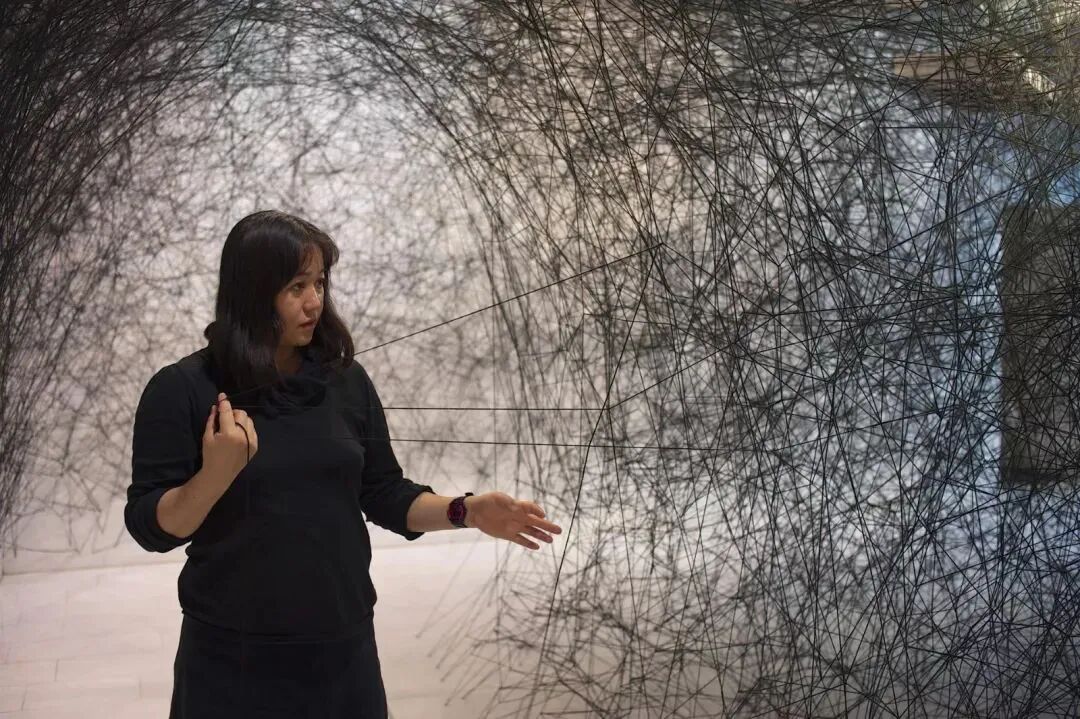
Chiharu Shiota, born in Osaka, Japan, in 1972, is renowned for her signature thread installations that envelop entire rooms. These red, black, or white filaments—dense as a neural network, interlacing like veins, or spun like the spider’s web of fate—wind around and bind together aged objects imprinted with the traces of time, conjuring immersive spaces at once monumental and unsettling.
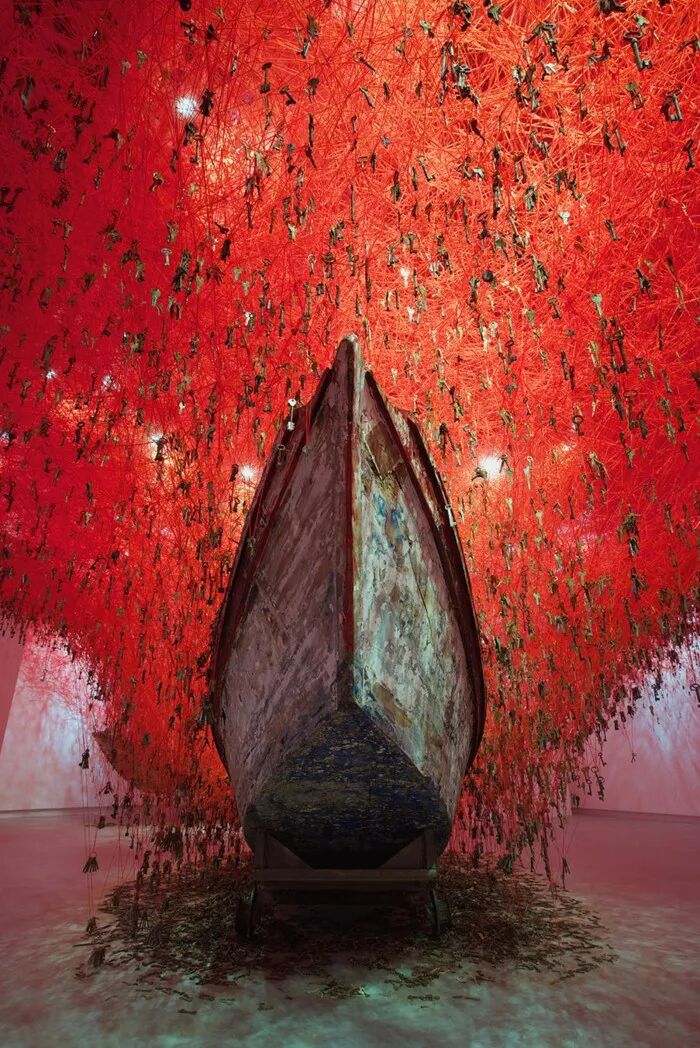
Chiharu Shiota, The Key in the Hand, 2015, 2019; old keys, Venetian boats, red wool; installation view.
Her practice spans installation, performance, film, and stage design, yet every work turns on a single preoccupation: an endless enquiry into such fundamental human themes as memory and forgetting, life and death, presence and absence, identity and belonging. In an age fractured by fragments of information, her work functions as a vast magnetic field of the spirit, drawing viewers in search of their own coordinates.
A central tension lies in the fact that Shiota’s work presents itself as intensely personal—its impulses arising largely from private childhood trauma, the identity anxiety of a life lived across borders, and her own mortal struggle with cancer.
This essay will argue that this relentless excavation of her inner experience carries her work beyond the autobiographical, allowing it to touch and answer a far broader collective unconscious, historical trauma, and social reality.
I. Trauma
Shiota’s art did not spring from nowhere as some exotic bloom; its profound emotional force is rooted in her singular lived experience and the cultural context of her time. Her oeuvre is a visual epic that ceaselessly symbolises and universalises personal experience. To grasp the source of her thought is the only way into the vast universe she builds from thread.
(1) A Personal Life History on Display
Shiota’s artistic language was shaped and honed by several pivotal moments in her life—among them the whole arc of her transformation from a student of painting into a world-class artist who speaks through the entire body and the space around it.
1. Childhood Trauma, the Turn to Art, and the Struggle with Illness
Childhood memory is often the first and most enduring wellspring of an artist’s career. For Shiota, a fire at a neighbour’s house became the origin point of her artistic preoccupation with the motifs of ‘presence’ and ‘disappearance’.
She has returned to this episode again and again: the piano that sat silent in the flames, and the everyday scenes devoured by fire, left an indelible mark on her young mind. It gave her, at a very early age, an intuitive grasp of a truth—that an object’s physical presence can vanish in an instant, yet the memory, sound, and spirit it carries on persist in a more obstinate form.
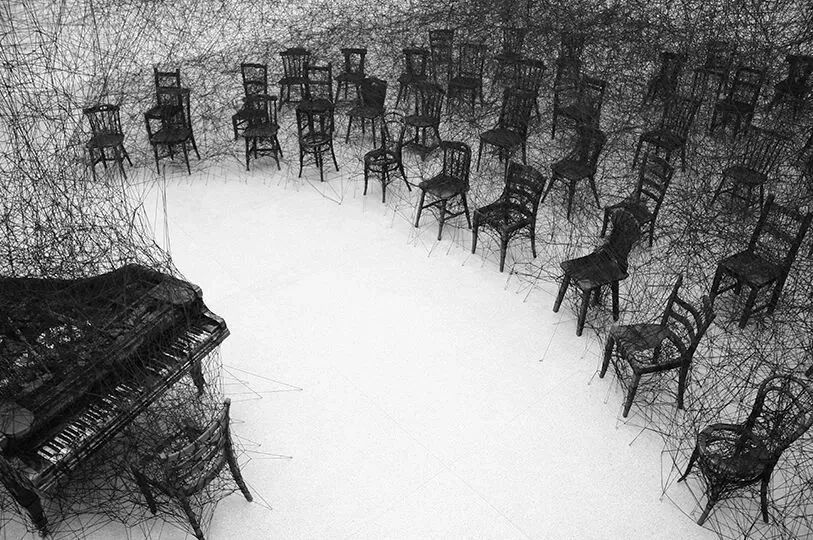
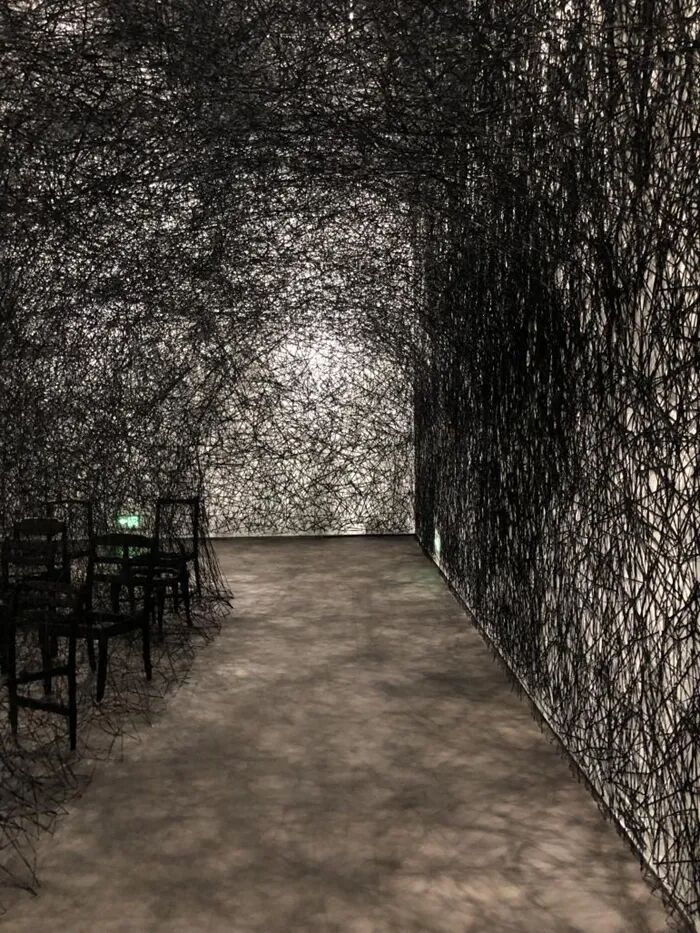
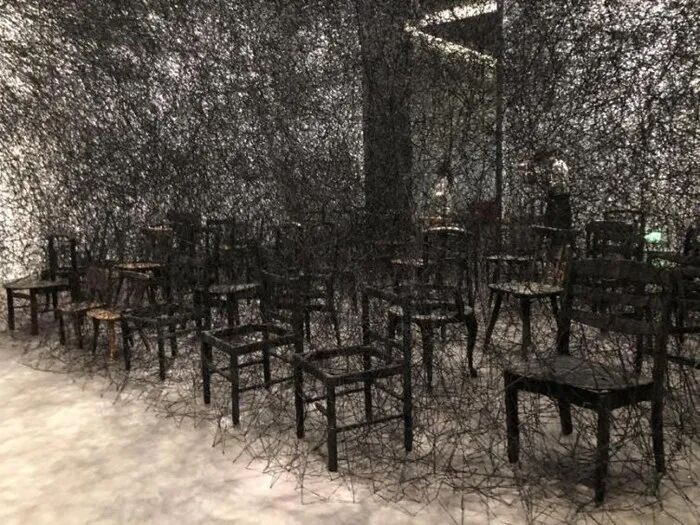
This traumatic initiation directly gave rise to many later works. In In Silence (2008), for instance, a charred piano and rows of theatre seats are wrapped in an airtight web of black thread; the entire space becomes a vast, frozen mute button. The piece is the most direct artistic translation of that childhood trauma. The viewer is returned to the instant of the fire, and what one feels is not a clamorous destruction but a deafening silence—a profound experience of how memory ‘speaks’ after matter has vanished.
This fixation on traumatic memory can be set in dialogue with the work of the French-American artist Louise Bourgeois. Bourgeois’s entire career processed the psychological wounds of a childhood marked by her father’s infidelity; her celebrated ‘Cells’ series places old furniture, clothing, and sculpture inside enclosed iron cages, building psychological theatres of memory, pain, and claustrophobia. As the art historian Robert Storr observed, Bourgeois materialises memory—she does not depict it but reconstructs in matter the psychic space in which it occurred. Shiota does likewise: her burnt piano is not a simple re-enactment of a fire but a material encapsulation of the traumatic memory itself.
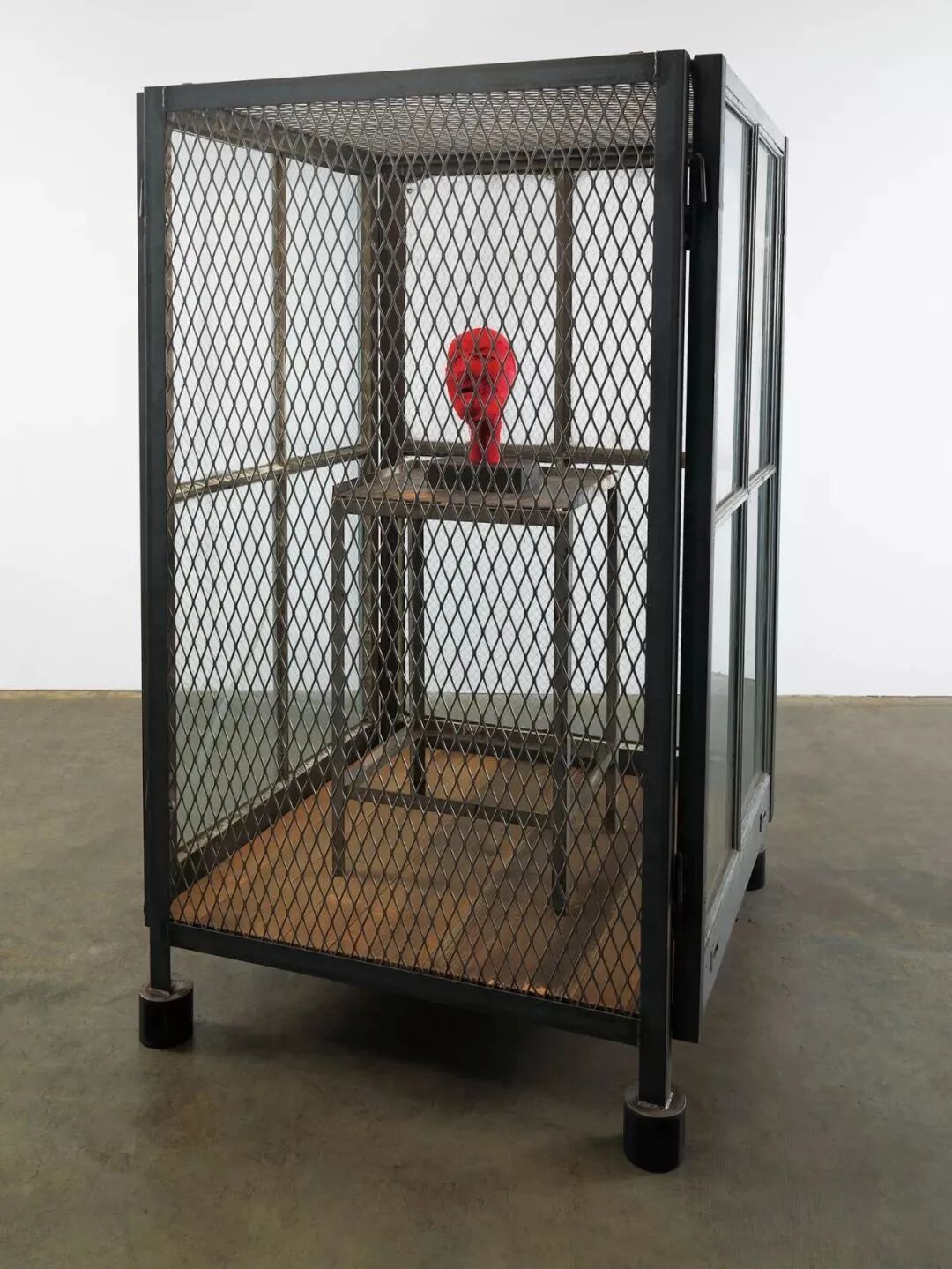
194.9 × 122.6 × 122.6 cm, 2000
Shiota studied painting in her early years at Kyoto Seika University. Yet she soon felt the limits of the two-dimensional plane. However she smeared pigment across the canvas, she found she could not truly express the entangled relation within her—to the world and to her own existence. She longed to create with the whole body and with space; this imperative drove her, decisively, toward performance and installation.
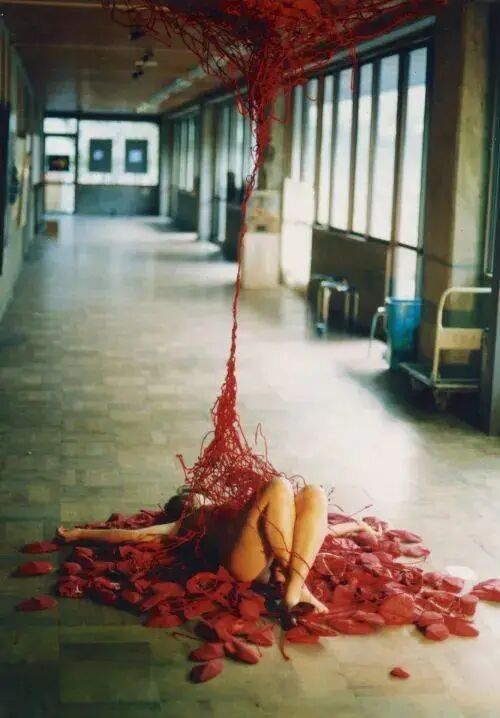
Her 1994 performance Becoming Painting marks a landmark turning point. In it she doused her whole body in toxic red enamel paint, the skin blistering and festering under the chemical burn. Through an act bordering on self-mutilation, she turned her body into the canvas, testing the boundary between artistic creation and physical pain. The performance probes the relation between artist and medium—the artist does not ‘use’ the medium but must ‘become’ it. This exploration of bodily limits echoes numerous performance practices of the 1960s and 1970s.
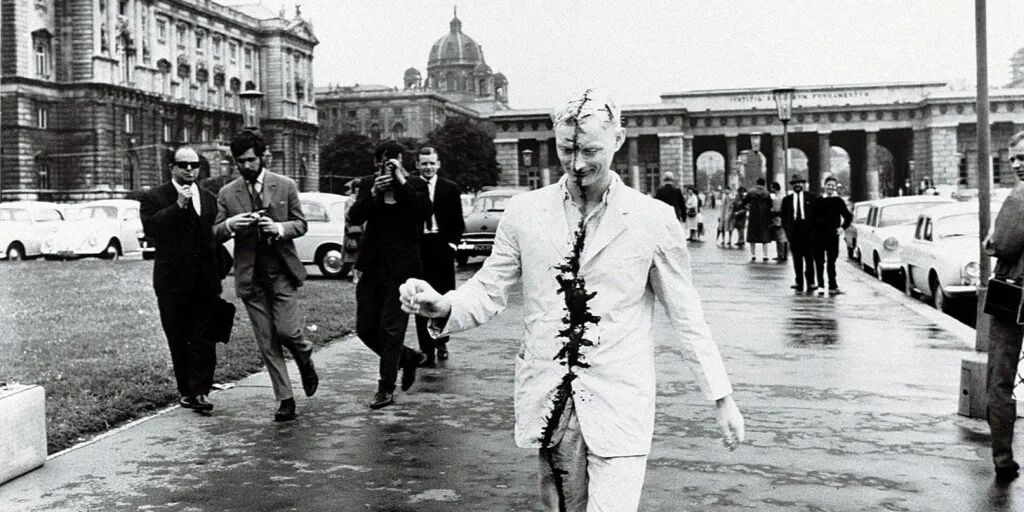
The Austrian artist Günter Brus once painted himself white and walked the streets of Vienna
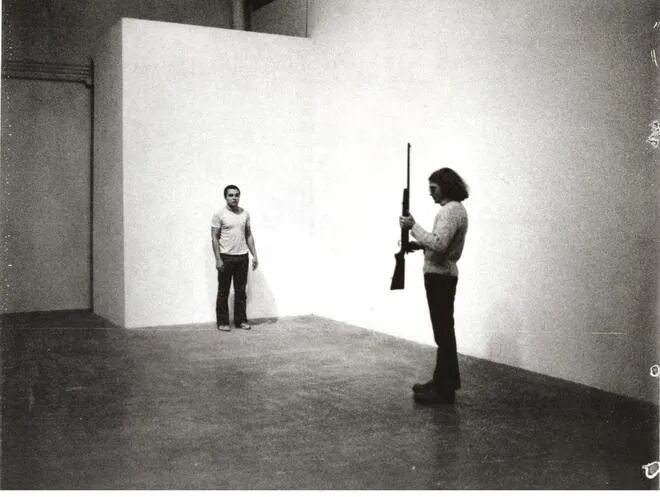
For example, the Austrian artist Günter Brus painted himself white and walked the streets of Vienna, probing the tense relation between the individual and public space. The American artist Chris Burden, in his work Shoot (1971), had a friend fire a rifle at his arm, testing the limits of art and the audience’s capacity to endure in the most extreme manner. Beside them, Shiota’s Becoming Painting shares the same bodily martyrdom, yet its aim is more inward: a blood-hued baptism of artistic identity, announcing her complete rupture with traditional painting.
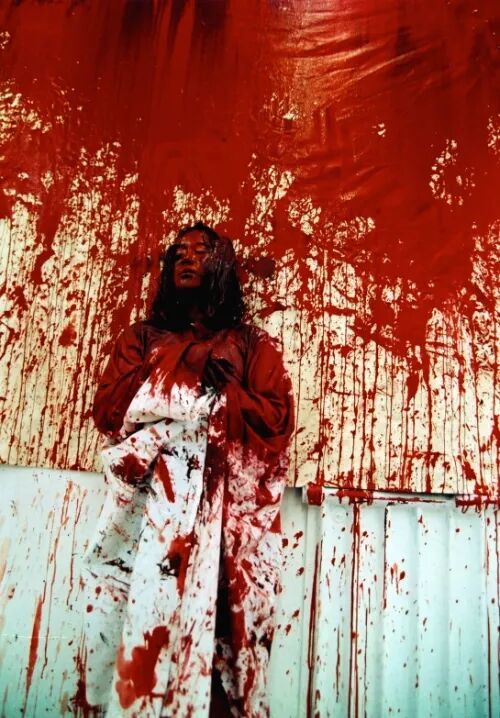
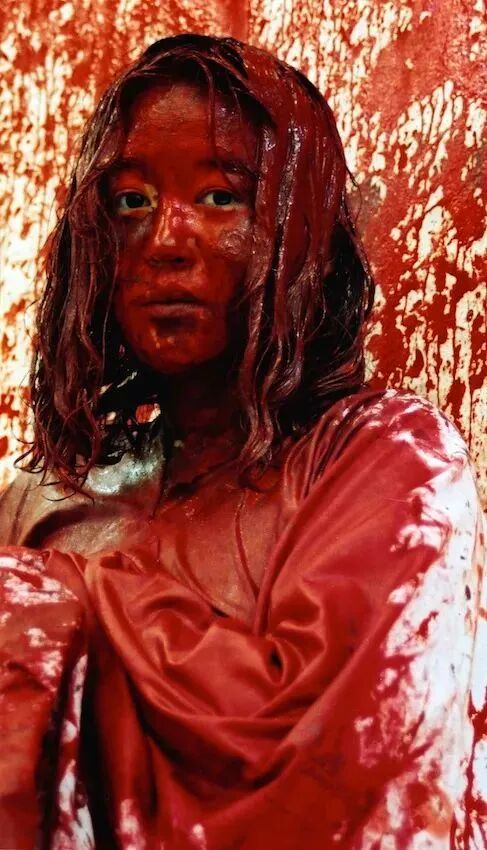
If childhood trauma and the turn to art shaped the ‘why’ and the ‘how’ of her practice, then her struggle with illness injected it with a philosophical depth that confronts life and death head-on. Shiota has twice been diagnosed with cancer; this brush with death gave her an understanding of the fragility of life, soul, and existence that few attain. Far from sinking her, it fuelled an even fiercer creative urge. What she seeks to capture is precisely the trembling of the soul born of life’s uncertainty.
The curator Mami Kataoka writes: ‘Shiota’s art is not about despair but about how, when facing the abyss of existence, the soul trembles, senses, and connects with all its strength.’ This experience lifted her work entirely beyond mere aesthetic enquiry or personal emotional release, sublimating it into a universal questioning of how human beings affirm their own existence within finite life. It recalls the work of the Mexican artist Frida Kahlo, who endured the after-effects of a traffic accident all her life; her paintings teem with broken bodies, bleeding hearts, and crowns of thorns, yet these images of suffering were ultimately transformed into tenacious hymns to the will to live. Shiota’s threads are, in a sense, the ‘thorns’ with which she sutures the fissures of life and weaves the meaning of existence.

2. The ‘Other’ Perspective of Berlin
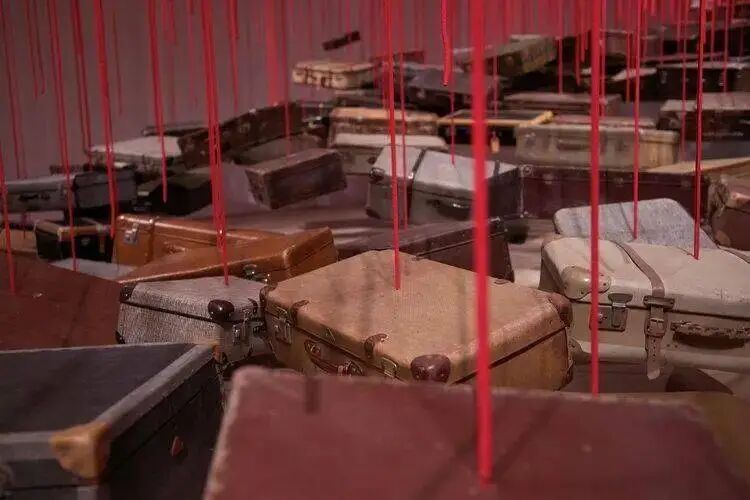
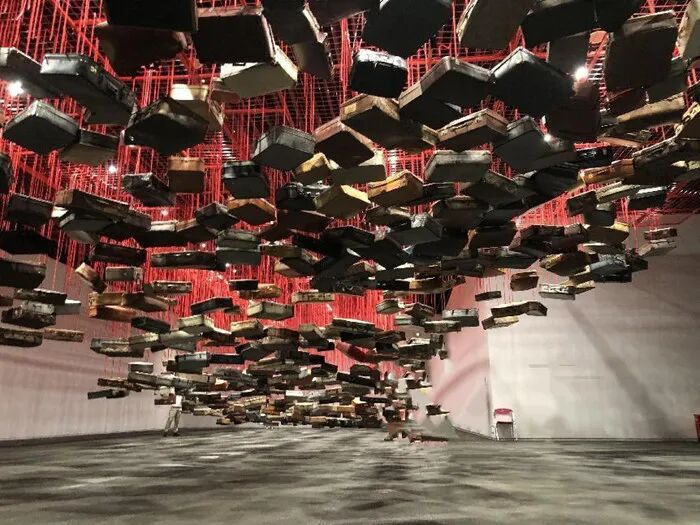
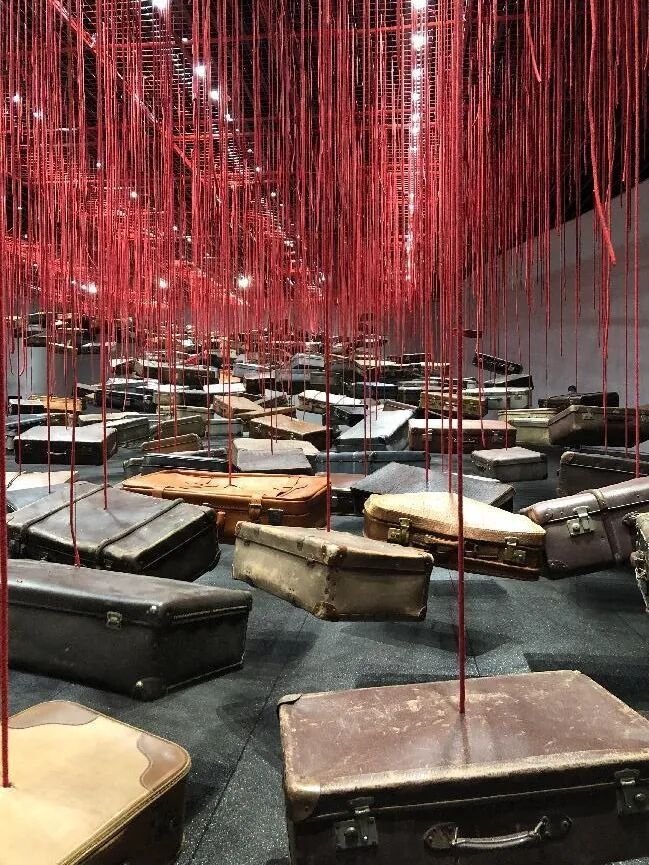
Her move to Germany in 1996—studying first in Hamburg and Braunschweig, before settling in Berlin—is another crucial geographic and cultural coordinate in the formation of her thought. As an Asian woman artist living in the West, she could not avoid confronting cultural estrangement and the challenge of identity. This sense of drifting ‘elsewhere’ made her acutely sensitive to questions of borders, language, and cultural belonging. The suitcases, boats, and keys that recur throughout her work are precisely apt metaphors for this condition of flux and uncertainty. In Gathering: Search for Destination, hundreds of old suitcases hang suspended in mid-air on red thread, like a flock of lost migratory birds, or memory capsules each packed with stories of parting. These suitcases are at once a portrait of her own transnational life and a touch upon the shared state of mind of countless migrants, travellers, and exiles in the age of globalisation.
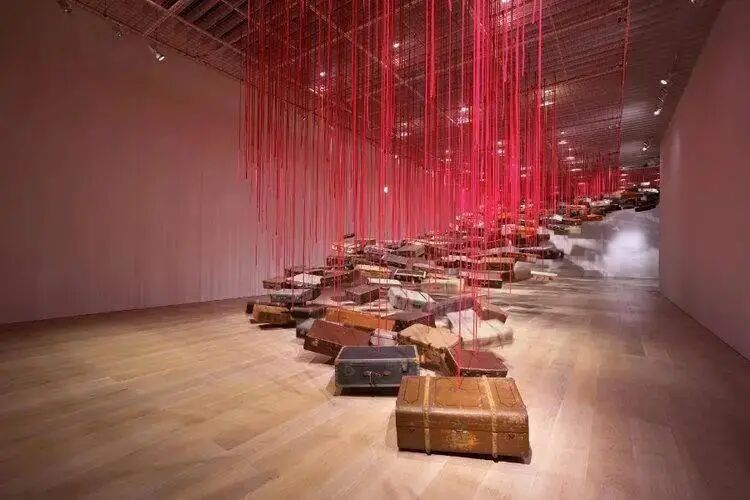
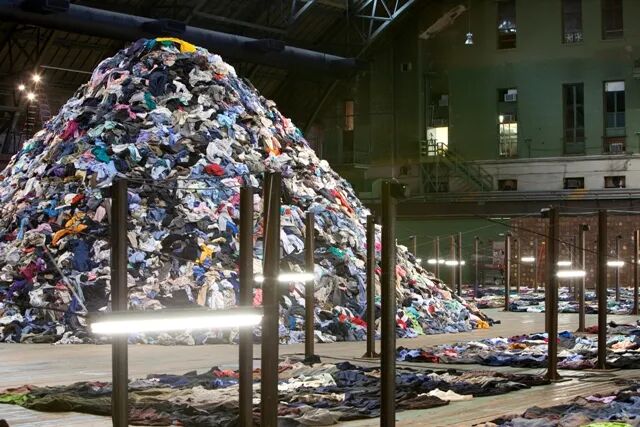
The German artist Christian Boltanski likewise excels at using old objects to explore memory and identity. In No Man’s Land (2010), he has a crane repeatedly seize and drop heaps of used clothing, building a vast, ever-shifting mountain of garments. These clothes stand for countless anonymous individuals, hinting at the fragility and vanishing of life in historical tragedies such as the Holocaust. By contrast, Boltanski’s work leans toward collective historical trauma, whereas Shiota’s suitcases focus more tightly on the individual’s identity anxiety in migration and the eternal search for ‘home’.
During her studies in Germany, her tutelage under Marina Abramović—the ‘mother of performance art’—further intensified Shiota’s exploration of the body, limits, and spirituality. Abramović is known for long, high-intensity performances in which she uses her own body as a medium for probing the limits of consciousness and the exchange of energy. In her most famous work, The Artist Is Present (2010), she sat silently at the Museum of Modern Art in New York for 736 hours, holding a wordless gaze with over a thousand visitors. Abramović once said: ‘The essence of performance is, before the audience, with your body, to tell a truth about here and now.’ Although Shiota later shifted her centre of gravity to installation, Abramović’s emphasis on ‘presence’ and spiritual energy profoundly shaped her. Shiota’s installations are in truth a kind of ‘absent presence’: the artist herself is not on site, yet the spiritual energy of her ritual-like, physically exhausting process of winding thread after thread is sealed wholly into the work. Walking into her installation, what the viewer feels is precisely this powerful aura injected by the artist’s bodily act.
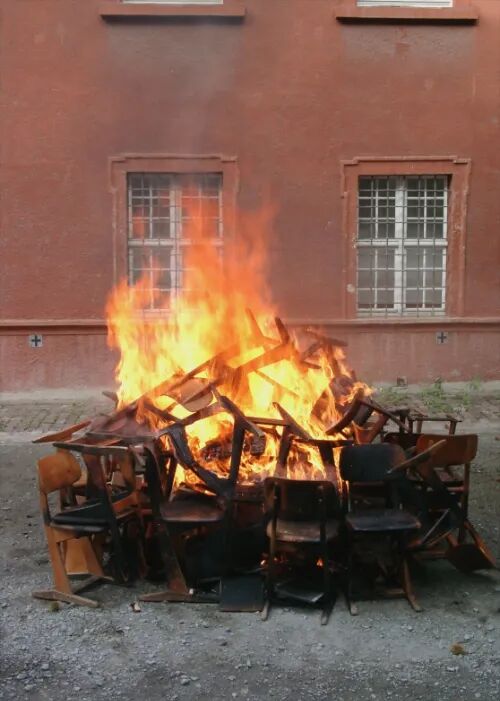
(2) A Silent Dialogue: As a Continuation of the Postwar Japanese Art Lineage
Existing scholarship rarely addresses directly how Japan’s postwar social transformations concretely shaped Shiota’s artistic thought. Her work seldom parodies ‘otaku’ culture as Takashi Murakami does, nor does it touch, as Makoto Aida does, upon such specific socio-political issues as Japan’s war responsibility or history textbooks. Yet we cannot conclude from this that her art is wholly detached from its social context. Through close reasoning we can discern a deep inner affinity between her production and the spiritual lineage of several generations of postwar Japanese artists; what she conducts is a more inward and silent dialogue.
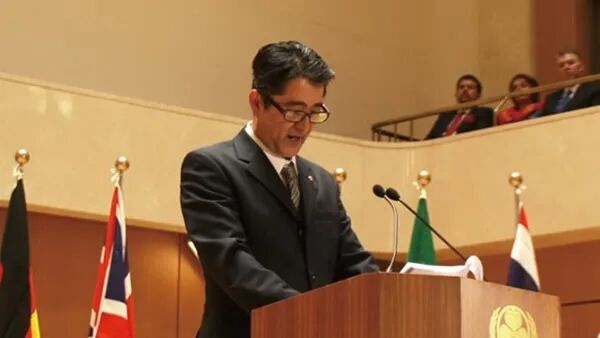
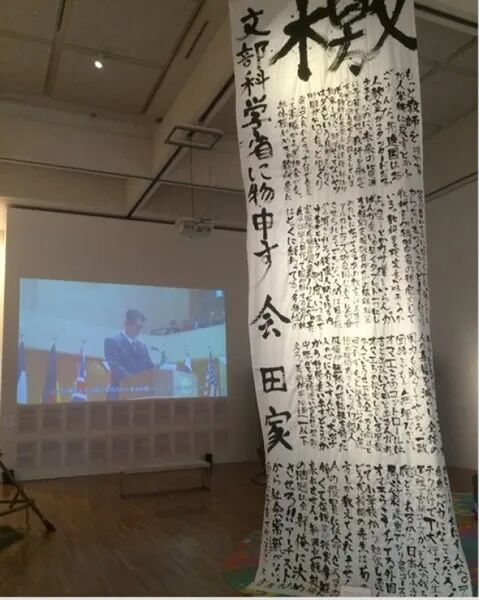
Works by the Japanese anti-war artist Makoto Aida: Aida ‘impersonating’ Shinzo Abe delivering a speech, and Aida’s large-scale textual ‘manifesto’.
1. Alienation from the Grand Narrative and the Turn Inward
Japanese society after the Second World War underwent violent upheavals—from the rubble of defeat, through an economic miracle, to the bursting of the bubble economy. This roller-coaster modernisation led many artists to doubt the grand narratives of nation, collective, and progress, turning instead inward to probe the value of individual existence and spiritual predicament. From the Gutai group’s emphasis in the 1950s on the direct interaction of matter and body, to Mono-ha’s concern in the 1970s with the ‘as-found’ state of things, to the more personal expression after the 1980s and 1990s, a defining feature of Japanese contemporary art is this ‘turn inward’.
Shiota’s work is precisely the continuation and deepening of this trend. She does not attempt to offer any macroscopic answer to complex social problems; rather, by pushing the display of personal anxiety, fear, and memory to an extreme, she prompts viewers to reflect universally on their own state of existence. As the critic Jin Katagiri writes, Shiota’s art ‘is a practice of “micro-politics”: she does not confront power directly but, by revealing the complexity of the individual’s inner world, dissolves the singularity and oppressiveness of the grand narrative.’ The tangled threads in her work can be read both as a person’s confused thoughts and as the complex, fragile, and ubiquitous network of relations between people in modern society.
2. An Echo of the Spirit of Mono-ha
Although Shiota’s visual idiom differs vastly from Mono-ha’s minimalist aesthetics, her attention to the ‘thing’ itself is spiritually akin to the Mono-ha movement that emerged in the 1960s and 1970s. Representative Mono-ha artists such as Lee Ufan and Nobuo Sekine stressed the juxtaposition of unprocessed or barely treated substances—stone, wood, iron plate—to investigate the relations between thing and thing, thing and space, thing and perception, intending to present a world ‘as it is.’ In his theoretical writings In Search of Encounter, Lee Ufan wrote: ‘The work of the artist is not to create but to guide—to lead the viewer to encounter the world of the thing-in-itself, unpolluted by language and concept.’
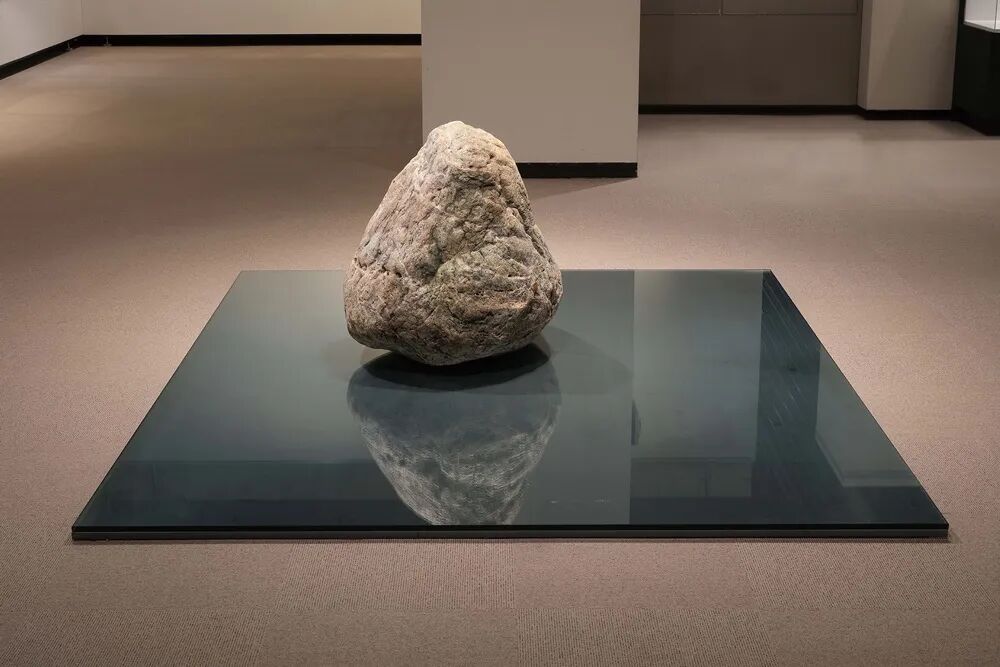
Although Shiota uses a great many man-made objects, what she attends to are ‘things’ that carry human memory and the traces of use.
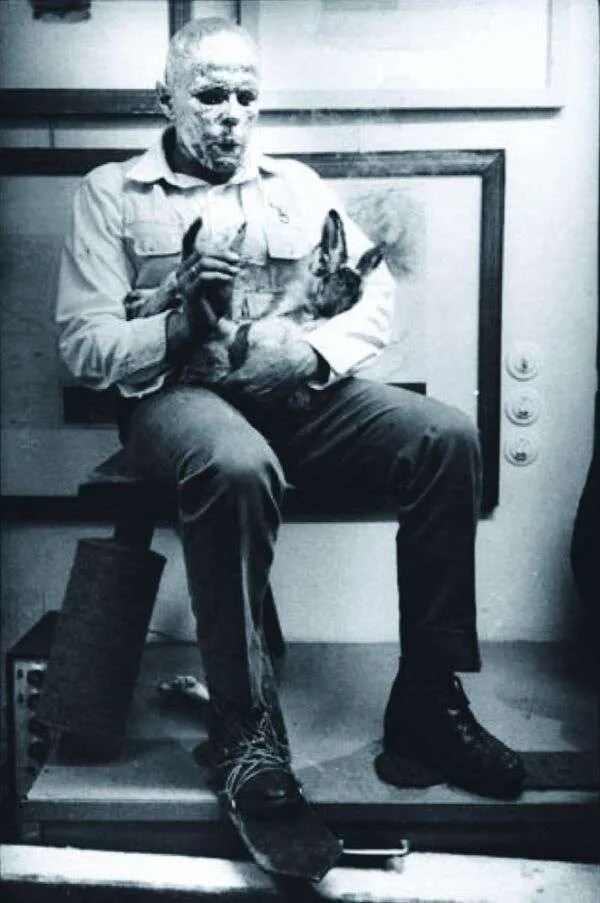
The old keys, shoes, and window frames she gathers from around the world are not, for her, refuse but silent witnesses of history. Unlike Mono-ha, she does not pursue the ‘as-found’ state of things; she goes further, letting these ‘human-scented’ objects tell their own human stories. Her threads are like the narrative threads linking the countless individual stories behind these objects. This is an artistic practice that binds matter deeply to human feeling and memory—a sensuous variation on the spirit of Mono-ha in a postmodern context. She lets objects transcend their functionality and enter a monumental state of being, which resonates with the German artist Joseph Beuys’s notion of ‘social sculpture.’ Beuys held that everyone is an artist and that any object of daily life (felt, fat) can become a medium for transmitting energy and thought. Shiota’s old objects, likewise, become ‘batteries’ that store and transmit the emotional energy of human beings.
3. Reflections on Cultural Identity in a Globalised Context
Shiota’s career has unfolded mainly in Europe, and her work is itself a product of cross-cultural exchange in the age of globalisation, deftly fusing an Eastern philosophy of life and death (such as the Buddhist concepts of conditioned arising and ‘emptiness’) with Western existentialist thought (such as Camus’s and Sartre’s writings on the anxiety of existence). Her exploration of identity is not a narrow enquiry into ‘Japaneseness’ or ‘Easternness’ but a universal theme of the cultural-identity anxiety and the search for belonging that modern people commonly face amid global flows.
Her work offers a model of how a non-Western artist can, on the international stage, neither cater to the Western imagination of ‘Oriental exoticism’ nor wholly abandon her own cultural roots, but instead, by excavating the most fundamental human emotions, find an international artistic language broadly intelligible and empathetic. Shiota’s choice undoubtedly offers profound inspiration to younger artists.
II. ‘The Vessel of Memory’: Objects, the Body, and the ‘Existence of Non-existence’
Shiota’s art is composed of several interwoven core themes that together draw a complex map of memory, identity, and existence. Its most central and moving aspect is her near-obsessive commitment to transforming intangible memory, emotion, and identity into tangible, perceptible artistic form. She summarises this core philosophy as the ‘existence of non-existence’—how to make those who have vanished, time that has passed, and feelings that cannot be touched ‘develop’ anew within the space of art.
(1) An Archaeology of Things: A Semiotic Analysis of Keys, Shoes, Beds, and Windows
In Shiota’s art, everyday objects are stripped from their functional context and sublimated into poetic signs and monuments bearing collective memory. Like an archaeologist of memory, she carefully excavates, collects, and exhibits these abandoned ‘fragments of civilisation,’ letting them regain dignity and voice within the network of thread.
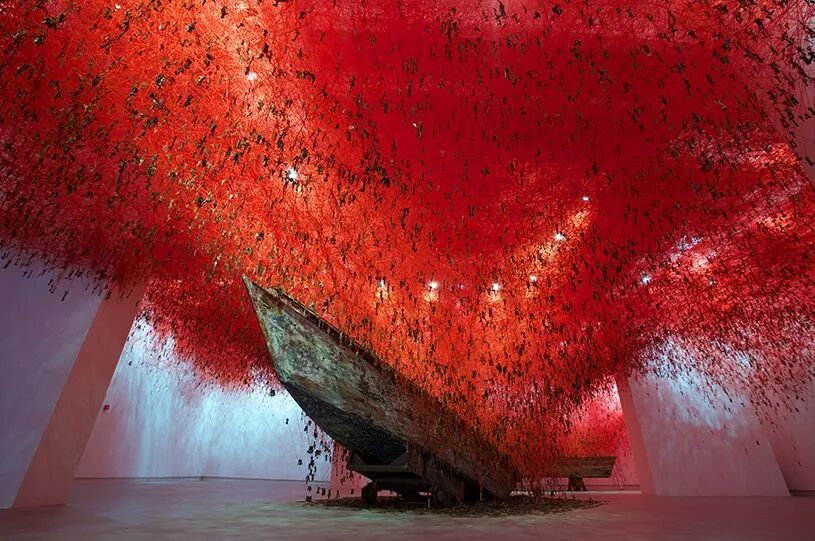
Chiharu Shiota, The Key in the Hand, 2015, 2019; old keys, Venetian boats, red wool; installation view.
1. The Semiotics of the Key
The key is among the most recurring images in Shiota’s work. In The Key in the Hand, her contribution to the Japanese Pavilion at the 2015 Venice Biennale, she gathered more than fifty thousand discarded keys from around the world and suspended them on dense red threads above two weathered wooden boats; the red thread-net cascades from the ceiling like a waterfall of memory or a rain of blood. The key—an object utterly familiar in daily life—is here invested with layered symbolic meaning.
First, the key is a symbol of opening and closing. It guards our most private spaces—home, diary, drawer. Behind every key lies a concrete space and the countless stories that unfolded within it. These spaces are ‘vessels’ that store our memory and dreams; Shiota’s keys are precisely the tools that open these ‘vessels of memory.’ When tens of thousands of keys gather together, they become the entrance to a vast repository of collective memory.
Second, the key also symbolises opportunity and the future. We often speak of ‘the key to opportunity,’ representing the possibility of entering an unknown world and opening a new life. Yet the keys Shiota uses are worn-out, their locks lost. They can open no physical door; all they can unlock is the door to past memory. This condition is in itself poignantly poetic. As viewers look up at this ‘starry sky’ of keys and red thread, there arises both a nostalgia for the warm routines of the past and a wistfulness toward the countless closed doors of a life. These keys connect to each of our hands and to the things we touch and treasure every day. Accumulated, they form a vast metaphor for hope, homesickness, and the trajectory of human existence. This interactive dimension further reinforces the work’s character as collective memory: those who donated keys wove a stretch of their own life stories into this grand work.
2. The Narrative of Footwear
Shoes are another motif that recurs throughout Shiota’s work. In Dialogue with DNA and later in Accumulation: Searching for Destination, she collected great numbers of old shoes, at times linking them with red thread, at times arranging them in orderly rows. Shoes touch the human body most directly; they bear their owner’s weight and follow the owner across endless distances. The worn marks of every pair record a unique journey through life.
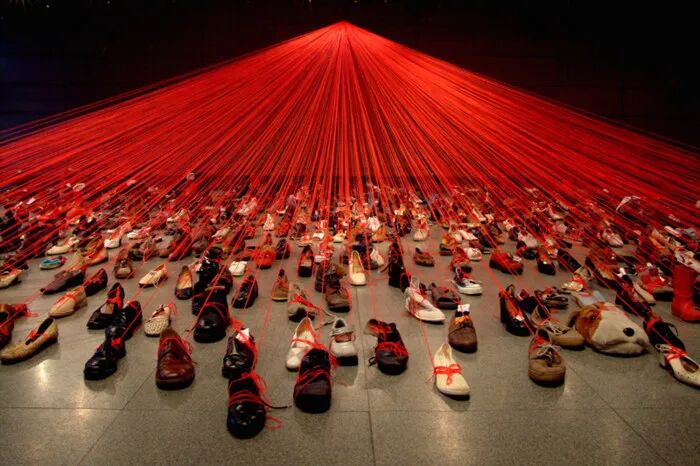
Unlike the privacy of the key, shoes are more public and social. They hint at walking, migration, pilgrimage, even flight. In discussing her shoe works, Shiota has said: ‘What interests me is where the owners of these shoes have gone, and what dreams and lives they had.’ These shoes—above all the empty, ownerless ones—strongly imply the owner’s ‘absence.’ Through ‘accumulation,’ they likewise reveal the hardship, perseverance, and hope of ordinary people along the long road of life. Every pair is a silent narrator.
3. The Metaphor of Beds and Windows
Bed and window are two further important elements with which Shiota constructs intimate psychological space. The bed is where life begins and ends, where we spend roughly a third of our lives; it bears our dreams, illnesses, erotic love, and loneliness.
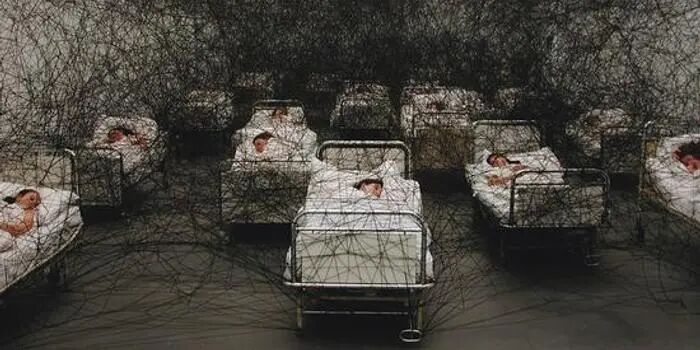
In In the Sleep, several white hospital beds are enveloped in a black thread-net, as if visualising an invisible nightmare or the struggle of approaching death. Here the black thread is at once a protective cocoon and a suffocating cage, perfectly conveying the claustrophobic half-consciousness of the sleep/illness state. Partly inspired by her own hospitalisation, the work carries a more universal philosophical meditation on the blurred zone between life and death.
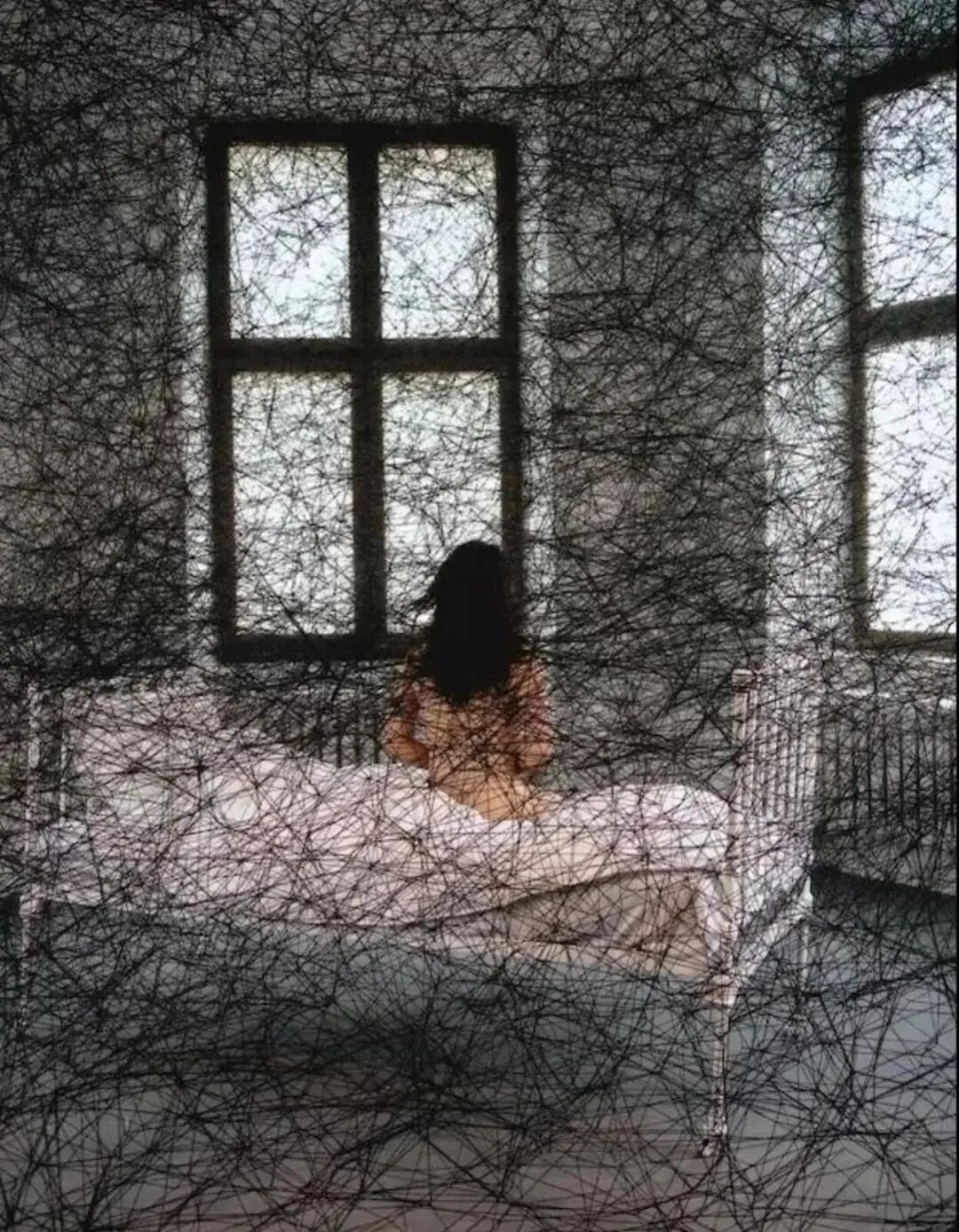
Window, then, is the threshold connecting inside and outside, the private and the public world. It is both protection and longing. Shiota has said, ‘I collect old things because they carry others’ memories. Empty chairs, burnt pianos, discarded keys—these objects are themselves an “absence of presence”: though their owners are not there, their traces still tremble in space.’ On the matter of the object itself, she has said: ‘The “absence of presence” in my work resonates with the “emptiness” (kū) of Eastern philosophy. Absence is not annihilation but a merging into the vaster universe, re-entering the flow of time and connecting with all things.’
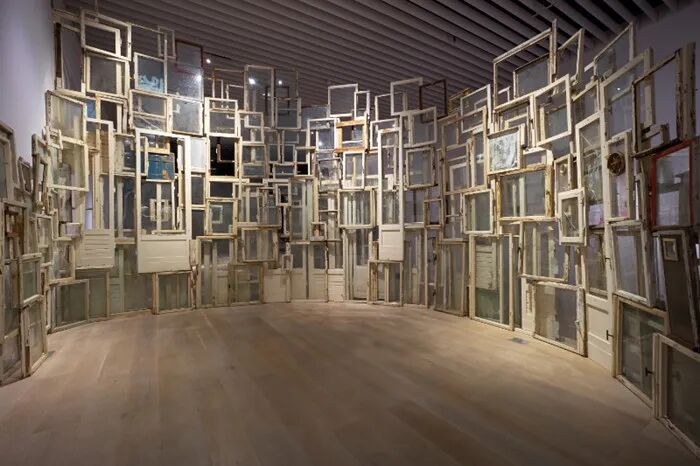
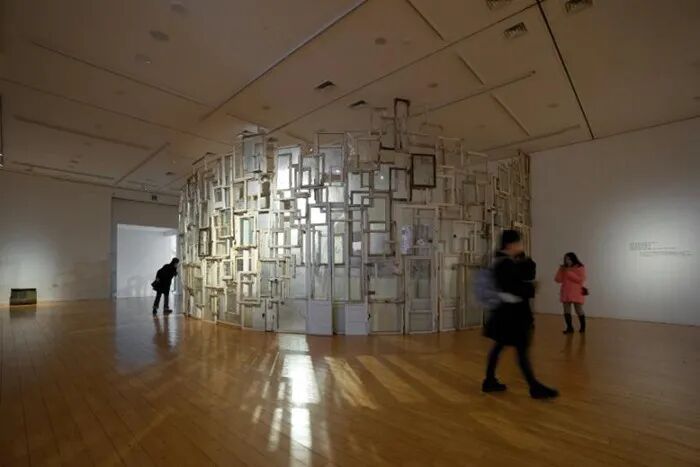
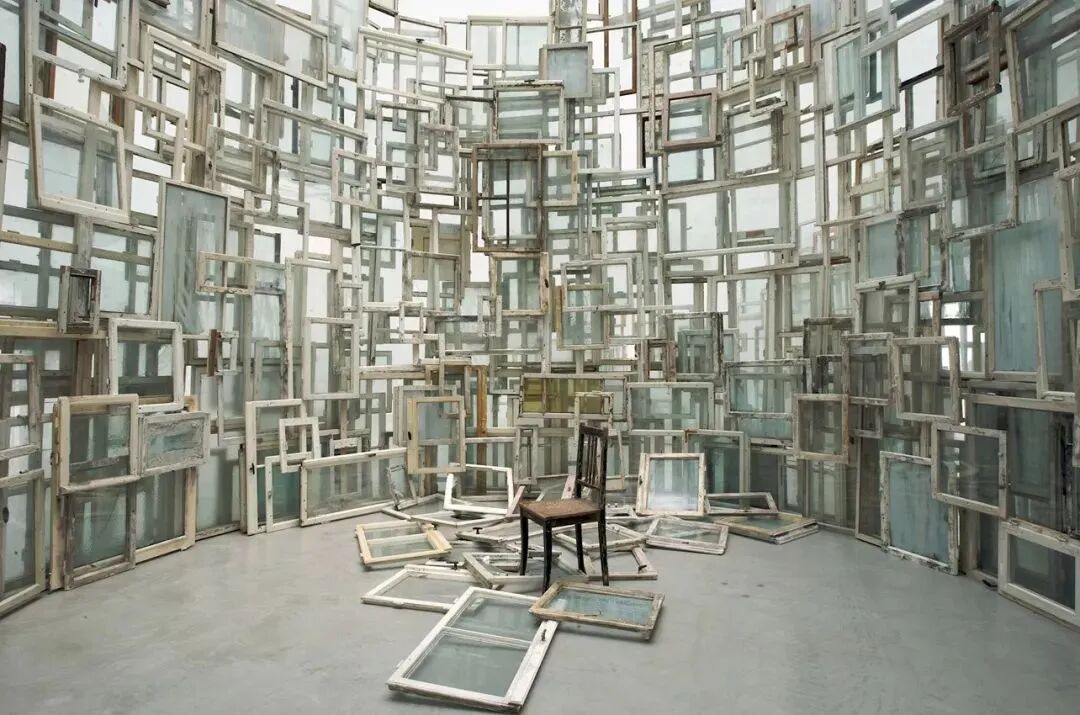
In The Memory of a House, she collected hundreds of old window frames from buildings demolished in East Berlin and stacked them into a vast, tottering wall. Behind these windows once lay the lives of countless German families, bearing witness to the historical changes around the fall of the Berlin Wall. Now stripped from their buildings, they gaze at the viewer like so many blind eyes. The work deftly connects personal memory (the family life within the windows) with the grand memory of the city’s history (the division and reunification of Berlin).
(2) The Field of the Body: Identity’s Flux and Boundaries in the Early Performance Art
Before Shiota turned to large-scale installation, her body was her principal artistic medium. Her early performance art furnishes crucial clues for understanding the concerns with identity, boundary, and existence in her later work.
As noted, Becoming Painting was a violent farewell to her identity as a ‘painter.’ Another important early work is From DNA to DNA (1994), which foreshadows her later preoccupation with the life sciences, genetic memory, and the struggle against illness. Here her body becomes an observed and analysed object, probing how, under the gaze, human life is datafied and objectified.


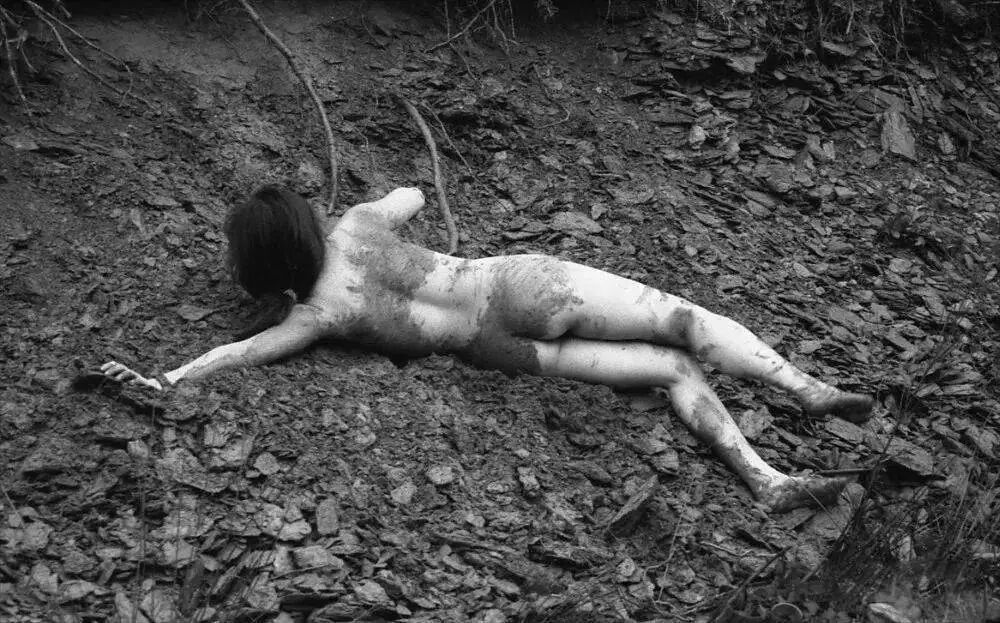
In Bathroom (1999), Shiota sits naked in a bathtub full of muddy water, repeatedly rinsing her body with the slurry. Earth signifies both land, roots, and life, and filth and death. However she scrubs, her body remains coated in mud. This futile, ritualistic act profoundly expresses her identity anxiety as a stranger in a foreign land—the predicament that, however hard she tries, she cannot wash away her cultural imprint or fully merge into a new environment. It resonates spiritually with the work of the Cuban-American artist Ana Mendieta. In her celebrated Silueta series, Mendieta impressed her body onto the land of Cuba or Mexico, or shaped female silhouettes from earth, blood, and flowers, to explore the complex relation between body and land, exile and roots. Shiota’s Bathroom similarly makes the body a site of dialogue with ‘land’ (the cultural environment), yet her expression is more inward and fraught with struggle.
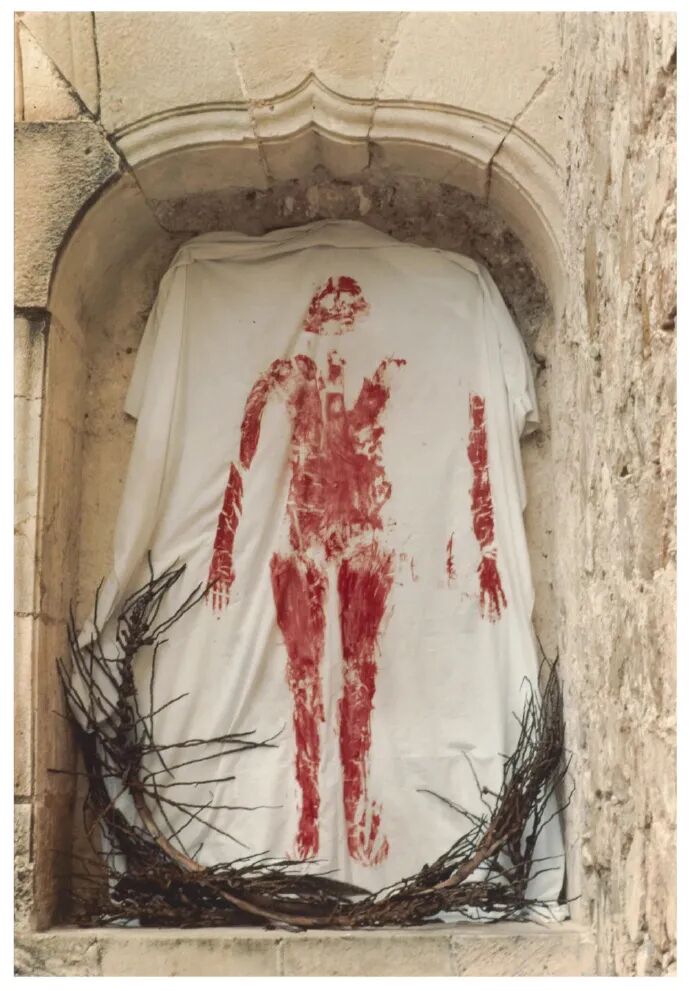
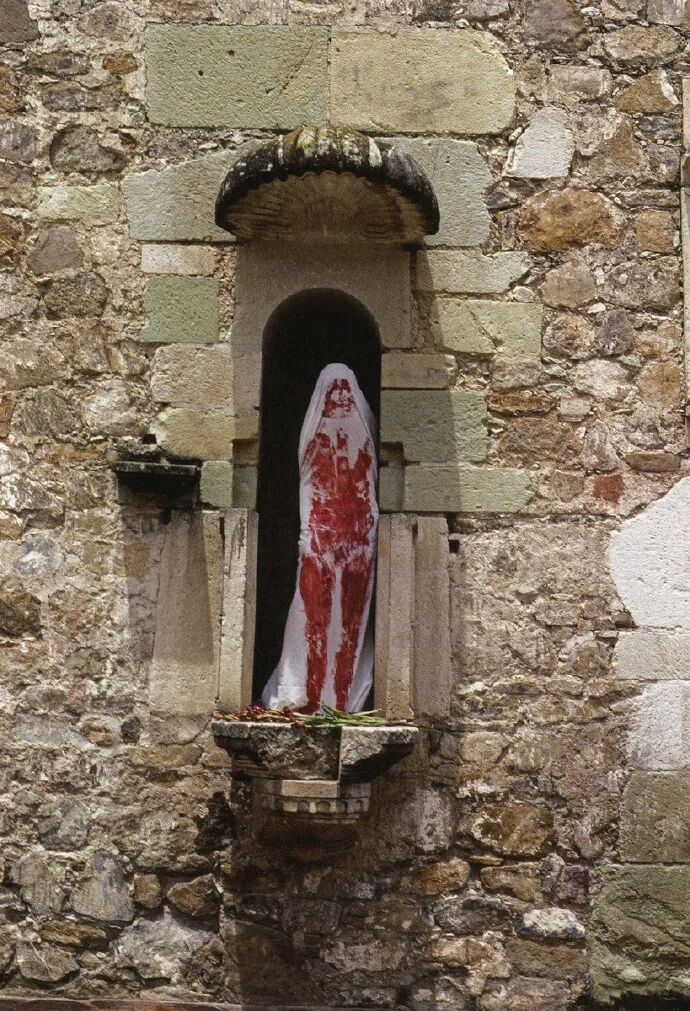
These early performances, though formally unlike the later vast thread installations, share a core idea. They all attend to the problem of ‘boundary’: the boundary between art and life, body and outside, identity, life and death. Her body was the first laboratory in which to test these boundaries. Later she extended this exploration of boundaries from her own body to the entire architectural space. Her thread is the tool with which she redefines spatial boundaries, connects the boundaries of different objects, and ultimately blurs the boundary between reality and memory. One might say her monumental installations are the magnified extension of those early bodily acts.
III. Weaving with ‘Thread’ the Inner Bonds of Emotion, Space, and Cosmos
Thread is Shiota’s signature and her language. She seizes ‘thread’—the simplest, most primal material—and mines its symbolic meaning and visual expressiveness to the limit, developing a complete, complex, and highly recognisable personal artistic language. In her use of thread she studies its properties of connection, entanglement, and penetration. With thread she weaves the inner bonds of emotion, space, and cosmos.
(1) The Symbolism of Colour: The Psychoanalytic and Cultural Connotations of Red, Black, and White Thread
Shiota’s choice of thread colour is extremely restrained, concentrated on three: red, black, white. Each carries rich symbolic meaning and potent emotional force.
1. Red Thread: Kinship, Fate, and Social Relations
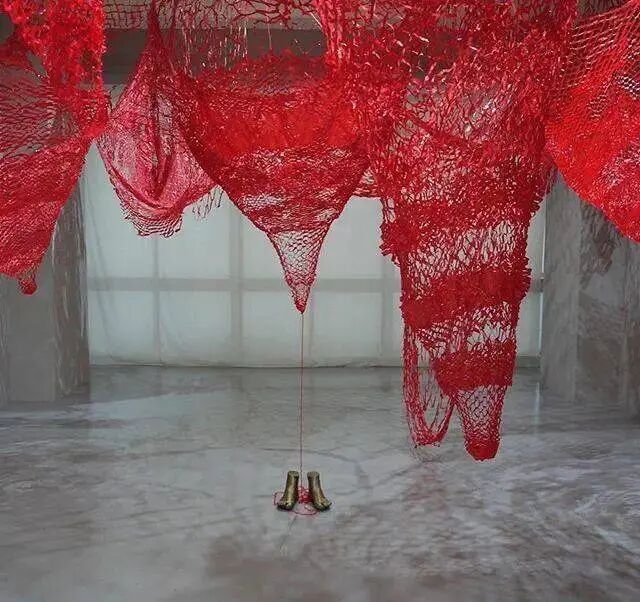
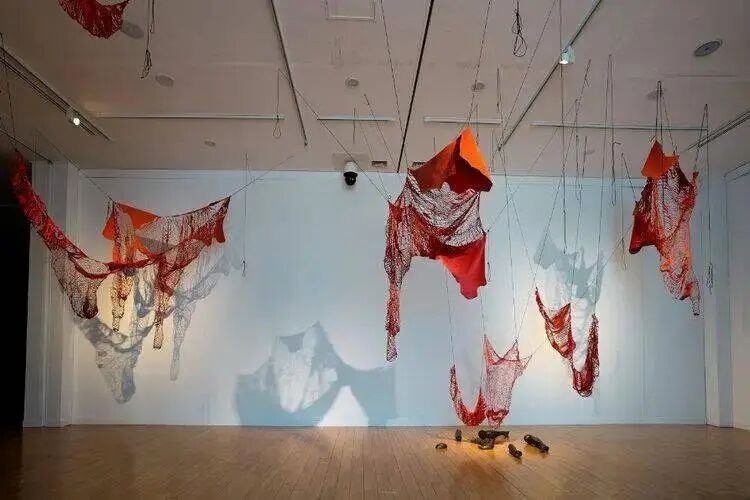
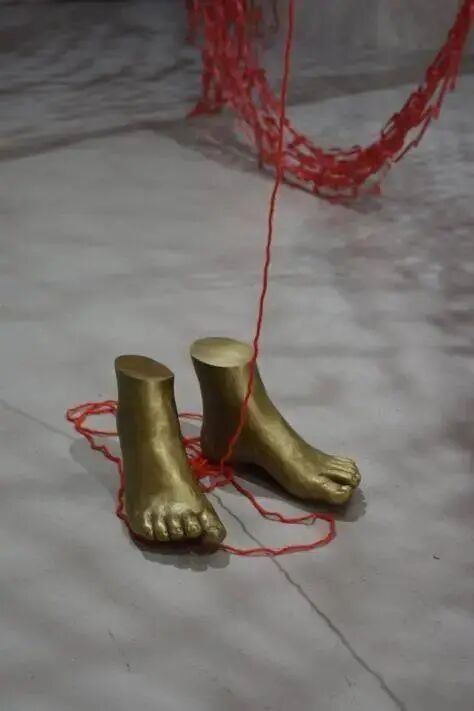
Red is the most striking colour in Shiota’s work. To her, red symbolises blood, and from there extends to kinship, life, the relations between people, even nationality (as in the red of the Japanese flag). In traditional Japanese culture the red thread is often held to be the ‘thread of fate’ connecting those destined to meet. Shiota’s red thread is precisely the sum of these complex meanings.
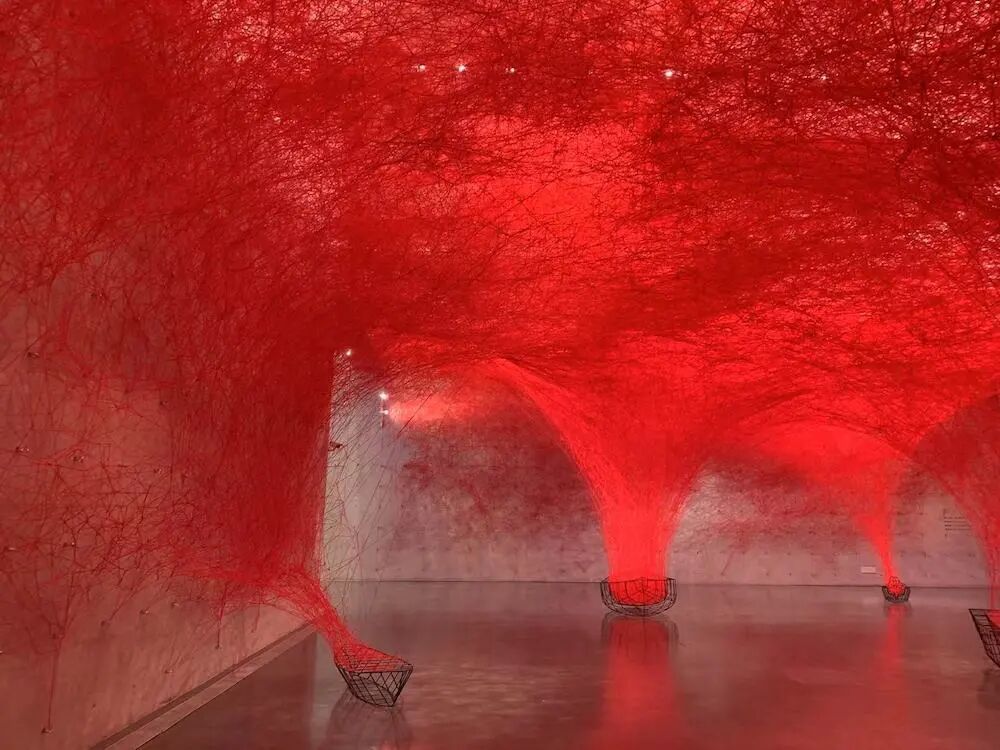
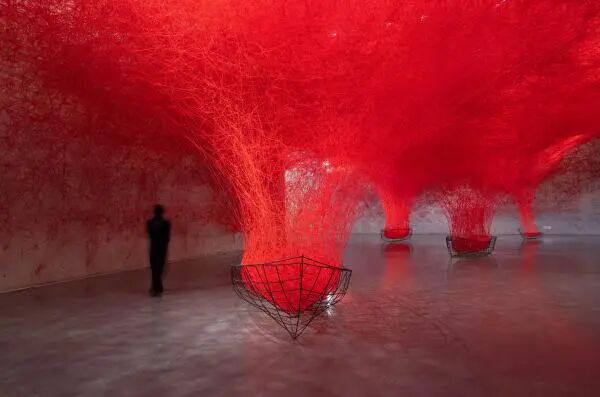
In The Key in the Hand or Uncertain Journey (2016), the all-encompassing red thread forms a gigantic organism. It resembles both the blood vessels and neural network of the human body, pulsing with vital energy, and an inescapable web of social relations enveloping the individual. Entering such a space, the viewer feels the contradictory sensation of being at once warmed and bound.
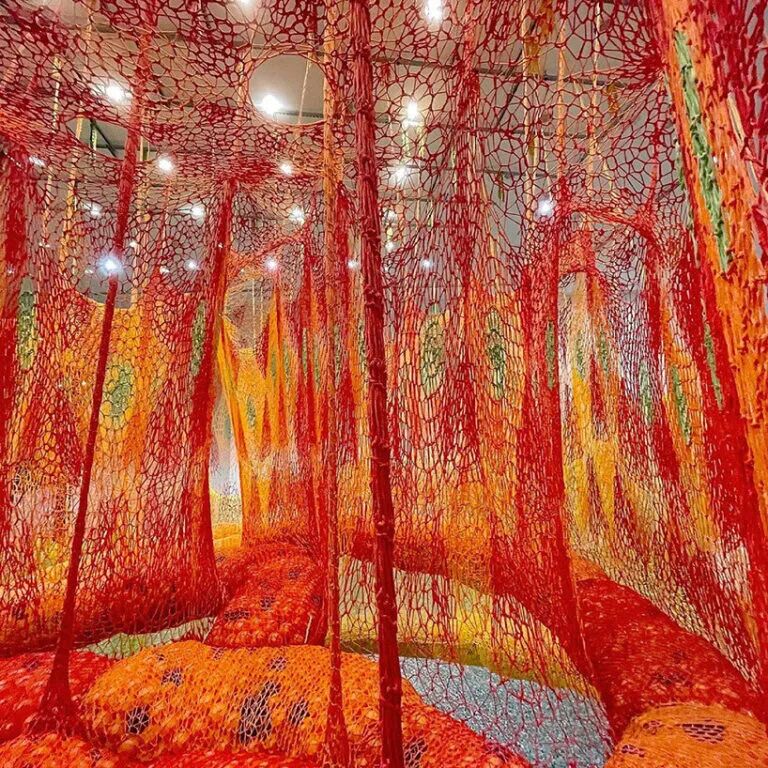
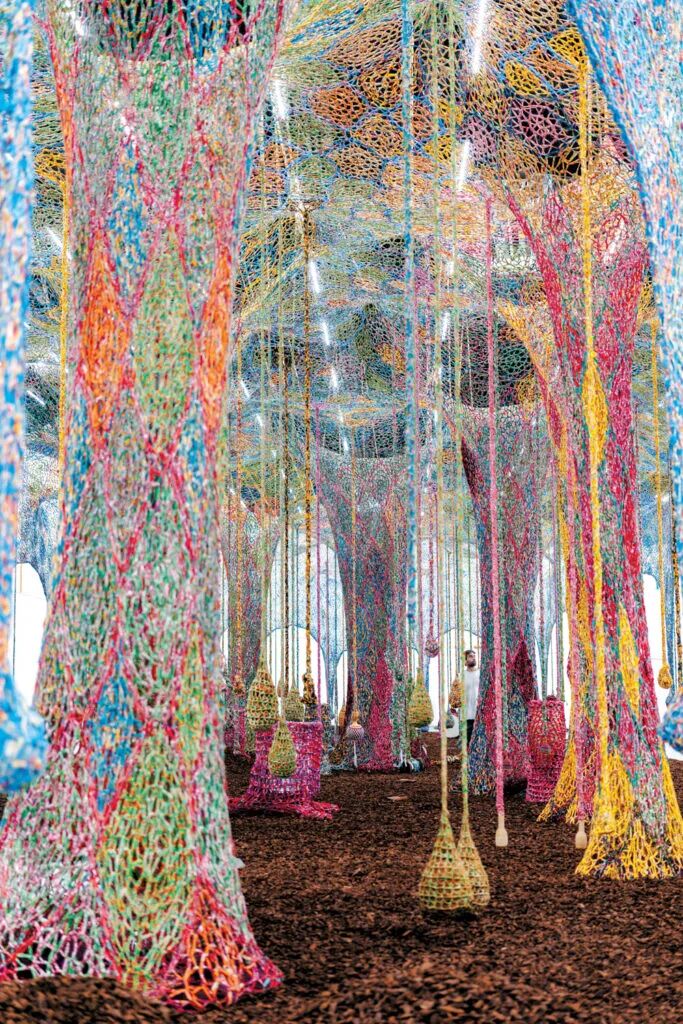
This visual effect can be compared with the installations of the Brazilian artist Ernesto Neto. Neto often uses semi-transparent elastic fabric to build cave-like organic forms that viewers can touch and climb, filled with spices inside, emphasising a sensory, womb-warm experience. Although Shiota’s red-thread network is also organic in form, it is visually sharper and tenser, saturated with intricate narrativity rather than pure sensory pleasure. As the psychoanalyst Jacques Lacan described, human subjectivity is formed within the ‘symbolic web’ of language and social relations. Shiota’s red thread is the perfect visualisation of this ‘symbolic web.’
2. Black Thread: Cosmos, Death, and Burnt Memory
If the red thread is about ‘connection’ and ‘life,’ then the black thread points more toward ‘rupture’ and ‘ending.’ Black is night, the profundity of the cosmos, and the colour of death and the unknown. In Shiota’s vocabulary the black thread is also closely bound to the burnt, carbonised matter of her childhood fire memory.
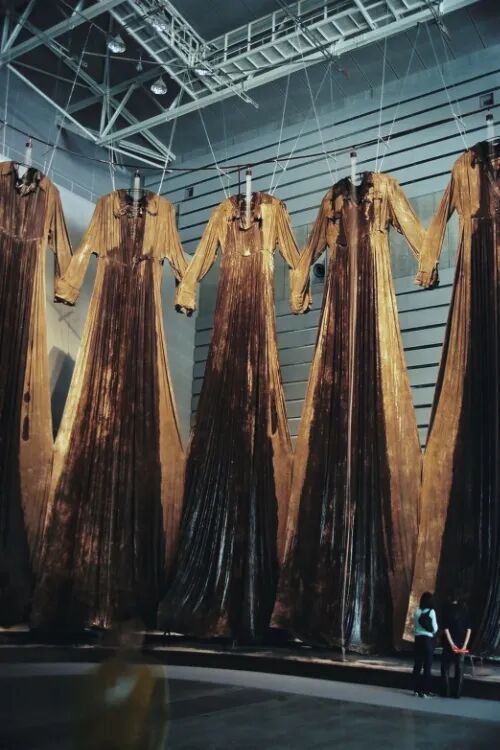
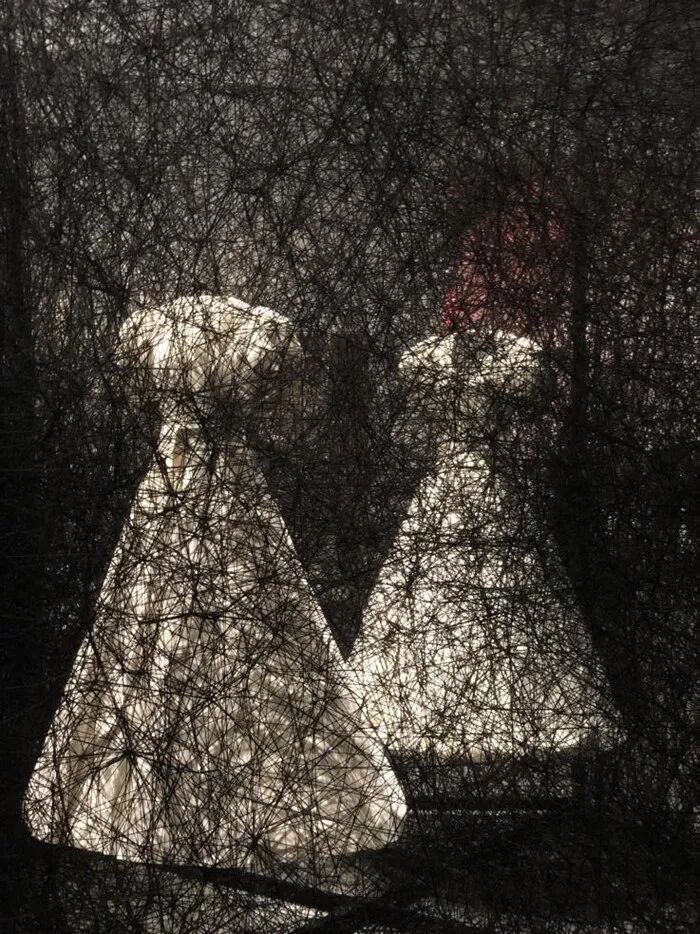
In In Silence, the work wrapping the charred piano, the black thread is like congealed smoke, sealing the instant of disaster and creating a cosmos of traumatic memory. In another work, Reflection of Space and Time, black thread winds around a white dress, hinting at the entanglement between dream and reality, life and death. The use of black lends the work a strong solemnity and an atmosphere of philosophical meditation.
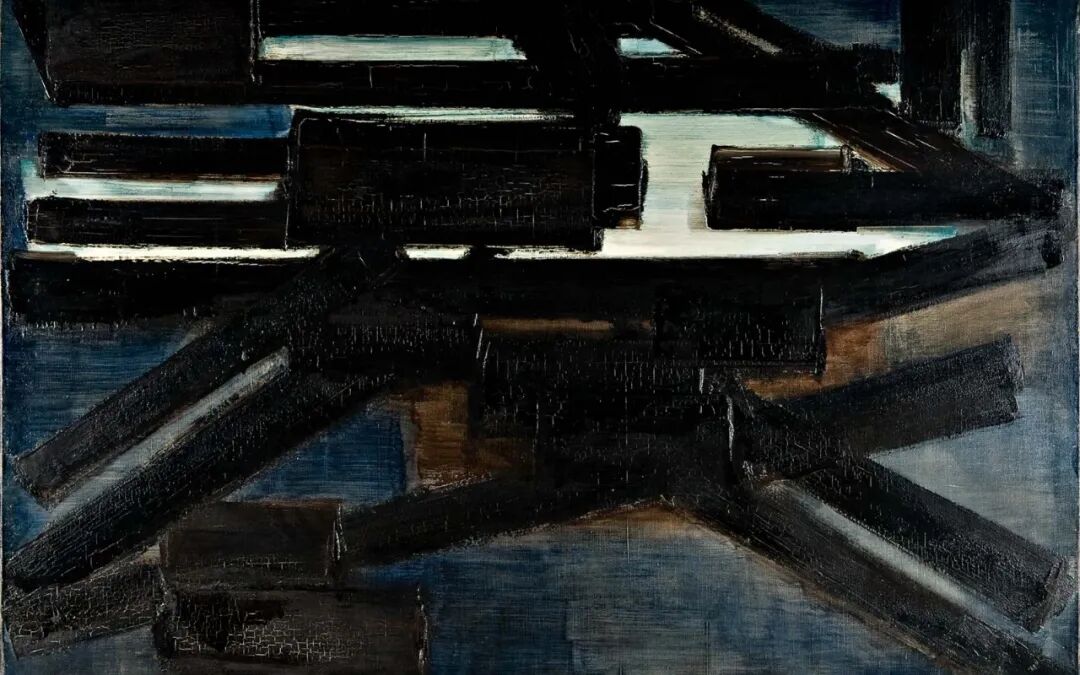
Shiota’s black thread installations possess the function of building a spiritual field, yet she achieves it through a three-dimensional, enveloping mode rather than two-dimensional painting. The French artist Pierre Soulages devoted his life to exploring the possibilities of black, holding that black reflects light and possesses rich strata. Under lighting, Shiota’s black thread likewise produces complex chiaroscuro: it absorbs light and reflects it, creating a contradictory space that is both dark and scintillating.
3. White Thread: Purity, the Cycle of Life, and Absence
White appears relatively late in Shiota’s work, yet it is no less significant.
White can symbolise purity and rebirth, as in the colour of a wedding gown. It can also symbolise death and mourning, as in the colour of a funeral. At the same time, white is a colour of ‘emptiness,’ representing absence and infinite possibility. In The Line of Life (2021), she used white thread on a large scale for the first time. The white thread-net seems lighter and more ethereal than the red and black, perhaps symbolising the cycle of life, perhaps hinting at a purified resting place of the soul.
The use of white can be linked to the aesthetic of “negative space” (yohaku) in Japanese design. In traditional Japanese painting and architecture, the “empty” part matters as much as the “solid.” White is precisely the visual embodiment of this “empty.” Shiota’s white-thread installations create a space full of ‘interval’ (ma)—a spiritual field in which viewers can breathe and meditate freely.
(2) The ‘Painting’ of Space: How Thread Installations Reshape Space and Create an Immersive Psychological Field
Shiota often says she ‘paints’ with thread in space. This is no simple metaphor. She thoroughly breaks the two-dimensionality of painting, liberating line—the most basic element of painting—into three-dimensional space, creating an entirely new artistic form.
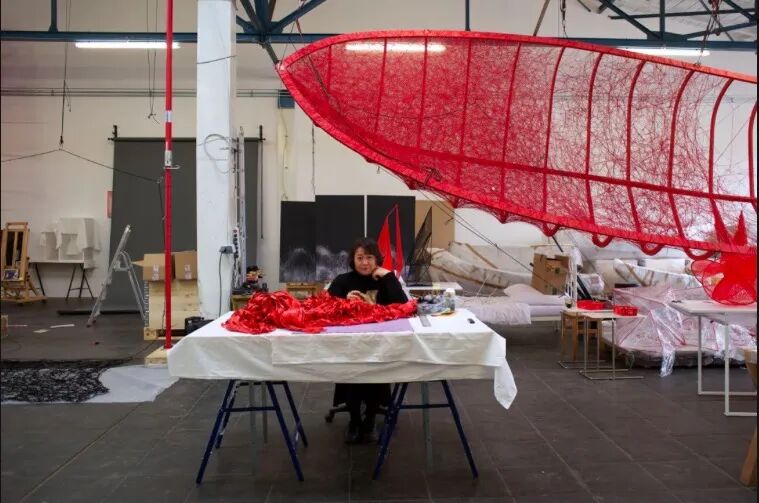
Her creative process is itself a deeply bodily painting act. She and her team spend weeks or even months repeatedly moving through, pulling, and knotting the space, weaving hundreds of kilometres of thread into a complex network. The process, like a spider spinning its web, has an instinctive, organic constructive quality. The finished installation is no longer an object to be ‘looked at’ but an environment to be ‘experienced’ with the whole body. Viewers are invited into this ‘other world’ of lines, and their sense of space, direction, even time, is altered.
This thorough reshaping of space is a core feature of immersive art. Yayoi Kusama’s Infinity Mirror Room is a classic case of immersive art; through mirror reflection and LED lights she creates an infinitely extending, vertiginous cosmic space. Unlike Kusama’s infinite space composed of light and illusion, Shiota’s space is material and tangible, yet equally capable of dissolving ordinary spatial perception. The Argentine artist Tomás Saraceno is also known for his vast net-like installations that viewers can climb; his work leans more toward modelling astrophysics, ecology, and social networks. Shiota’s ‘net,’ by contrast, remains a psychological and emotional ‘inner cosmos.’
The curator and art historian Hans Ulrich Obrist, speaking of installation art, once said: ‘The best installation art is the kind of “psychological architecture” that stays in your memory after you have left.’ Shiota’s work is exactly this. After leaving the gallery, viewers still carry the feeling of being wrapped and wound in thread; this bodily memory is far deeper than looking at a painting or a photograph.
(3) ‘Accumulation’ as Method: With ‘Accumulated Memory’ as the Core Concept
‘Accumulation’ is another keyword for understanding Shiota’s art.
Whether tens of thousands of keys and shoes or hundreds of thousands of thread knots, her work always achieves a qualitative leap through the enormous accumulation of quantity, attaining an awe-inspiring, monumental effect.
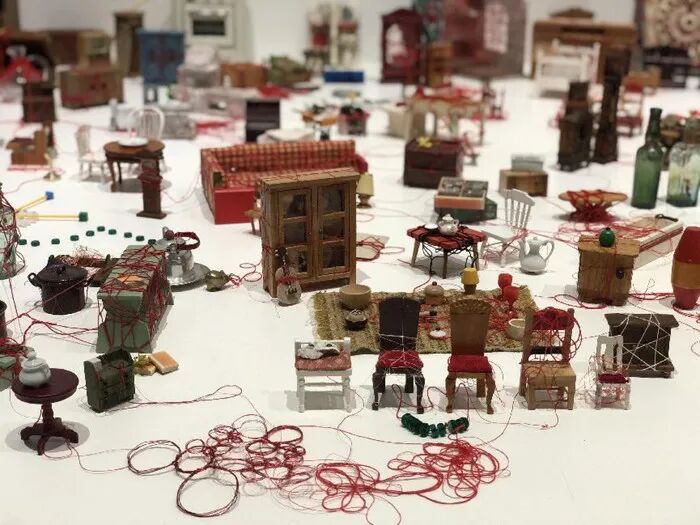
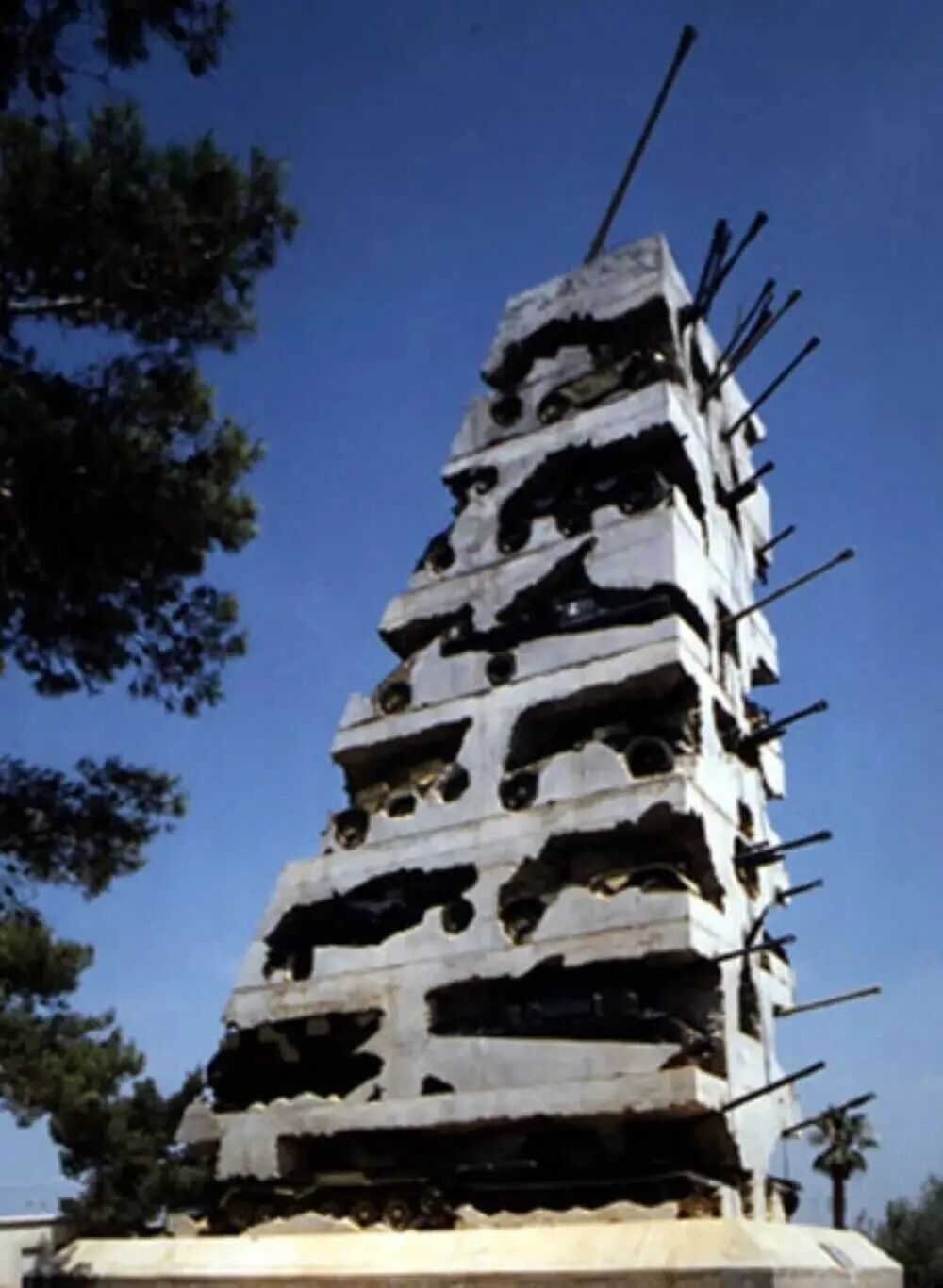
This strategy of ‘accumulation’ is, first, a method of universalising personal emotion. The story of a single key is private, but the stories of fifty thousand keys converge into a shared sea of human memory. One person’s anxiety may be trivial, but the web of anxiety woven from countless threads acquires a universal power to move everyone. This method also appears in the work of the French artist Arman, known for his ‘accumulation’ series, in which he heaps the same kind of object (gas masks, violins, clocks) in glass cases to criticise the material glut of consumer society. Unlike Arman’s social critique, Shiota’s ‘accumulation’ carries a more poetic and emotional warmth. What she accumulates is not standardised industrial products but old objects saturated with the marks of personal use.
Second, ‘accumulation’ is itself a visual presentation of time and labour. The densely woven thread-net clearly records the immense devotion of the artist and her team. This near-obsessive, repetitive labour carries something of spiritual practice. It fills the work with the warmth of the hand, resisting the tendency in contemporary art to over-rely on industrial fabrication and the games of concept.
Ultimately, what Shiota’s ‘accumulation’ points to is a kind of ‘accumulated memory.’ This concept can be linked to the theory of ‘collective memory’ proposed by the French sociologist Maurice Halbwachs. Halbwachs held that memory is not a purely personal act but is constructed and transmitted within a social framework. Shiota’s work, by accumulating countless individuals’ ‘micro-memory objects,’ builds a perceptible, non-textual field of ‘collective memory.’ Her art becomes an alternative mode of writing history—one that records not the deeds of kings and generals but the small, precious moments in the lives of countless ordinary people.
IV. From Personal Trauma to Collective Memory
Shiota’s work rarely responds directly to specific socio-political events, but this does not mean her art is ahistorical. On the contrary, through a highly personal and poetic language she touches upon a deeper historical consciousness and collective memory. She offers a path beyond direct social critique—one that, by evoking universal emotional resonance, prompts people toward a more personal and introspective reflection on history.
(1) Rethinking ‘Critique’: Emotional Resonance as a Path to Historical Reflection
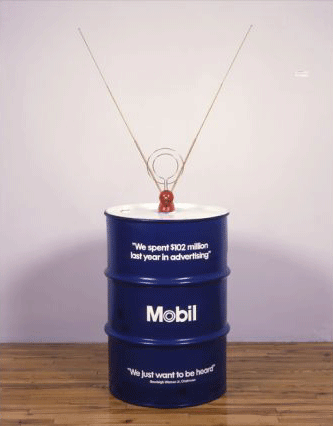
In contemporary art, ‘critical art’ that intervenes in society and politics directly and radically occupies an important place. The German artist Hans Haacke, for instance, through exposing the collusion of interest between museums and big business, pursued ‘institutional critique.’ Shiota’s path is altogether different. She offers no slogans, levels no accusation; what she does is create a space in which viewers can quiet their minds and feel and think.
(For the work’s full meaning, follow this account and reply with the keyword ‘Haacke.’)
Her work can be seen as an ‘archaeology of emotion.’ What she excavates is not the objective facts of historical events but the emotional imprint those events left within people. Facing the wall of old windows in The Memory of a House, viewers may not know the specific story behind each window, yet they can feel the loss, the vicissitudes, and the longing for the past brought by historical change. This universal emotion stirred by the work becomes a bridge connecting the viewer’s personal experience with grand history. Viewers may recall the transformations of their own hometown or the departure of loved ones, and thereby understand, at a deeper level, how history shapes individual fate.
The art critic Claire Bishop, in her book Artificial Hells: Participatory Art and the Politics of Spectatorship, has distinguished different types of ‘participatory art.’ She reminds us that not only art which directly mobilises viewers into social action is political. Art that can reshape our modes of perception, awaken our empathy, and let us see the world from a new angle equally possesses profound ‘political’ potential. Shiota’s art belongs to the latter. By creating a field charged with emotional tension, she invites viewers to an inner ‘participation’ that may ultimately lead to a deeper understanding of history and reality.
(2) The Confluence of Collective Memory in The Key in the Hand
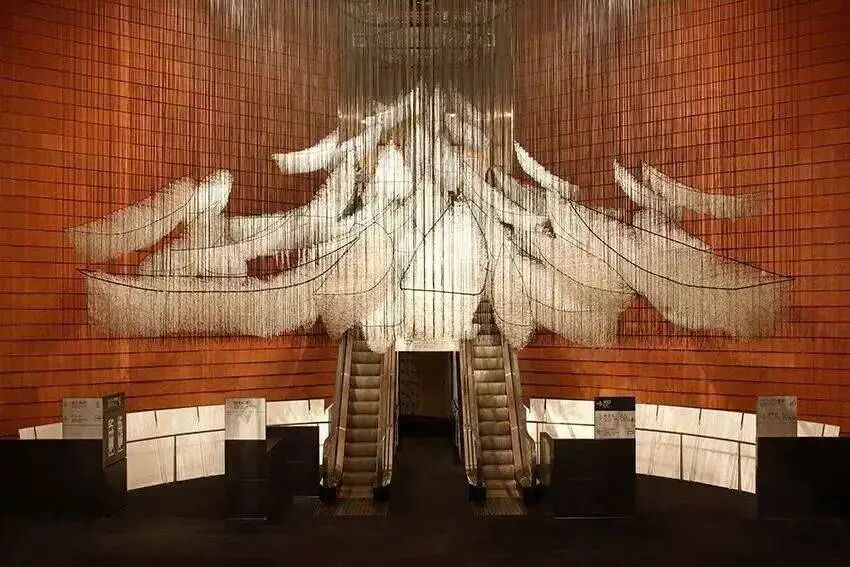
Returning once more to The Key in the Hand. The reason it became a representative work of Shiota’s and won international acclaim is precisely that it perfectly embodies how personalised objects can be transformed into a powerful vehicle of collective memory. The key, as a symbol guarding ‘home,’ is closely bound to humanity’s most basic sense of security and belonging. Today, as globalisation and urbanisation accelerate, the very concept of ‘home’ is growing ever more unstable and fragile. People migrate and disperse ceaselessly for study, work, war, or disaster.
The fifty thousand keys suspended in the work are like fifty thousand displaced souls; the ‘homes’ they once guarded may long since be gone, yet the keys themselves have become the final witnesses of memory. The two weathered wooden boats are like a Noah’s ark, striving to carry these scattered memories toward an unknown shore. The red thread-net is both the bloodline connecting these memories and a fishing net catching hope. Although no human figure appears in the work, it is full of human breath and story. In an intensely poetic way it touches the shared existential condition of humanity in the twenty-first century: the fluidity of identity, the spread of nostalgia, and the eternal effort to find a spiritual home amid uncertainty.
(3) The Metaphorical Expression of Shared Human Destiny and Historical Witness in Uncertain Journey and The Memory of a House
If The Key in the Hand is a gathering of individual memories, then Uncertain Journey is more like a grand allegory of humanity’s shared destiny. In an exhibition space in Berlin, countless red threads burst from the highest point of the ceiling, extending and entwining until they connect to several boat-shaped frames on the ground that are nothing but skeletons. The entire space is swallowed by this gigantic red network, like a huge, beating heart or a nebula in formation. The boat, since antiquity, has symbolised exploration, expedition, escape, and hope. But here the boats are hollow skeletons, hinting at the hardship and uncertainty of the journey.
The work can be read as a metaphorical response to the current global refugee crisis and mass migration. Those red threads are the trajectories of countless people torn from their homeland, the connections between them and their native soil stretched and ripped apart, and the new, fragile community networks they build in displacement. Compared with the German artist Anselm Kiefer’s colossal paintings and installations—laden with heavy history and myth, made of lead, straw, and ash—Kiefer’s work directly excavates and mournfully reflects upon German historical trauma, whereas Shiota’s Uncertain Journey is more abstract and universal: it points not to a specific historical event but to an eternal human condition—always on the road, always searching, always facing the unknown.
The Memory of a House explores historical witness in another way. The windows removed from old Berlin buildings are silent observers. They have ‘seen’ a family’s joys and sorrows, ‘seen’ a city’s division and reunification, ‘seen’ the end of one era and the dawn of another. Now these ‘eyes’ are gathered together, as if engaged in a wordless confrontation, forcing us to ask: who writes history? Whose memory is preserved, whose forgotten? The work reminds us that the grand historical narrative is ultimately composed of countless individual, everyday, neglected ‘interior views through the window.’
Coda: The Eternal Traveller
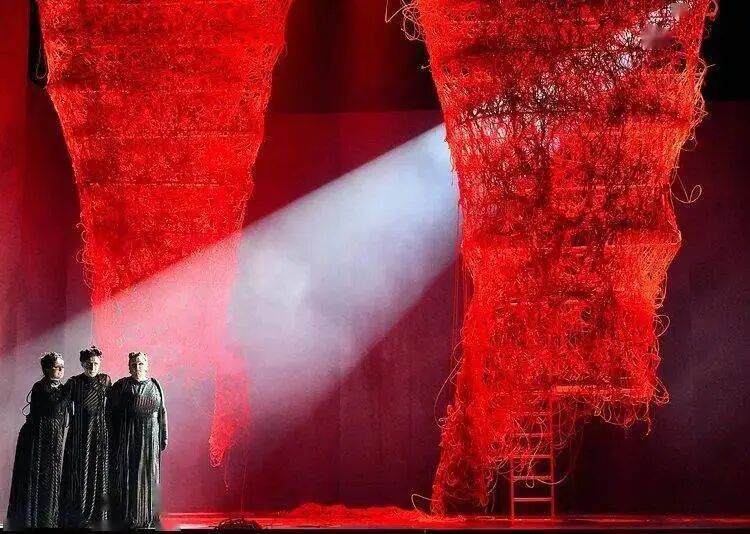
Shiota’s art is a long journey that begins with the individual and ends with the cosmos. Setting out from her most private traumas, anxieties, and experiences, she ultimately arrives at a philosophical speculation communicable to all. Summarising her practice, we can distil several highly illuminating core strategies: she excels at distilling extremely private personal experiences—childhood trauma, illness, identity anxiety—into universal human emotions and philosophical propositions that resonate with the widest audience; she endows abandoned everyday objects with soul and dignity, raising them through ‘accumulation’ from refuse to monuments bearing collective memory; she seizes ‘thread’—the simplest, most primal material—and mines its symbolic meaning and visual expressiveness to the limit, developing a complete, complex, and highly recognisable personal artistic language; and she is an outstanding ‘spatial director,’ who through carefully constructed immersive environments creates narratively charged spaces of dramatic tension, guiding viewers through a profound experience of body and soul.
Shiota’s artistic contribution reaches far beyond the creation of a unique, unforgettable visual language. More importantly, she offers those of us living in a modern society saturated with uncertainty, loss, and existential anxiety a profound and poetic visual paradigm—teaching us how to face memory, how to embrace absence, how to confirm our own coordinates within invisible connections. Her works are like so many gigantic ‘catchers of memory,’ capturing the emotions, stories, and glimmers of soul about to dissipate in the torrent of time. She is an eternal traveller, moving between Eastern and Western cultures, lingering at the boundary of life and death; she is above all a weaver of existence, who with thousands of strands weaves for us a sanctuary where our ‘trembling souls’ may rest. In her artistic world we see ourselves, we see others, we see that invisible yet resilient web of life connecting past, present, and future. In the history of contemporary art, her art will continue, with its silent yet mighty force, to send forth a lasting echo.
订阅艺术评论
订阅即赠《2024中国当代艺术关键词》内部思考笔记 PDF
每周免费获取最新当代艺术批评与研究