I.
The affair of Bai Di (Zhao Aimin), a professor at the China Academy of Art — the “Bai Di Incident,” as it has come to be called — has, over the past two days, been like a boulder flung into a river, stirring up wave upon wave of public opinion. Most people have condemned Bai Di for having lost all moral sense and disgraced his vocation, brimming with righteous anger; yet most of those same people condemn the man and discard the calligraphy along with him, writing off several decades of attainment in one stroke. Worse still, numerous self-media accounts have published the name and photographs of the young woman who was victimised, and only here and there in the clamour does any voice speak of the victim herself… a deafening, unseemly spectacle.
First, back to the matter itself. The Shangcheng district police of the Hangzhou Municipal Public Security Bureau issued a notice: at approximately 11:30 on 22 August 2023, a woman called the police to report that she had been raped by a teacher at a certain university. The police notice came on 29 August, seven days after the event. According to the explanation given in the article “On the Categories of Situation Notices,” published by the China Police Network:
“As to the intention and the purpose of issuing it: first, there was no choice but to issue it — the incident had itself already generated heat online, and multiple information sources had appeared; internet users had formed points of interest and emotional leanings, and public feeling around the event had already coalesced. At such a point an official voice is needed to reduce speculation and suspicion, and to answer the public’s concern with facts.”
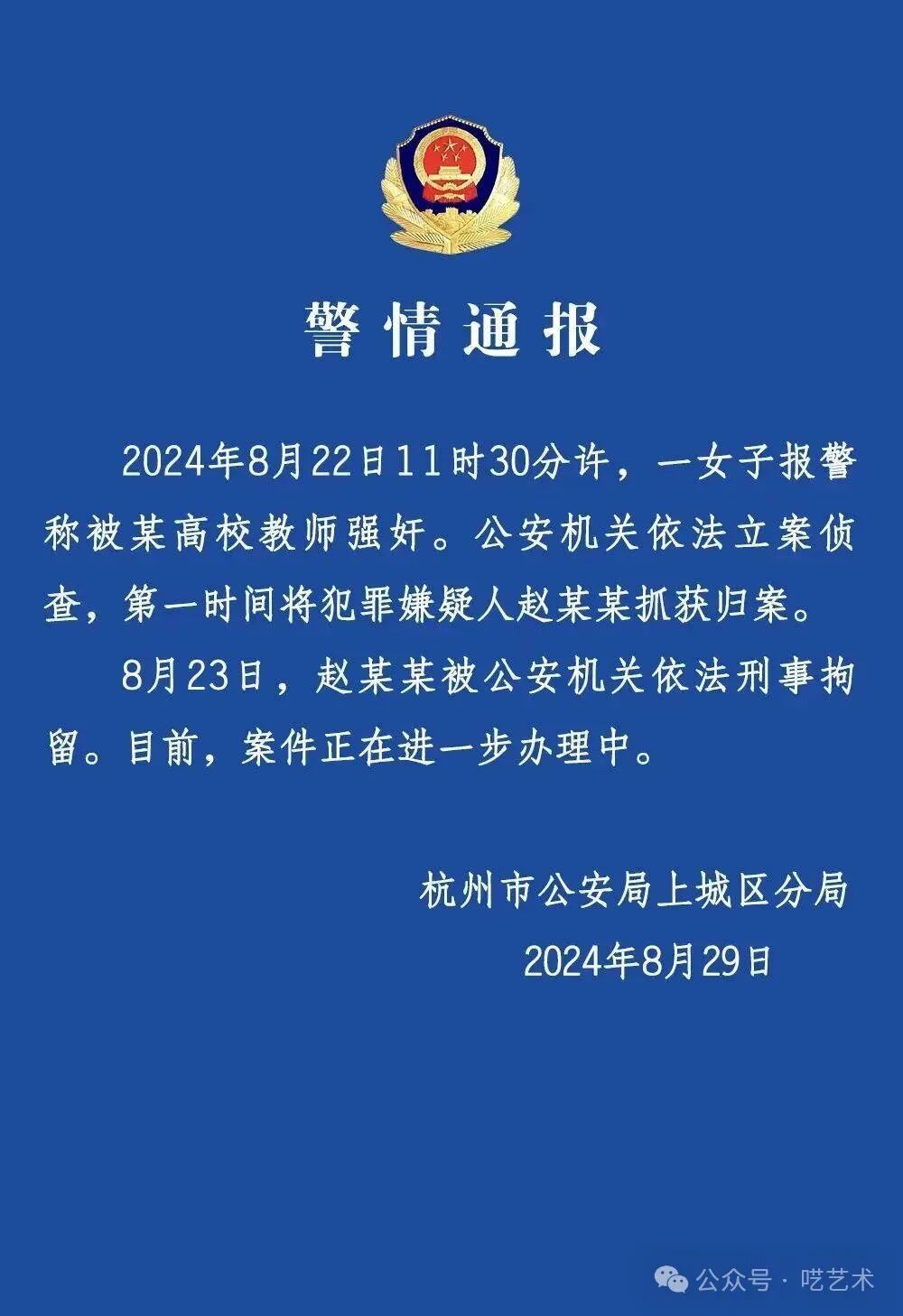
From this one may judge that the matter had already caught fire online and “entered the trending searches,” leaving them no option but to issue it.
The reasons it came to trend are, roughly speaking, two.
The first: topics of the “sexual assault at a university” kind are in themselves already sensitive words, touching the moral contrast with the idealised image the public holds of higher education — the greater the contrast, the greater the heat. It follows that the assaults which surface are only the tip of the iceberg: in July, a doctoral student at Renmin University was subjected to prolonged forced molestation by her supervisor; there was the case of the dean of the School of Fine Arts at Shaanxi Normal University inducing female students into sexual violation; and so on, and so on — incidents that offend against public order and good morals are everywhere online. Such things inevitably ferment. They have become a means by which the internet and the self-media harvest enormous traffic. People love to watch a spectacle, and no spectacle is too large; worse still, several self-media outlets have published photographs and detailed personal information of the victim.
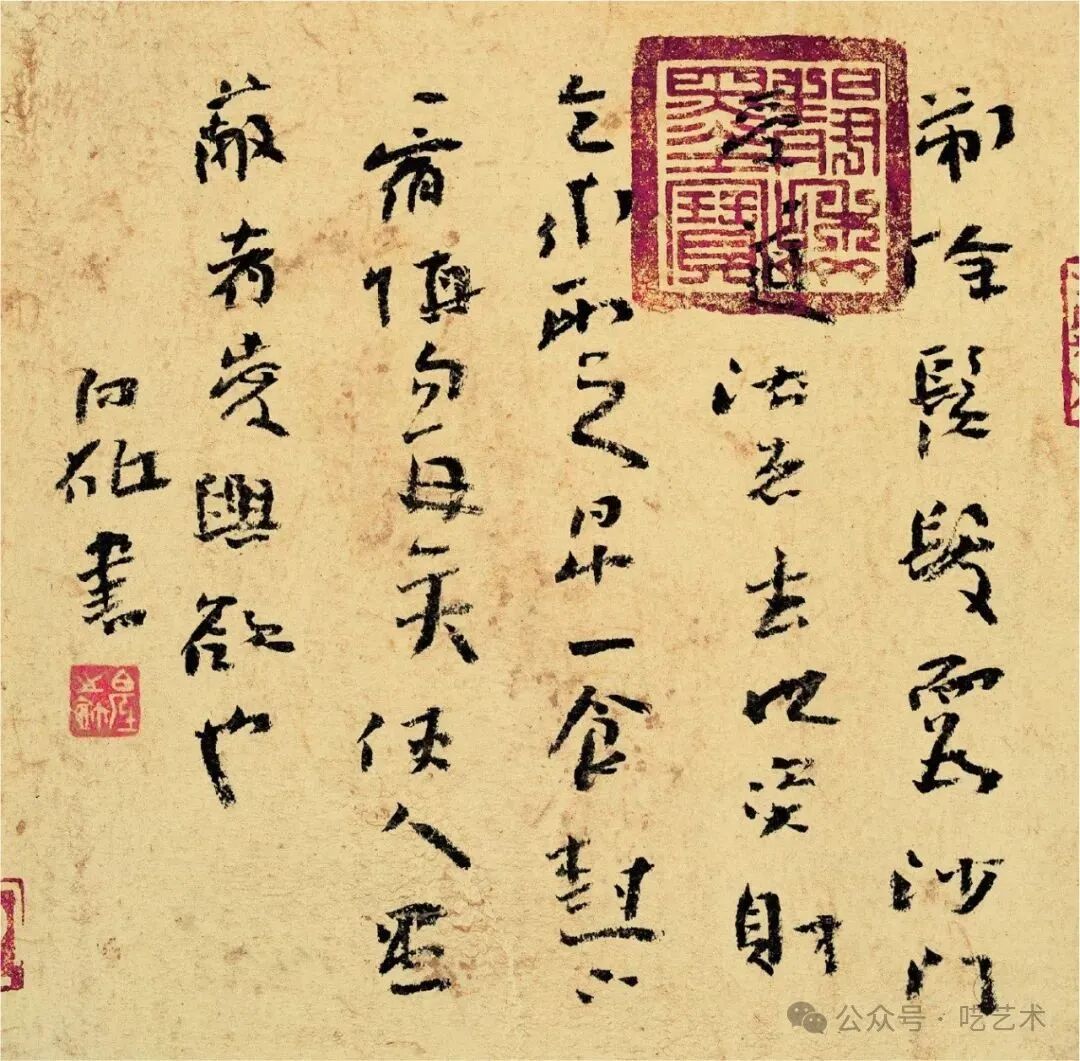
The second: the collapse of the personal “IP” of “former doctoral supervisor in calligraphy at the China Academy of Art” and of “Bai Di” himself. Students around Bai Di, friends, and those within the field who knew something have come forward with exposures; when a wall begins to fall, everyone pushes. The internet has become a courtroom of supreme morality, and so people actuated by every manner of motive have converged upon a single result — because he raped a female student, a lifetime’s good name is destroyed in an instant.
Back to the matter itself. A report published on 29 August by a Pengpai account on The Paper, headlined “A Certain Zhao (59, professor at the China Academy of Art), criminally detained!,” states:
“It is further reported by persons familiar with the matter that the incident took place at around 12 noon on 21 August: a certain Ma went at invitation to the studio of a certain Zhao in Shangcheng District, Hangzhou, for lunch; during the course of the meal the two drank alcohol, after which Zhao had sexual relations with Ma. On 24 August, Ma reported to the police that she had been raped by Zhao…”
Subsequently, reports of the incident published by Sina Finance Headlines, Luzhong Morning Post, Foshan News, Tianyan News and other outlets all carried forward the formulation “allegedly raped by a certain Zhao.” Combined with the police notice, the matter was for all practical purposes taken as established by netizens.

To begin with, take the phrase “allegedly raped by a certain Zhao.” So far as the standard defining “rape” goes, the criminal law of this country still follows the traditional legislative model of the crime of rape founded upon violence: Article 236 of the Criminal Law of the People’s Republic of China provides that whoever rapes a woman by violence, coercion or other means is to be sentenced to fixed-term imprisonment of not less than three years and not more than ten years. There is, however, another tendency within Chinese criminal-law theory — arising from the influence of feminism and from a theoretical tendency towards reforming the standard of the crime of rape worldwide — whereby the great majority of Anglo-American and continental European countries have replaced the traditional violence-based legislative model with one founded upon absence of consent, providing fuller respect for the individual’s sexual autonomy.
Two questions arise from this.
First, under the legislative model as it stands, did Professor Bai Di in fact employ “violence, coercion or other means” to force a sexual relation with the student Ma? Did anyone see it done, or is there evidence from the scene to prove that Bai Di used “violence or coercion”? At present the police have given no such notice; they have said only that “the case is under further handling.”
Second, on the principle of consent as the basis, everything turns upon the victimised young woman, Ma: how it happened, and why it went so far. None of this do we know. There were no witnesses and no accounts; we know only that “the victimised young woman Ma went at invitation to the studio for lunch,” and that afterwards “sexual relations occurred following drink.” Consent and its absence rest entirely with Ma; there exists here no objective standard.
As things now stand, none of it is clear — whether there was violence or coercion on Bai Di’s part, why the victim Ma did not consent, what the specific reasons were — and none of it is known to us. Yet even setting that consideration aside, criticism, abuse and judgement of Bai Di have already come sweeping over the internet, with public opinion uniformly one-sided. It brings to mind the Wang Leehom affair: while Leehom Wang was being put through his moral trial, no one thought to ask what lay behind his wife’s actions, or what was hidden there. Today it can fairly be said that, official notices aside, what we see online is what someone wants us to see.
And this touches upon a problem: in most settings of everyday life we take a resistant stance towards personal attack, because “respecting and safeguarding human rights” is explicitly provided for in the Constitution of this country. In reality, in whatever setting, once a personal attack enters the picture, the direction of public opinion immediately reverses: a personal attack, in any environment and under any condition, is nothing more than a discharge of spleen. Yet online it has become the form we know best — online violence. In this online world, where everyone takes off their mask, and where virtual disdain and licence confront us, the earnest moral system that once applied no longer holds. Among people who do not know one another, once the scruples are laid down, a dislocation between transgression and ethics may readily occur. Because the information we receive about this case is pieced together from fragments — we have not seen it, nor heard it, nor lived it — we assemble our own “morality” out of them: the degeneration of a teacher’s virtue, a beast in human clothing, and the indignation that springs from instinct. Hence the coarse and violent vocabulary and judgements, the sentencing before trial, and even — for the sake of traffic — the publishing of the victim’s private photographs and personal details. What all this discloses — shallowness of thought, letting others set the tempo, a utilitarian social psychology that sees things only in black and white — is itself cause for grave concern.
None of this is written to whitewash Bai Di. It is rather to say that, as we cry out for justice online, our concern for the body of students who live beneath academic power in the university ought to be more equal and more rational; before it is established whether there was violence or coercion, and why the young woman did not consent, we should do all we can to avoid passing judgement before trial.
II.
“Sexual harassment,” “molestation,” “sexual assault”… in recent years these words have been inseparably attached to universities and to the workplace, and one root cause of the sexual violence that cannot be evaded is “power.” Yet its frequent occurrence does not mean that our understanding of it has risen above the superficial.
What we know of sexual violence comes mainly from publicity campaigns, and the principal object of concern in mainstream publicity is the group of victims; every effort is spent telling victims how to avoid sexual harassment. This is the publicity we habitually see. But analysis of why perpetrators carry out their violations is exceedingly rare, and in almost every report the perpetrator occupies a position of absence. Once a headline such as “A University Professor Sexually Assaults a Female Student” appears, it falls inevitably into the fixed moral groove of “the university professor is no better than a beast” and “the poor female student”; sympathy for the weak is human instinct. Thus, in preventing sexual violence, directing attention upon the victim becomes the narrative logic of news of this kind. As for causes, for the motives of the acting subject who is called the perpetrator — whether it was the victim’s own fault that drove the offence, whether there are hidden interests involved — the media reports attempt to avoid all of it, and gradually our thinking grows complacent: put bluntly, we are interested only in how wretched you are. Seeing that you are wretched, and seeing that the person who assaulted you comes to a wretched end, gives a ghoulish pleasure of gossip and prying. As for why you were assaulted, and what drove the one who assaulted you, none of it matters in the least.
As far back as the Stone Age our ancestors lived in the form of tribes; they had to cooperate with one another, to go out hunting and to resist incursion from outside, while among themselves they also competed for power and advantage. Keeping constant track of information about enemies and companions was therefore part of their capacity to survive: it made the distinguishing of friend from foe easier, and keeping oneself safe easier too. This is why we are born today carrying our ancestors’ “gossip” gene. “Distinguishing friend from foe” is also the inner motive of moral judgement; only today the battlefield has shifted to the internet and to ideology. Political correctness, ethical correctness, correctness of stance — inside the blind spot of all this correctness one may do wrong things at will: judgement before trial, online violence, indiscriminate abuse and the like.
The artist Luo Yang’s work Girls: Zhou Yan presents Zhou Yan, a girl who had once endured brutal gender violence, in her transformation and growth after passing through that wound.

In primitive society men were naturally endowed with physical superiority over women, and so mostly took upon themselves the work of hunting. In order to ensure that property could be inherited by their own descendants, men imposed control and violation upon women’s sexual autonomy; women became the “assets” — even the “tools” — by which men enlarged their clans and preserved their property. In sexual autonomy women were thus reduced to a subordinate and second-rank position, and with that came inequality between the sexes, gender discrimination, and even sexual violence — and, at the same time, the socialisation of gender. If the woman does not consent, the man’s sexual imposition becomes rape; equally, if she does consent, the principle of female “passivity” may operate as a moral discipline, so that any departure from passivity makes her a slut who offends against public morals. One might say that whether she consents or not, a woman’s sexual power remains always “passive.”
Sexual violation is thus in itself a violent crime grounded upon gender discrimination and unequal relations of power. For a woman at such a juncture, she already holds unequal sexual power, and if a weak position in social power is added to it — student, subordinate and so forth — then the crux of sexual violation lies not in whether she “consented” to intercourse, but in this: whether she consents or not, the outcome is the same, and resistance is all but impossible. The reverse holds too. In the Republican period, for example, the writer Shen Congwen, as a teacher, pursued the student Zhang Zhaohe and wrote her a flood of love letters; Hu Shi, who was then the university’s president, far from preventing it, went so far as to play the matchmaker, and the affair is still told as a charming anecdote. The same was true of Lu Xun and Xu Guangping, Hu Shi and Cao Chengying, Liang Shuming and Luo Suhui — cases all of a kind.

The artist Liu Jiajia’s work Monologue wraps hard implements of daily life in the colour of women’s skin, presenting the contradiction in which women are caught between hardness and softness.
Catharine MacKinnon, the representative figure of left-wing feminist jurisprudence in the United States, has argued that “consent” is itself a concept shot through with inequality. She gives the example of two people, A and B: A makes a sexual demand, and B acquiesces or submits; then all we can do is fix our attention endlessly upon B — upon what is going through her head, or upon what she is prepared to have others do to her body. Analysed from the perspective of “consent,” therefore, whether B has been raped is decided by B’s expression, and not by what A has actually done to B. If B consents on the surface, this very surface conceals the fact that A’s domination has violated B’s freedom. If B does not consent, then B has been raped — and yet it is the accuser who ends up being put “on trial.” In the present age, acknowledging that rape has occurred looks like winning sexual freedom and freedom from persecution; in reality it also means being left, as MacKinnon puts it, “free” into possession of nothing at all. Within a male-dominated environment a woman’s autonomous will is hard pressed; yet what one ordinarily sees is that a woman has not truly consented of her own free will, while something that looks like a meeting of minds — a “reasonable” sex — may nevertheless have come about.
On this premise, once such a consensual and reasonable sex has taken place, there is also what Professor Josephine Ho calls the “logic of profit and loss”: whatever way you put it, the man is the one who gains; whatever way you put it, the woman is the one who loses. Men believe themselves entitled to anything they want from a woman, and believe that she “welcomes” it; women believe their loss must be made good with a larger measure of other kinds of power — monogamy, perhaps, or some other compensation in power.
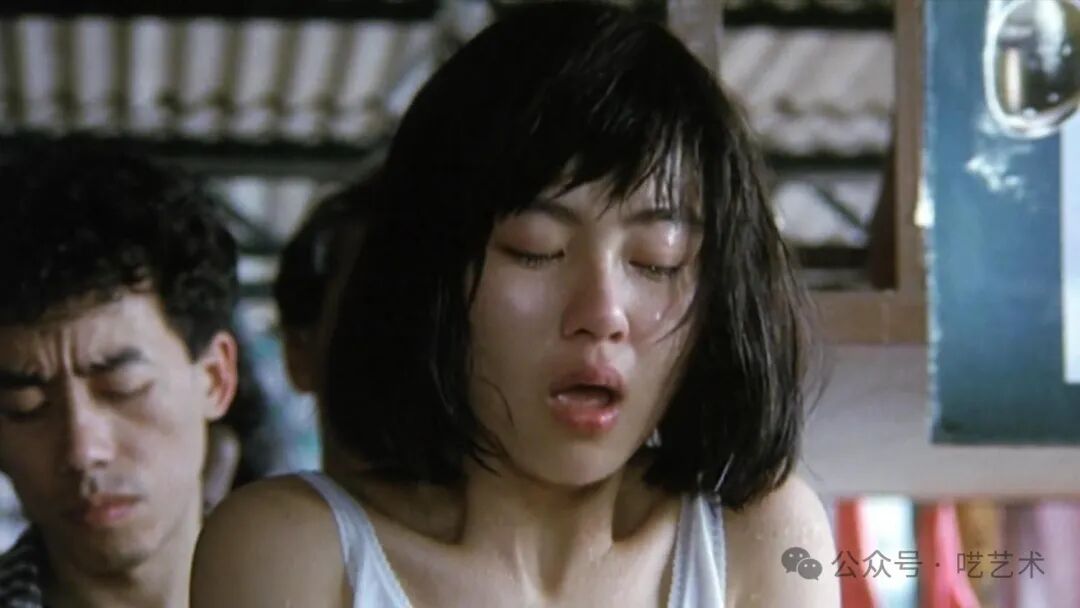
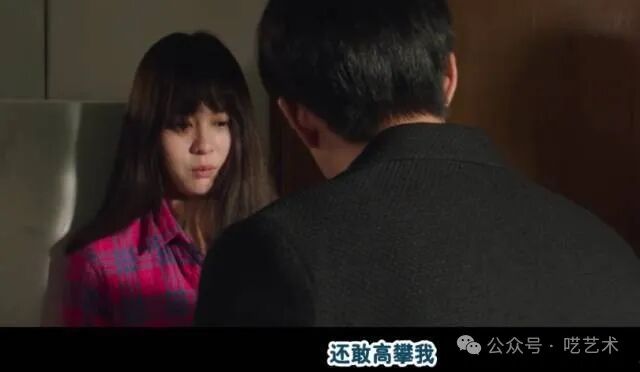
So, returning to the matter itself: whether there was violence or coercion, whether the young woman consented, and exactly why she did not consent — behind all of it a deeper stratum of possible causes comes into view, and this is nothing at all like the case of two unacquainted people in which a man suddenly turns beast and rapes a woman. Our energies should be spent upon “what precisely Bai Di, as the violator, did to the female student,” rather than upon simply putting the question of whether the female student was raped on trial by internet. That is to say, when one party has violated another party’s sexual power, the two subjects are equals; when one party breaks this equality, and there is no adequate mechanism of redress or compensation, no sufficient power with which to make the other party amends, then the consequence produced by this “inequality” is what can properly be called rape. In short, gender equality means that women ought to receive the same treatment as men, or the differential treatment that is reasonable because women differ from men naturally and physiologically.
What I want to say is that this treatment has never been equal among us. Consider how a female university student at a social gathering will, by unspoken agreement, take care to stress that her supervisor too is a woman. Several years ago a male teacher at Beijing Language and Culture University was suspended from his post for posting pornographic remarks in a chat group; the question was not that “pornographic” remarks, as a destructive view, affect others and thus warrant suspension — the chief point is that what is here defined as “pornography” is a concept that discriminates against and injures women, casting them into subordination. It should be said that the immediate public response to sexual assault, molestation, entrapment and pornography in universities, together with the way the authorities handle them, amounts to handling that is unequal and relatively ineffectual; the “passivity” imposed upon women is an abuse of long standing, and under the double pressure of passivity before two forms of power it is very hard indeed for a female student to possess an autonomous will. Whether genuinely effective campus mechanisms for the prevention of sexual violation and harassment have been established, whether the rights of female students and teachers can genuinely be safeguarded, whether real equality between the sexes has been achieved rather than public opinion running ahead of the facts and judgement before trial — these are the questions that universities really ought to be pondering and reforming.
After all, once public opinion runs ahead and judgement precedes trial, the consequence is that women remain for the long term in a secondary and subordinate position with regard to their own personal rights. As set out above, whether the woman consents or refuses is alike a long-term and substantial injury to herself. Some victims are brave enough to call the police; far more whose suffering never reaches us choose to settle the matter quietly. Nor can anyone be certain that behind every victimised young woman there lies only “simple victimhood”; it is not inconceivable that the episode affords an opening to certain parties with interests to gain, who ride the sympathy of public opinion in order to do as they please.
Equality between the sexes, equal and effective mechanisms of protection established, judging each matter on its merits from an equal standpoint, and no longer condemning the person on account of the deed — no judgement before trial, no public opinion running ahead: this alone is the effective path by which we may strangle sexual violation on campus in its cradle.
III. Bai Di’s Gift for Calligraphy
Bai Di’s gift for calligraphy had already begun to show itself in the 1980s; work made while he was still in his twenties was already ample and mature. One might say that Bai Di, as a calligrapher of the older generation, drew the dividends of both the academy and his era, and that his work long ago formed a settled constituency of its own in the market. He had talent, and everything went smoothly; he cannot be called unsuccessful. True, in recent years his work has grown somewhat formulaic, lacking the abundant talent of his early years, and even among his own students few have truly made their way. That I shall leave aside for the moment — but once this incident occurred, an old traditional notion seemed once more to be confirmed: that the calligraphy is the man.
What I want to say is that the occurrence of this incident is not a simple case of the writing resembling the man. Leaving aside the many doubtful points and the truth of the matter itself, the fragmented information put out by the media does suggest that Bai Di did indeed do this thing; what awaits him is overwhelming public condemnation and, once the court pronounces sentence, imprisonment. For him this cannot but be a form of suffering.
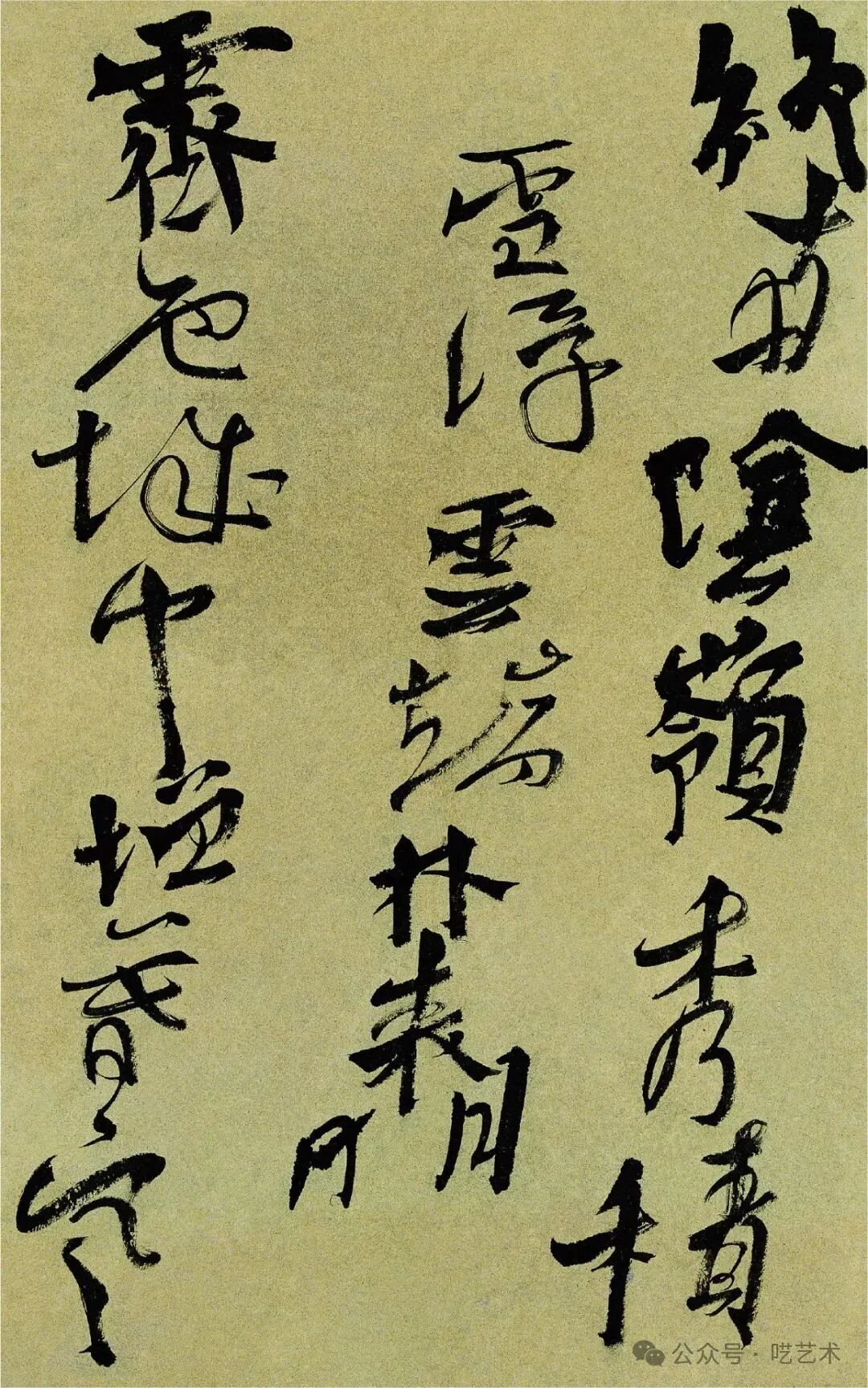
What can be stated with certainty is that artistic achievement opens onto an achievement that is unknown to itself, a value that forms a system of its own. To borrow Croce’s words, art is in essence a self-conscious activity, the embodiment of feeling, whereas morality belongs to the practical stage of the activity of the mind and is in essence a practice possessed of a rational purpose; artistic activity is independent of moral activity, and though it may carry a moral tendency, morality is not its sole end. Of course, the purpose of artistic activity is by no means to be immoral either; the point is simply that art is not a moral activity. There is a line in Croce’s writing: a good will can make an honest man, but it will not necessarily make an artist. If we were to weigh the achievements of artists and writers by their personal social morality, then the artistic achievement of the likes of Wilde, Matisse and Picasso, and of many Chinese painters, calligraphers and men of letters ancient and modern — Xu Wei, Fan Zhongyan and others — would all be forfeit in turn. That Xu Wei killed his second wife may be known to few; yet his extraordinary achievement in the untrammelled ink manner has secured him a name in art history. Hence “condemning the man on account of the deed, dismissing the calligraphy on account of the man” is likewise a form of judgement before trial; the traditional notions that the calligraphy is the man and the painting is the man can serve only as reference, not as the sole standard by which an artist’s artistic value is judged.
I would counsel Mr Bai Di, having suffered this calamity, to reflect well within prison walls and to repent with sincerity. Although morality is not the terminus of art, neither is anti-morality the road that art must necessarily travel. Those who work professionally in art still affirm the achievements Bai Di once had; it is only to say that a man who lives too restlessly, whose path has run too smoothly, does himself no kindness as an artist — work grown mannered, sunk into formula, brought to a standstill, and even a recklessness in morals: perhaps all of this is connected to that. Borrowing Freud’s words for Bai Di: artistic creation is the sublimation of the artist’s repressed sexual instinct, and through creation the artist expresses and resolves inner conflict and desire. Given that calligraphy is this restrained and inward spiritual complex — form without form, sound without sound — the work Bai Di made thirty years ago was genuinely rare. The trouble is that no falsity may be mixed into a complex that is ceaselessly refined: to commit a grave wrong through the recklessness that comes of having eaten the dividends of the academy is as pitiable as being unable to rise again in prison because one has let slip the dividends of one’s era and one’s market — for artistic achievement that reaches a certain measure is something that can be left to those who come after.
As for the young woman who was victimised, to borrow the words of Duanmu Yi: You have a life of your own. Do not let a thing like this distort how you see the world, or sacrifice the precious kindness and integrity that are a young person’s own. Use what strength remains to you to repay those who gave you help, and to change this ugly reality — rather than waiting out the years as an ill-used daughter-in-law only to become the mother-in-law in turn.




A dog’s nature is to go wherever there is meat, and to get that meat by any means. Among these endless reports, those who curse Bai Di can be understood, and those who would dismiss the calligraphy on account of the man are within the bounds of reason; but those who publish the victim’s private photographs and her name behave no differently from dogs, and do harm a hundred times greater than Bai Di’s. Before investigation and trial have concluded, what they do is nothing less than cruelty towards the young woman. Bai Di is already close to sixty, but the victim is only thirty. She still has a life to live; she still hopes to marry. How can it be that, on account of one injury she has suffered, she must be wounded again and again by a public standing upon the high ground of morality, becoming the sacrifice offered up to the mob’s plunder of morality and of traffic — and, in the end, left with a freedom that amounts to having nothing at all, as MacKinnon said? Therefore, to publish a victim’s private details is nothing other than murder. A sincere plea to all you “Zhao Aimin” figures behind the media: for mercy’s sake, hold back.
31 August 2024
订阅艺术评论
订阅即赠《2024中国当代艺术关键词》内部思考笔记 PDF
每周免费获取最新当代艺术批评与研究