I. Tonight Is the Eve of the 2026 Lunar Year of the Horse (Bingwu)
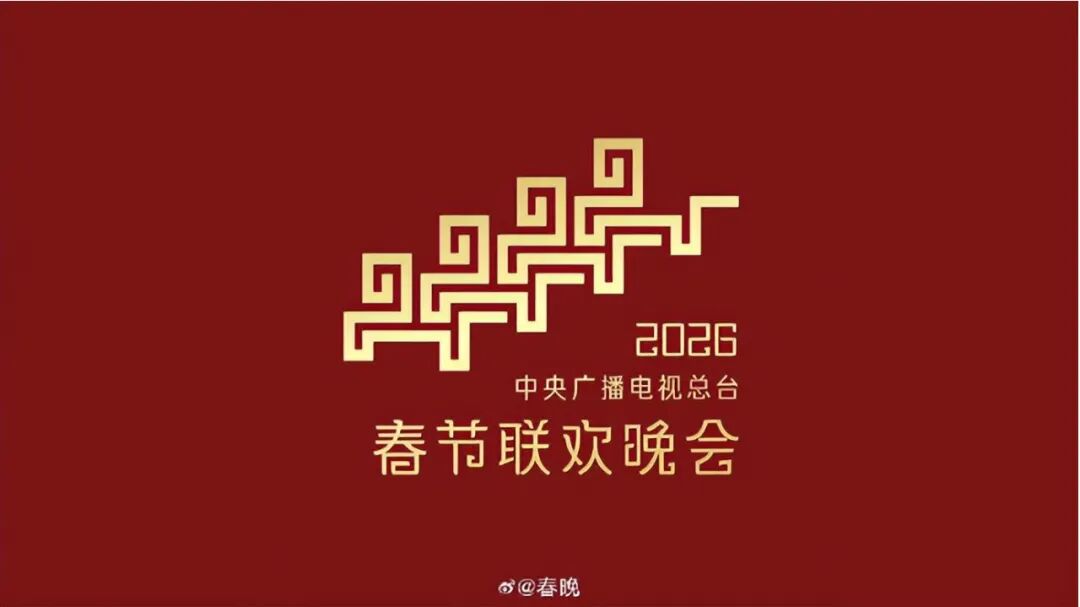
Tonight is the eve of the 2026 lunar Year of the Horse, the Bingwu year. Outside the window there may be the occasional firework, but far more pervasive are the dazzling blessings streaming across digital screens. Across the data flows of the internet and the timelines of social media, a semiotic carnival of the “horse” is underway. The main ident of the CMG Spring Festival Gala — inspired by the seal-script form of the character “horse” and fused with the imagery of galloping steeds — has long since become the visual point of departure for tonight’s narrative. In countless e-cards, brand posters and family-group stickers, galloping red horses and golden steeds carry the ancient wishes of the “dragon-horse spirit” and “swift success”, enveloping this night of farewell and welcome in an unprecedented density of pixels. Car brands have deftly exploited the character “horse” in their names to send New Year greetings to hundreds of millions of Chinese consumers, seamlessly stitching commercial logic onto folk symbols.
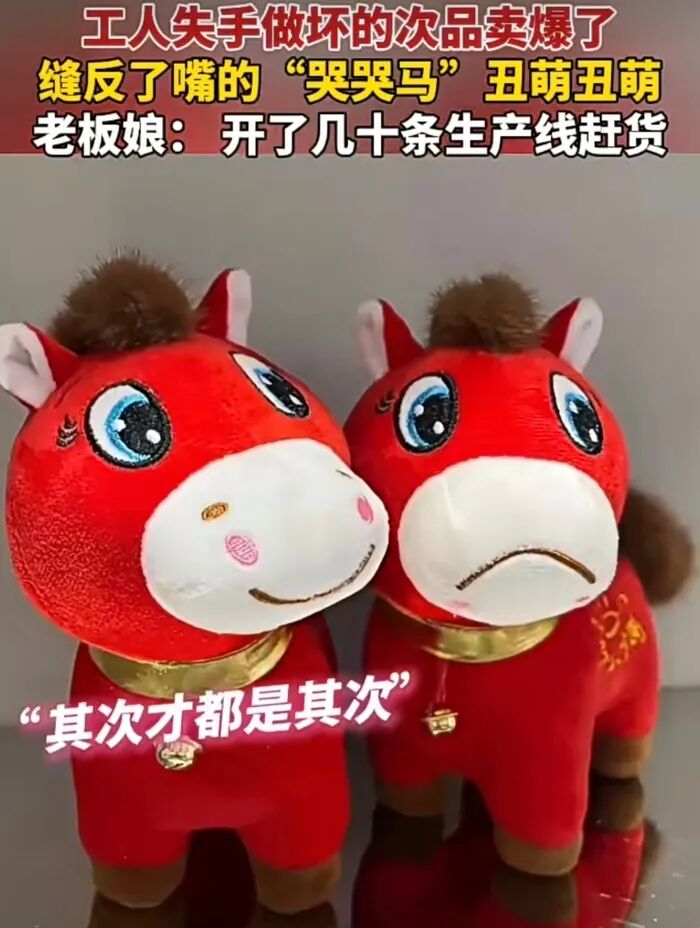
Within this festive, auspicious sea of signs, however, a curious cultural phenomenon has quietly surfaced. In the consumer setting of the younger generation, a doll called the “Crying Horse”, with its endearing yet faintly melancholic expression, has unexpectedly become a hit, dubbed the “mood horse” on social platforms. People buy it not to pray for success, but to seek emotional solace and self-reconciliation.
This shift — from the grand narrative of “strength and speed” to the micro-narrative of “bearing individual emotion” — inadvertently tears open the hard shell of traditional symbols, exposing the soft and complex structure of the contemporary psyche within.
As the horse, as a living creature, has all but withdrawn from our daily production and transport, what role exactly does it now play in the spheres of culture and art? We must concede that, amid the violent transition from agrarian to industrial and even informational civilisation, the horse’s identity has undergone a fundamental change. No longer a strategic resource that measured national power or decided the fortunes of war, no longer a tangible tool of productivity in fields and villages, it has been purified, beautified, and finally rendered into a refined and safe cultural amber — a purely aesthetic object, an elegant athlete in sporting competition, or a nostalgic sign we mourn in historical costume dramas and museums.
For millennia we have loaded the horse with too much sociological meaning: success, speed, strength, loyalty, ambition… These resplendent words wrap the horse’s biological essence like so many layers of splendid caparison. We praise its gallop because it satisfies humanity’s desire to transcend its own physical limits; we celebrate its noble bearing because it projects our ambition to achieve greatness. Yet we selectively forget its other aspect as a creature of flesh and blood: the pain of the lash, the humiliation of restraint, the castration of its wildness, and the inescapable senescence and death of the struggle to survive.
As the traditional auspicious phrases echo ceaselessly through tonight’s digital media — at once fervent and hollow — another pair of eyes, the eyes of contemporary art, gazes coolly, even coldly, into the interior of this cultural amber. They seek to pierce the “auspicious” epidermis over-decorated by history and folklore, to touch the horse’s body, feel its pain, comprehend its absurd predicament, and finally, upon its form, discern a spiritual mirror of us humans ourselves amid the predicaments of modernity.
In this essay I set the classic “horse” of modern Chinese art history — such as the galloping horse charged with national sentiment in Xu Beihong’s brushwork — alongside the “horses” that are hung, dismembered and imprisoned in the work of Western contemporary artists such as Maurizio Cattelan, Berlinde De Bruyckere and Jannis Kounellis. Through this visual dialogue across time and space I reveal the deconstruction and recombination of the ancient sign of the “horse” in a contemporary context. We will explore how, as the symbolic meaning of the “dragon-horse spirit” is gradually dissolved by the realities of technological development, contemporary art transforms the “horse” from a grand national allegory into a profound allegory about individual existence, the fragility of life and civilisational conflict.
What we are about to see is no longer the “horse in the painting” but the “horse as concept”. This conceptual horse may no longer run, yet its silence, its suspension, its wounds precisely constitute the most forceful interrogation of our era.
II. Before Delving into How Contemporary Art “Problematises” the Image of the Horse
Before delving into how contemporary art “problematises” the image of the horse, we must first return to a solid cultural coordinate. In China, no discussion of art about the “horse” can bypass the name Xu Beihong (1895–1953). His horses have all but become the emblem of twentieth-century Chinese painting, famed throughout the world. To understand Xu’s horses is not merely to understand a painting style, but to understand the psychic projection of an era and a nation at a specific historical juncture.
(1) The Traditional Horse
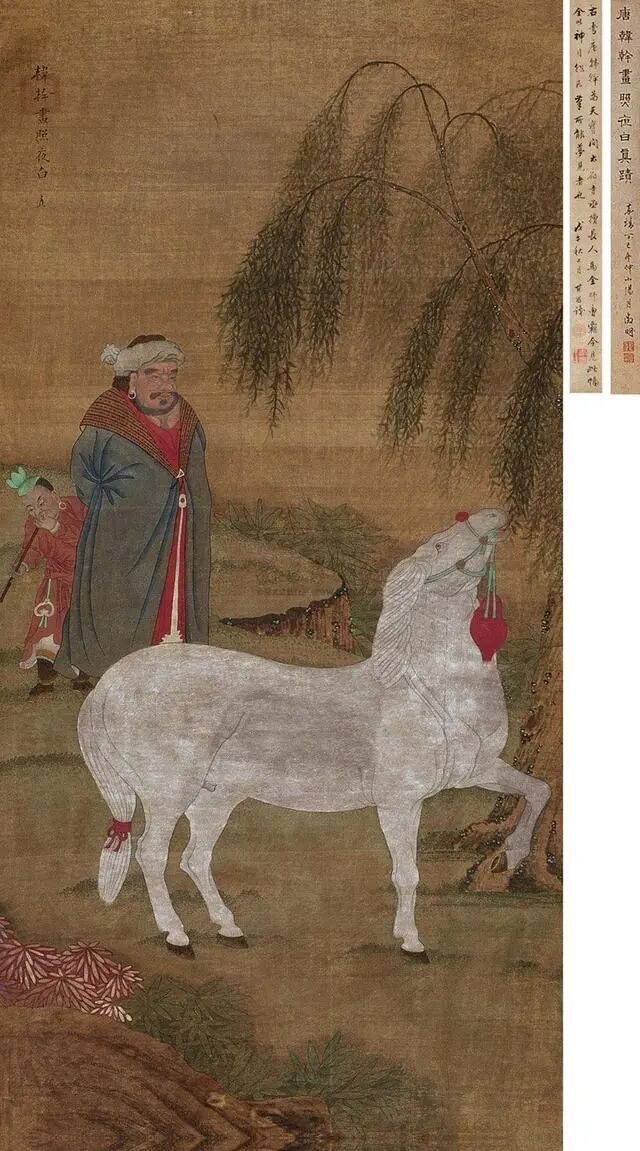
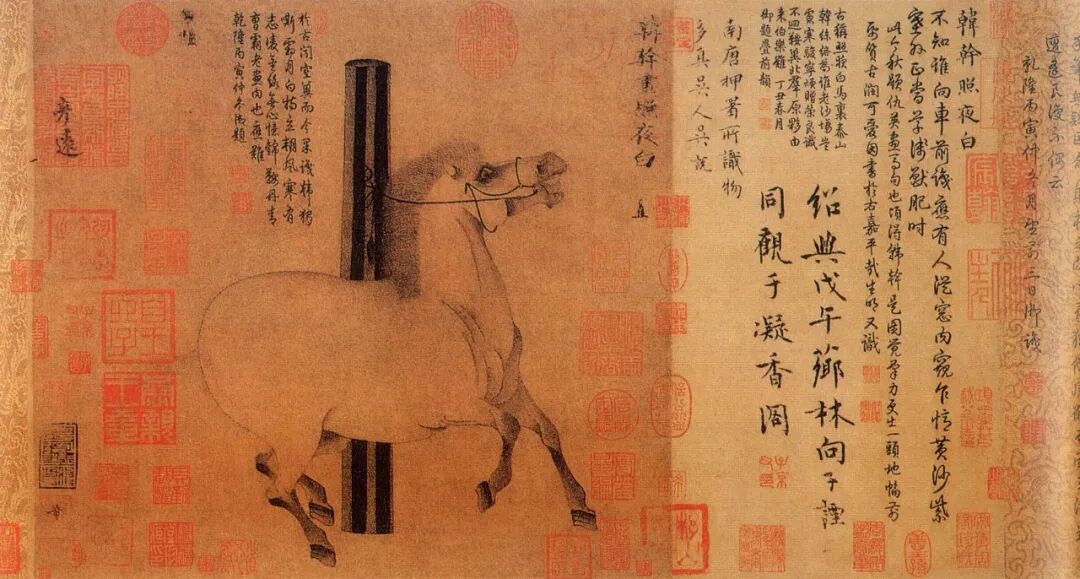
In China’s long painting history, the genre of horse painting has deep roots and constitutes its own system. It was never merely the objective depiction of an animal, but a cultural code intimately bound to imperial power, politics, the military and the literati spirit.
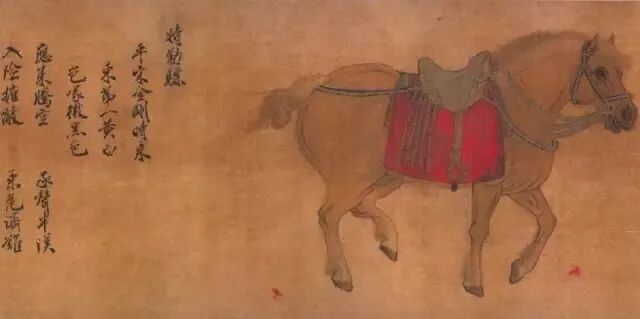
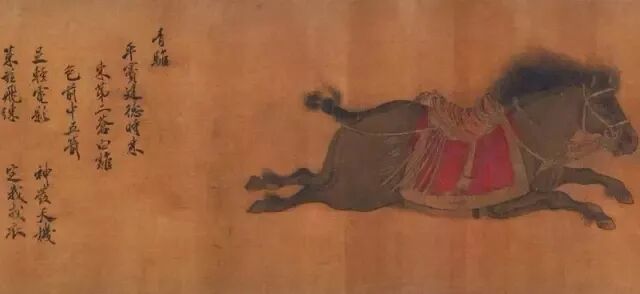
Han Gan of the Tang dynasty was celebrated for painting “flesh horses” — plump, powerful beasts brimming with the spirit of the High Tang, a direct image of an empire at its zenith, when heavenly horses came from the West. His famous painting “Night-Shining White”, though depicting only a fine steed tethered to a post, conveys through its raised head, neighing mouth and straining body a defiant vitality, becoming a model emulated by countless later painters. Han Gan’s horse painting broke through the predecessors’ limitation of painting “the skin” and reached the level of painting “the bone” — where “bone” denotes both anatomical accuracy and an inner, robust spirit.
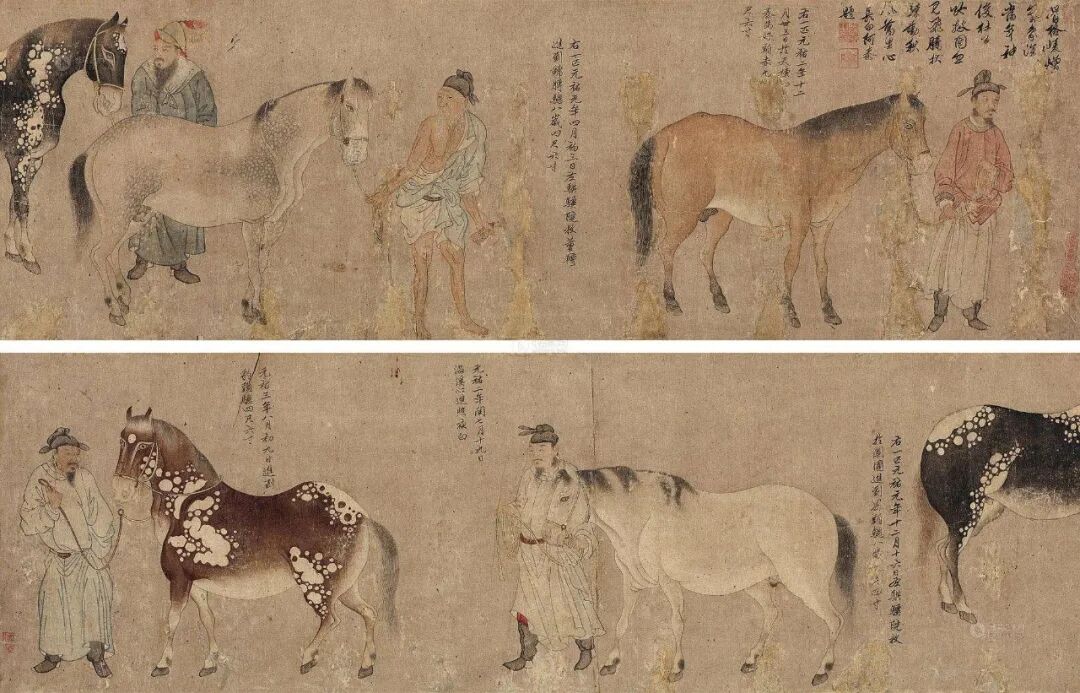

In the Song dynasty, with the rise of literati painting, Li Gonglin brought horse painting to the aesthetic realm of “simplicity and restraint” through his plain-line (bai-miao) technique. In his “Five Horses”, precise yet resilient lines delineate five famous horses presented as tribute from the Western Regions together with their grooms. The form, breed, temperament and even mood of each horse are captured to the full within the most economical ink. At this point the horse, beyond serving as a symbol of imperial territory, also became an object of connoisseurship and appreciation among scholars and gentlemen, its aesthetic value rising ever more prominently.
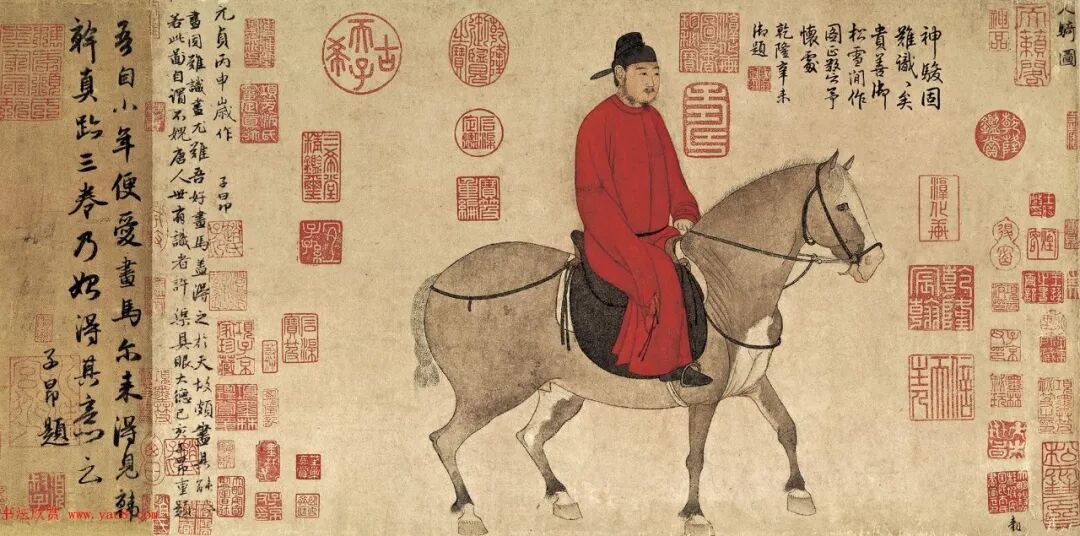
The appearance of Zhao Mengfu in the Yuan dynasty erected yet another monument in the history of horse painting. A descendant of the Song imperial house living under alien rule, Zhao’s state of mind was exceedingly complex. His horse paintings are often read by later generations as harbouring longing for the lost dynasty and an ambivalent attitude toward his own service to the Yuan. In works such as “Man on Horseback” he pursued a return to antiquity, reaching back to the Tang manner; his horses unite the vigour of Tang horses with the refined elegance of the literati. Here the horse becomes a vehicle through which the scholar-official class, in a turbulent age, could entrust their ambitions and settle their souls. As the art historian Wen Fong observed, the turn in Yuan literati painting lay in placing personal feeling and the delight of brush and ink above objective representation, and Zhao’s horses are an exemplary case of exactly this turn.
From Han Gan’s “flesh horse”, Li Gonglin’s “line horse” to Zhao Mengfu’s “heart horse”, the history of Chinese horse painting is a history woven from imperial grandeur, literati integrity and personal feeling. The image of the horse has always oscillated between “formal likeness” and “spiritual resonance”, yet its core function — as a vehicle of power, virtue or emotion — has remained constant. This is the deep tradition that Xu Beihong inherited.
(2) Xu Beihong’s Horses
Xu Beihong’s artistic career coincided with the most turbulent and humiliating period of modern Chinese history. The social Darwinism of the late Qing and early Republic, the May Fourth New Culture Movement’s fierce critique of tradition, and the warlord chaos and foreign invasion that followed together constituted an era calling for the strong, for rebirth, for the revival of national spirit. It was against this backdrop that Xu Beihong set forth his grand aim of “reforming Chinese painting”.
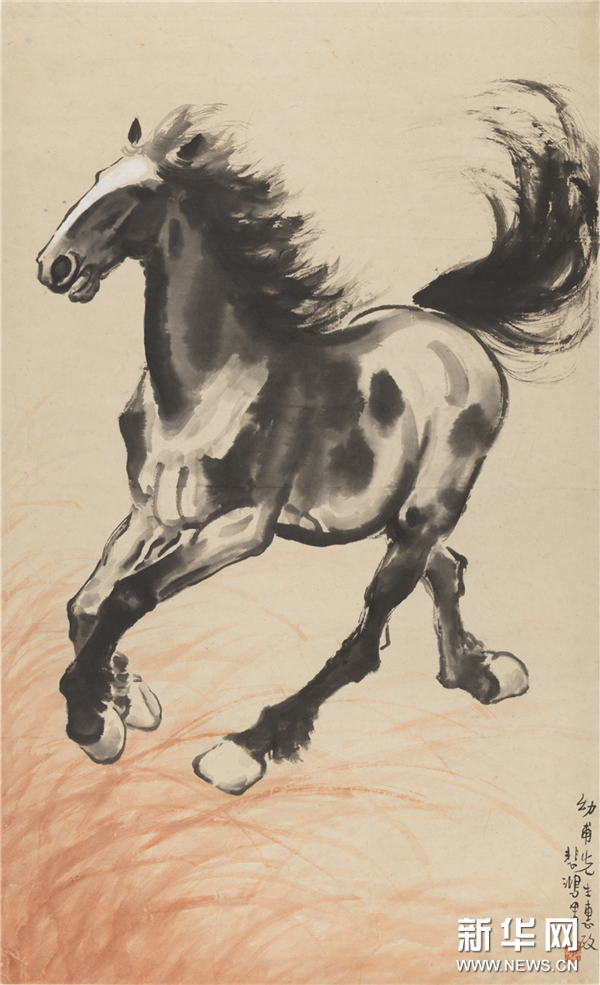
Xu’s horses are the most perfect realisation of his “Chinese–Western fusion” artistic ideal. Unlike traditional painters who relied on copying and formulaic “horse manuals”, he insisted on extensive sketching from life and anatomical study of real horses. This endowed his horses with an unprecedented sense of reality and volume in skeletal structure, muscular movement and the rendering of light and shadow. The art historian Michael Sullivan remarked: “Xu Beihong succeeded in combining the rigour of the European academic tradition with the bold freedom of Chinese brushwork, creating an artistic form both accessible to the public and charged with intense emotional impact.”
The force of this artistic form reached its peak during the War of Resistance against Japan in the 1930s and 1940s. With the nation in peril, Xu poured all his grief and patriotic fervour into the galloping horses beneath his brush. At this point the horse had completely transcended the category of animal; it was the embodiment of the Chinese nation’s unyielding spirit. They gallop in wild wind, they neigh across the open wilderness; their manes fly, their four hooves leave the ground, and their eyes are full of fortitude and defiance. They are warriors charging toward the battlefield, the awakened soul of a nation. In a series of works such as “Galloping Horse” and “Herd of Horses”, Xu often inscribed verses charged with a sense of peril — “It neighs in sorrow, longing to fight; it stands apart, gazing into the vast grey heavens,” “Where shall it go at the world’s end? To grieve at splendid promise spent in vain.” Exhibited in the rear areas, these paintings greatly lifted the morale of soldiers and civilians, performing the social function of “awakening the people and consolidating national consciousness”. In the wartime context these works were endowed with a specific iconographic meaning: through the horse’s “pressing ever forward” they allegorised the war effort’s “perseverance to the end”.
After the founding of the nation, Xu’s horses shifted with the times to symbolise the cheer and exhilaration of New China, brimming with the high socialist-construction spirit. One may say Xu’s horses were tightly bound to the national destiny of twentieth-century China; they are a grand, lucid, positively charged national allegory.
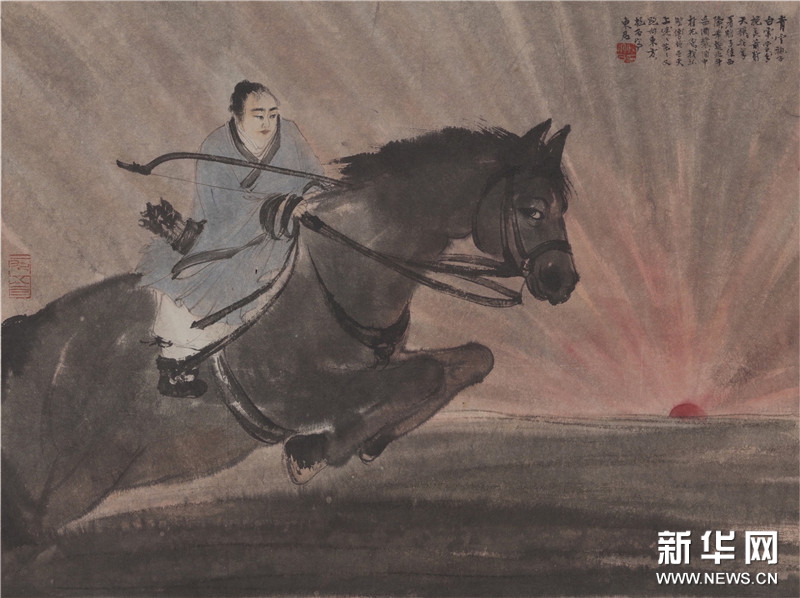
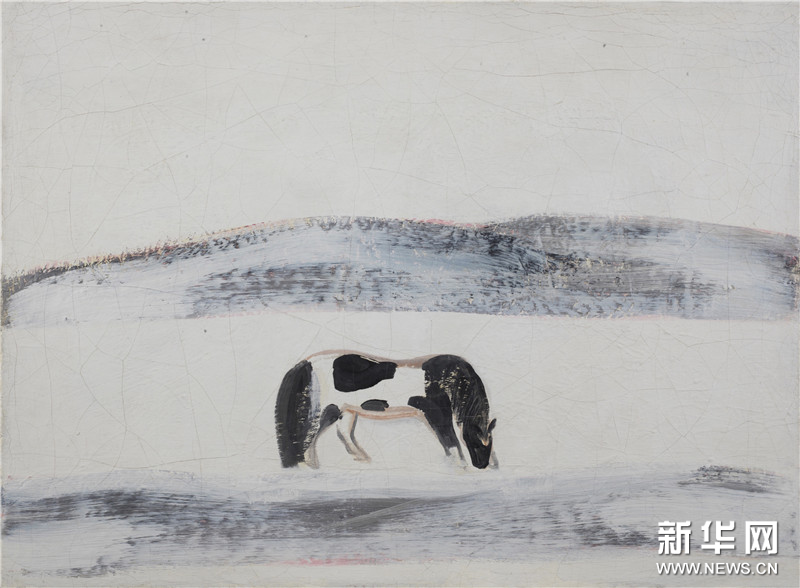
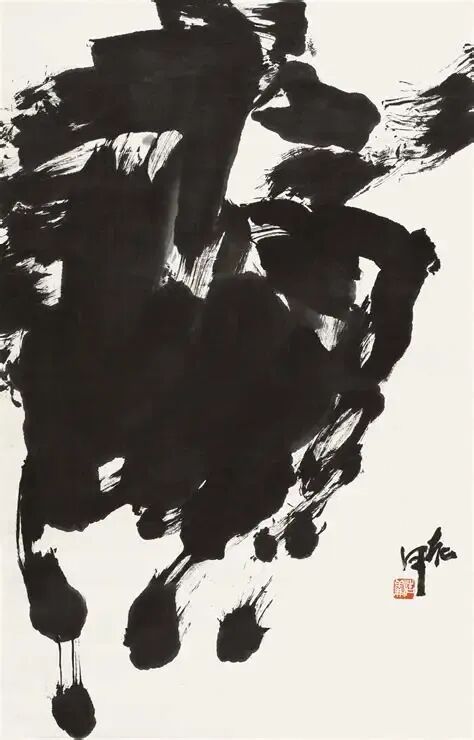
To this day, when we look again at Xu’s horses, we can still be moved by their consummate skill and full-blooded passion. Yet we must soberly recognise that the historical context sustaining this horse’s gallop is gone forever. Now that “salvation and survival” is no longer the theme of the age, and the path of national rejuvenation reveals a far more complex and plural face, the appeal of Xu-style, singular, high-pitched “dragon-horse spirit” symbolism is inevitably diminished.
Within the context of contemporary art, if an artist were merely to imitate Xu Beihong’s style in painting horses, their work would likely be seen as a hollow nostalgia or a reproduction of cheap nationalist symbols. For the vitality of art lies in whether it can respond to the real problems and real feelings of its own time. The anxiety of our era is no longer the collective fear of national extinction, but an identity crisis amid globalisation, a predicament of humanity under technological alienation, spiritual emptiness in a consumer society, and a loss of meaning brought by the information explosion. These complex, inward, even pathologically tinged moods of the age can no longer be simply summarised and borne by a single horse with head held high.
Thus a profound rupture has already occurred. Contemporary artists’ interest in the “horse” is no longer a continuation of the Xu Beihong-style “horse in the painting” as a vehicle of national spirit. They no longer care about rendering the horse “more lifelike” or “more spirited”. Rather, they take the horse as a “vehicle of concept”, a cultural sign that can be taken apart, recombined and interrogated. They attend to the horse’s “objecthood”: its weight, its hide, its skeleton, its very existence. What they want to see is the naked, silent, even suffering creature that remains once the horse has been stripped of all heroism and social halo — and, using it as a mirror, to reflect upon the human condition itself.
III.
If Xu Beihong’s horse is a banner projecting the collective will of the nation, then under the prism of contemporary art the image of the horse is refracted and decomposed, presenting an entirely different spectrum. This spectrum is no longer a single red passion, but comprises profound black (death), pallid white (fragility) and mixed grey (absurdity). Artists no longer look up at the horse’s sublimity, but bend down to scrutinise its body, touch its wounds, feel its temperature and weight. Here, through the key works of three highly representative artists, I explore in depth how the “horse” is transformed from a heroic symbol into a complex medium bearing the anxieties of modernity, the pain of life and civilisational conflict.
We praise the running horse often because we fear standing still; yet under the gaze of contemporary art, it is the hovering, silent horse that comes closest to the truth of our souls. This presupposed assertion will serve as the central thread running through the analysis of this chapter.
(1) Suspension: Maurizio Cattelan, Novecento
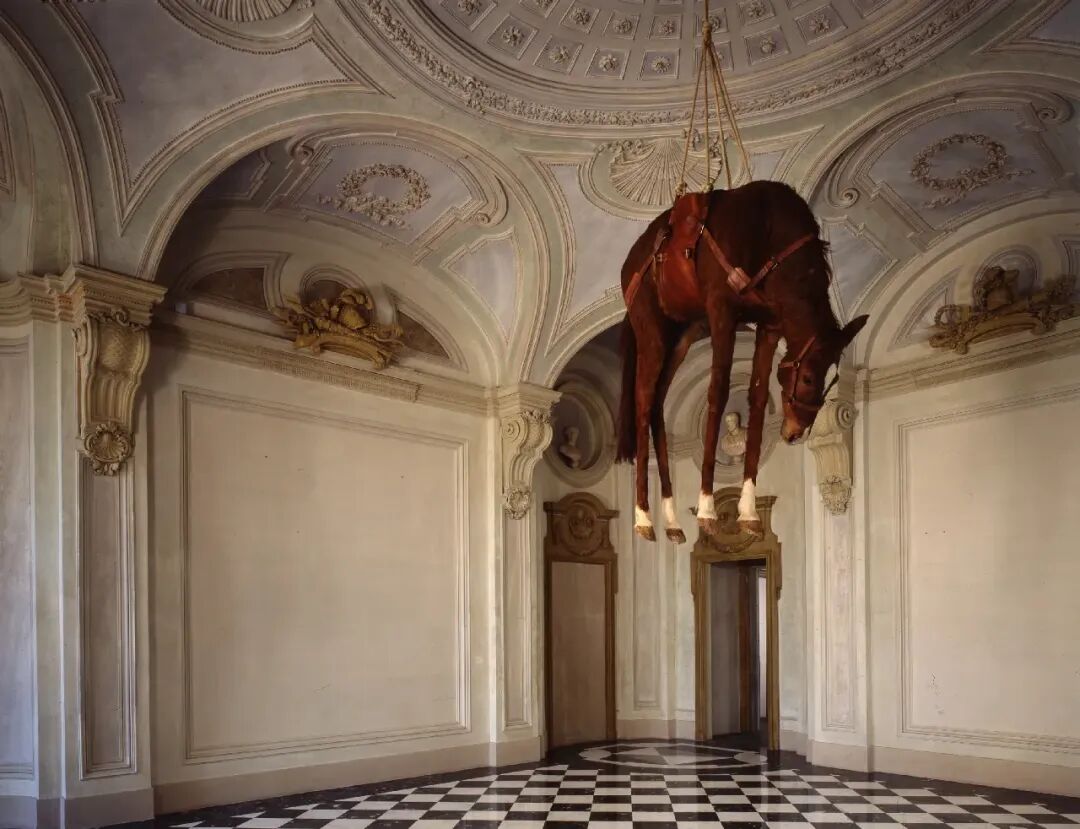
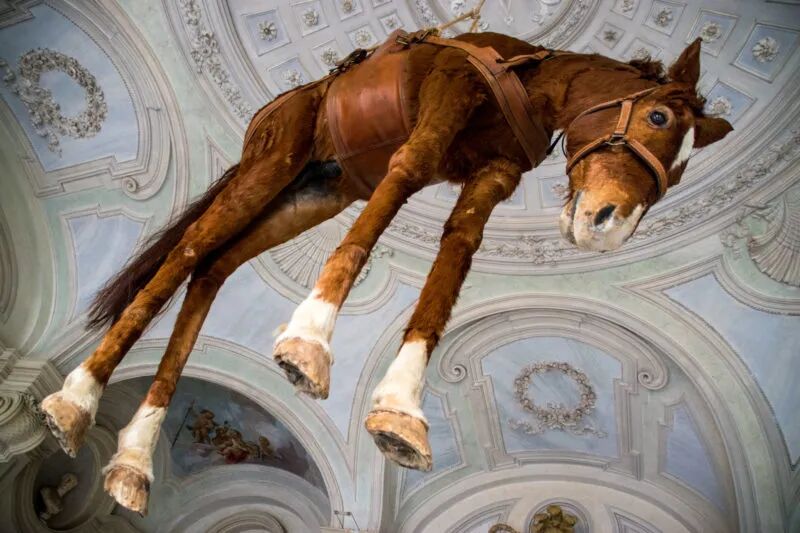
In the work of Italian contemporary artist Maurizio Cattelan, provocation and absurdity are eternal themes. Like a mischievous child or clown of the art world, he uses extremely succinct, playful and even cruel visual language to keep puncturing authority, subverting tradition and mocking the art system itself. Among his many shocking works, the 1997 installation “Novecento”, with its weighty silence and immense tragic sense, occupies an exceptionally special place.
The composition of “Novecento” is deceptively simple: a real horse, taxidermised, is suspended from the ceiling by a set of leather slings, its limbs hanging limply toward the ground. The horse, named “Tiramisù”, had been a prize-winning racehorse. Cattelan had it mounted and, in a near-humiliating manner, suspended it at the centre of a resplendent, Baroque-decorated hall of the Castello di Rivoli museum in Italy. The body is grotesquely elongated by gravity, appearing abnormally gaunt and exhausted, as if all its life-energy had been utterly drained by terrestrial pull. It neither runs nor neighs, nor even struggles. It merely hangs there, like a forgotten old coat, silently bearing its own weight and the gaze of every visitor.
This state of suspension first constitutes, on a physical level, a thorough subversion of the sign of the “horse”. The essence of the horse lies in movement, in its ability to overcome gravity and gallop across the earth. Cattelan, however, deprives it of its most important attribute, placing it in a wholly passive, utterly powerless situation. The art critic Nancy Spector wrote in the catalogue foreword to the Guggenheim Museum’s Cattelan retrospective “All” (2011): “Cattelan’s work often places familiar things in an unstable state, thereby forcing us to re-examine their inherent meanings. The horse in Novecento is a complete dismantling of the monumental image of heroism and strength.”
The title “Novecento” means “the twentieth century” in Italian. The intervention of this title instantly lifts the work’s meaning from an animal spectacle to the level of a grand historical allegory. This exhausted, suspended horse becomes the embodiment of the entire twentieth century.
The twentieth century was a century full of grand ideals and cruel realities. It opened with the optimism of the Enlightenment, believing that reason, science and progress would lead humanity into a bright future. What followed, however, were two world wars, the atrocities of fascism, the Gulag’s camps, the sharp antagonism of ideologies and countless revolutions and failures. Those great narratives that once inspired countless people to advance — communism, nationalism, liberalism — after being tempered in blood and fire, seemed to have exhausted their original energy and revealed their fatigue.
Cattelan’s “Novecento” is precisely a visual capture of the mood of “the end of history” that pervaded the close of that century. This horse symbolises all the utopian ideals and revolutionary passions that once galloped through the twentieth century. Now it hangs in the hall of history, unable to move, a specimen for mourning. Its powerlessness precisely metaphorises the spiritual exhaustion, suspended faith and lost direction that modern people generally felt after a century of upheaval and disillusionment. The French philosopher Jean-François Lyotard defined “postmodern” as a suspicion of “meta-narratives”. Cattelan’s horse is the tragic remnant after the failure of those “meta-narratives”.
Beyond the level of historical allegory, “Novecento” is also a profound portrait of the contemporary individual’s psychic state. That horse hanging in mid-air, touching neither heaven above nor earth below, resembles each of us struggling in modern society.
We live in an age of acceleration, driven by the logic of “higher, faster, stronger”, as if we must run ceaselessly like a perpetual-motion racehorse. Yet beneath endless competition and expectation, many feel a kind of inner suspension. A vast chasm lies between our ideals and reality; the meaning of our work and life often hangs in an uncertain state of suspension. We seem to move forward, yet spiritually we may be strung up by invisible ropes, unable to stir, bearing pressures from all sides and our own weight.
The horse’s silence is a metaphor for modern people’s aphasia. In a clamorous information society, we seem to possess unprecedented channels of expression, yet the anxiety, loneliness and powerlessness deep in our hearts are often hard to put into words. Cattelan’s work, in an extreme, silent manner, provides a visual outlet for this widespread interior experience. It lets us, as we gaze at that powerless beast, see our own reflection: the self who feels utterly exhausted in the small hours, out of place among the crowd, and trapped between advance and retreat on the road of life.
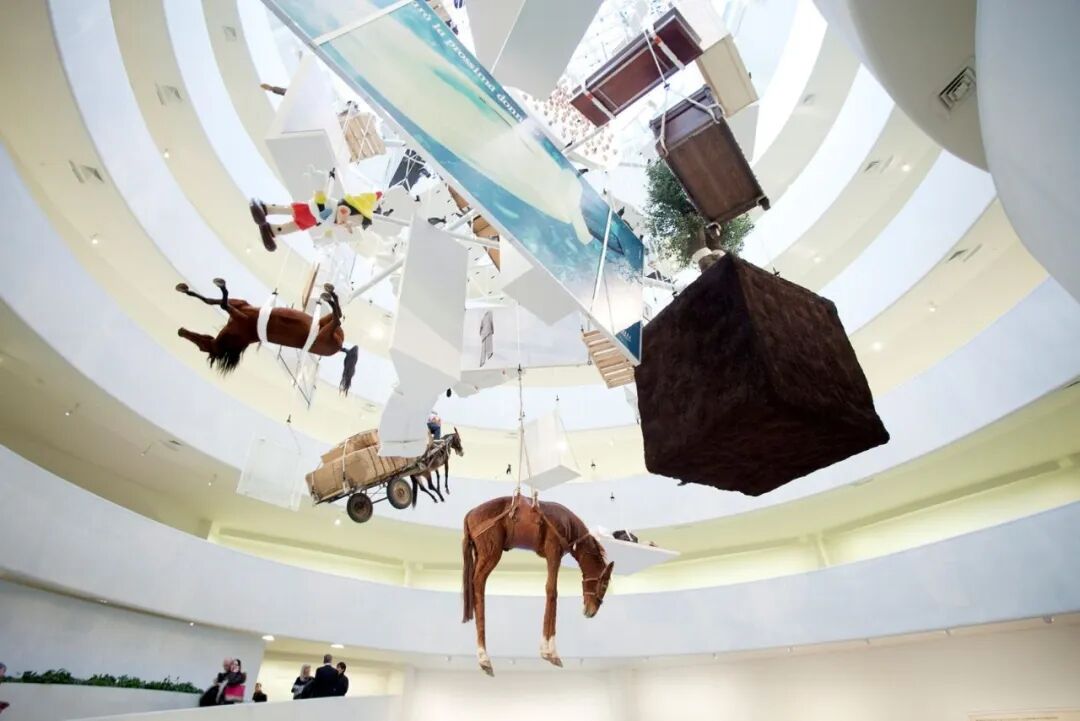
If Cattelan’s horse is a tragic specimen after the collapse of heroic ideals, then the work of Belgian artist Berlinde De Bruyckere leads our gaze to a deeper, more primordial level — that of the naked, suffering flesh once all identity and titles have been stripped away. Her practice, especially her sculptures using the horse as medium, may be called an archaeology of the “skin” of life’s vulnerability.
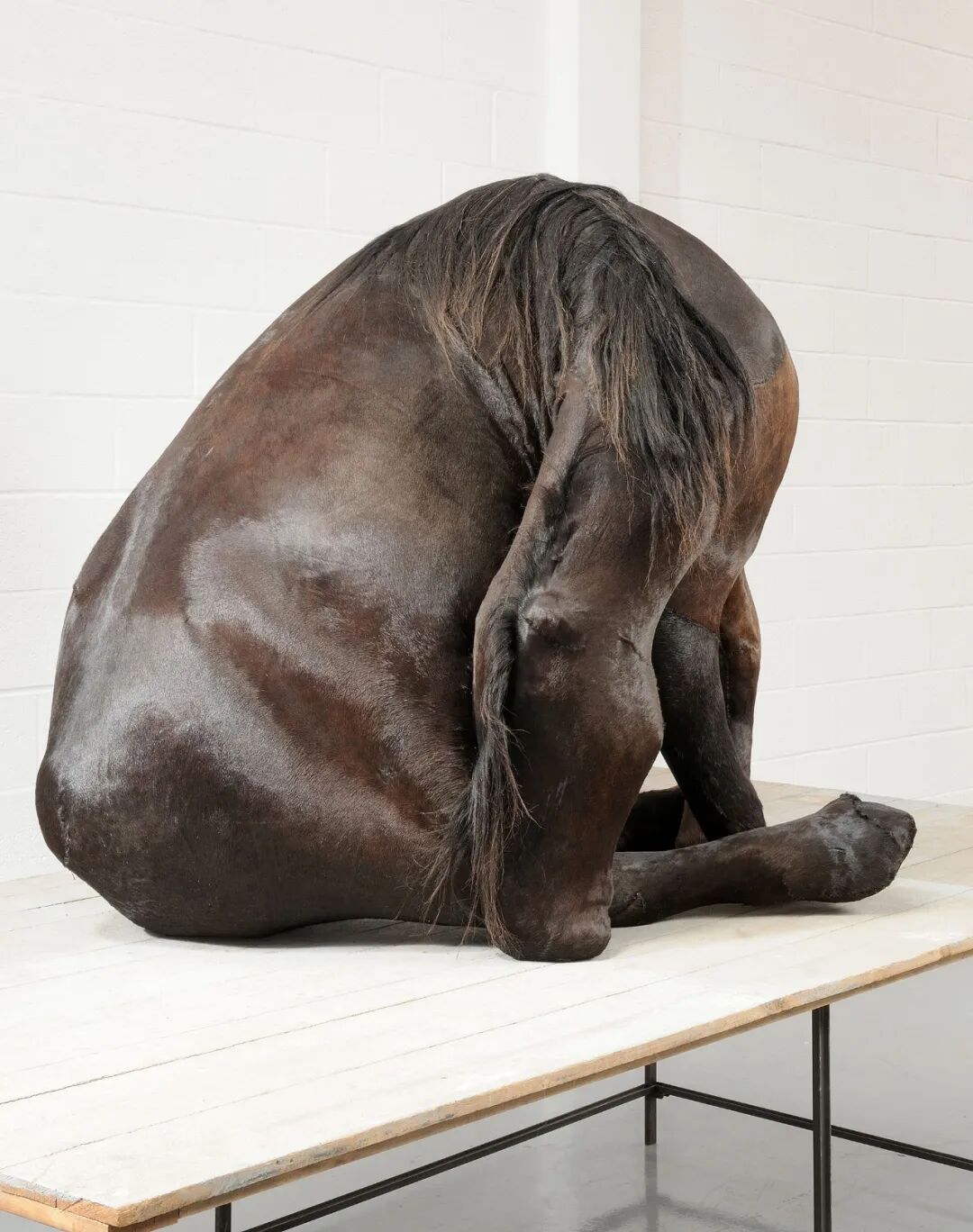
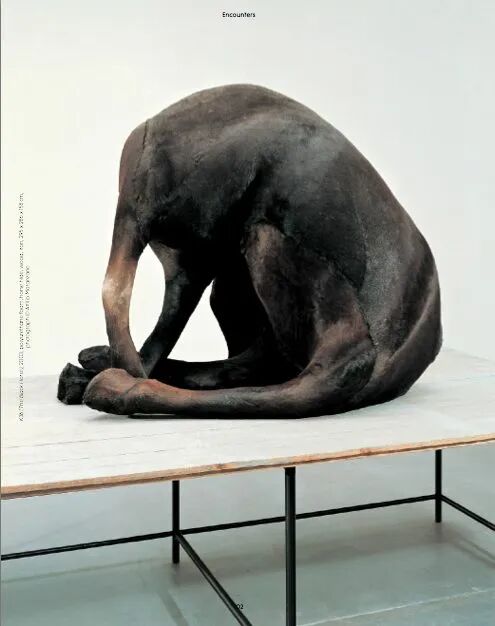
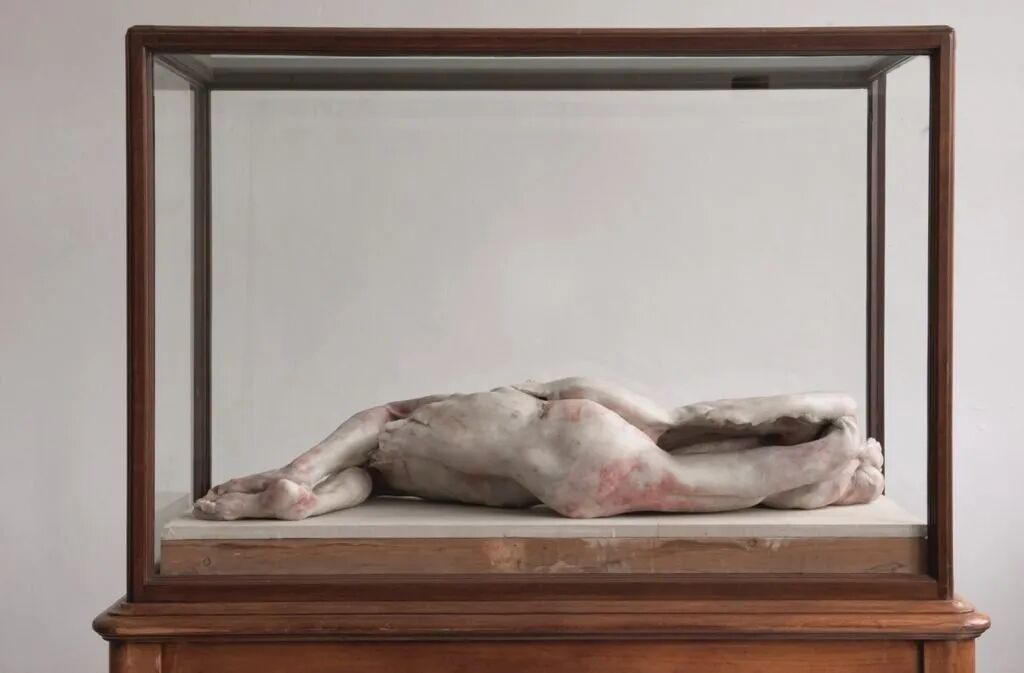
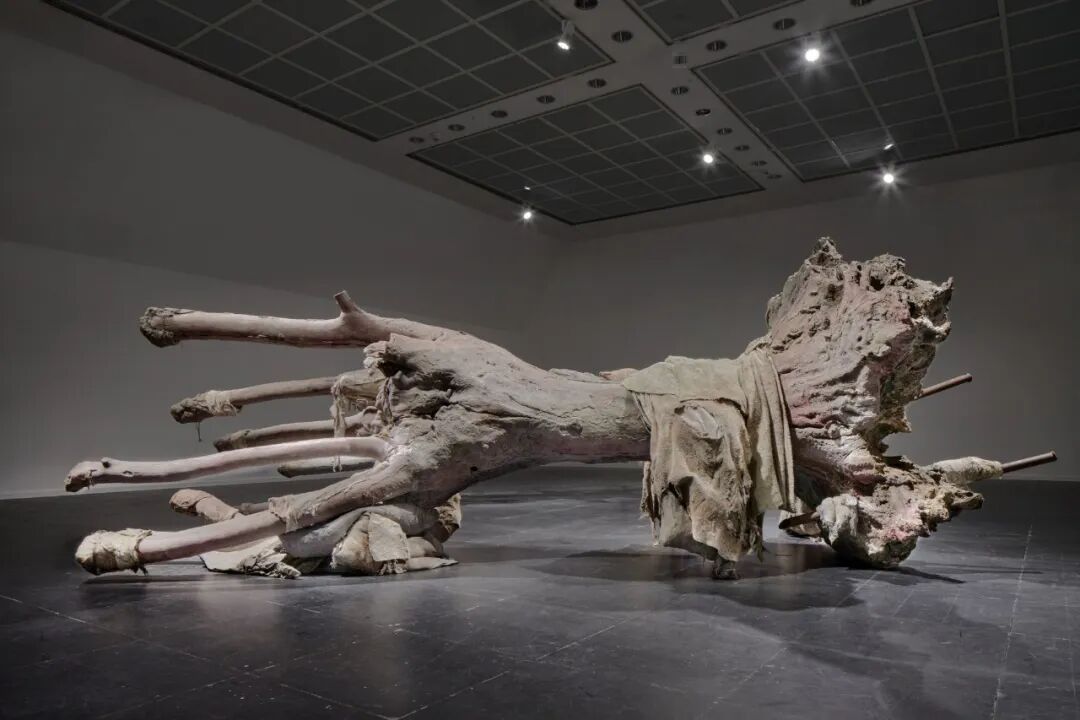
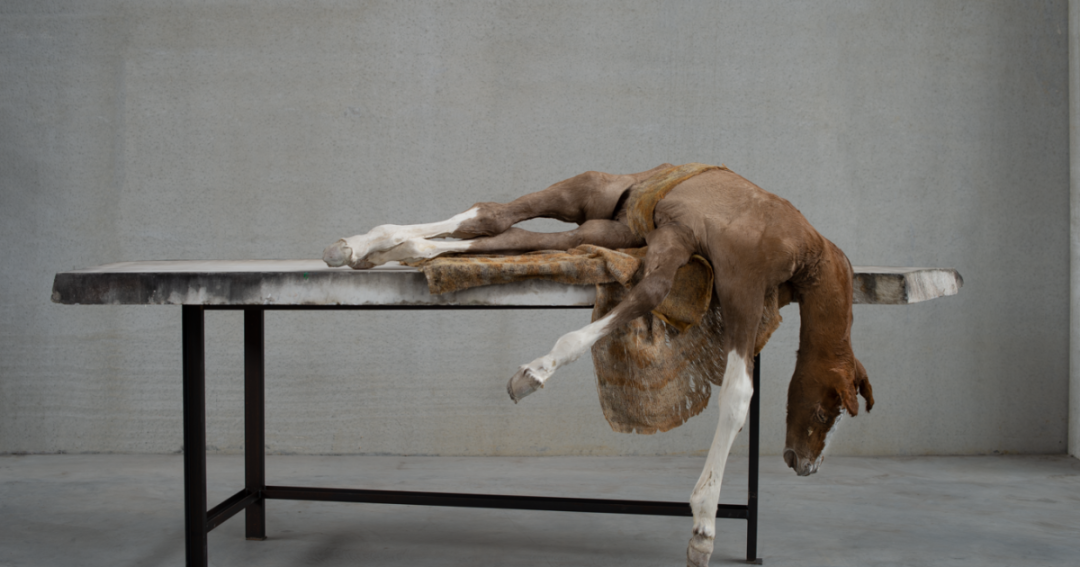
De Bruyckere does not use intact horse taxidermy. Instead, she uses real horsehide, which, after complex treatment, she re-stitches, stacks and distorts like a surgeon or a seamstress, using coarse thread, blankets, wire and wax, finally shaping it into a form at once familiar and strange.
In her work we see no horse head, eyes or hooves; these most recognisable and “spiritual” parts are deliberately hidden or removed. What we see are heaps of anonymous flesh, the folds of skin, traces of blood vessels and stitched scars laid bare without concealment. These “horse bodies” are often placed on crude wooden or iron plinths, at times like slaughterhouse offal casually discarded, at others like sacrificial victims in ancient ritual. At the 2003 Venice Biennale, her “Black Horse” was a giant, headless horse body lying quietly in the exhibition hall, as if having just undergone an unknown catastrophe. And in her “Cripplewood” series, giant, twisted tree trunks interweave with waxen, flesh-like forms; the horse element is further abstracted into a universal, suffering form of life.
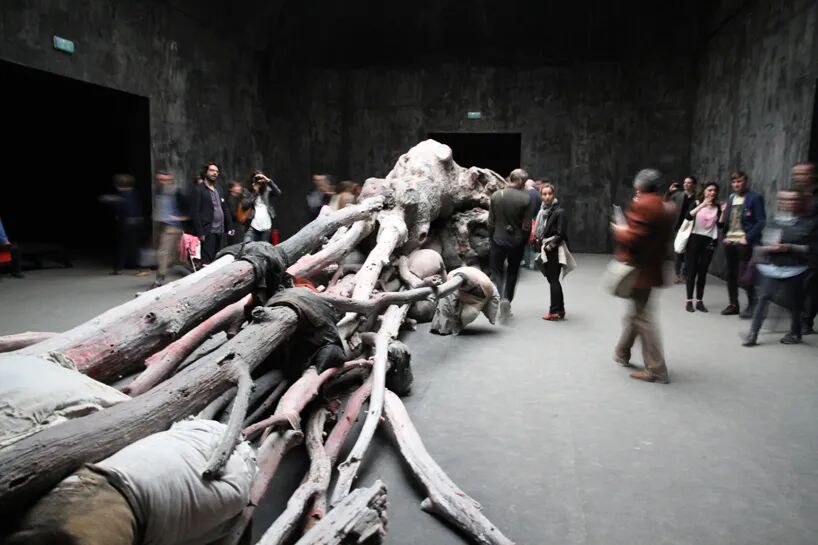
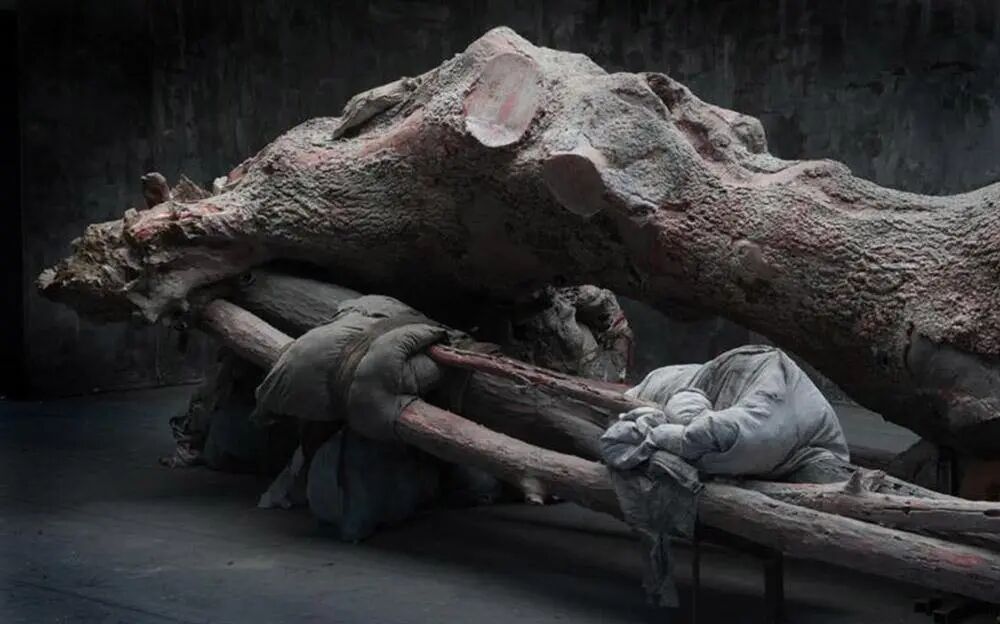
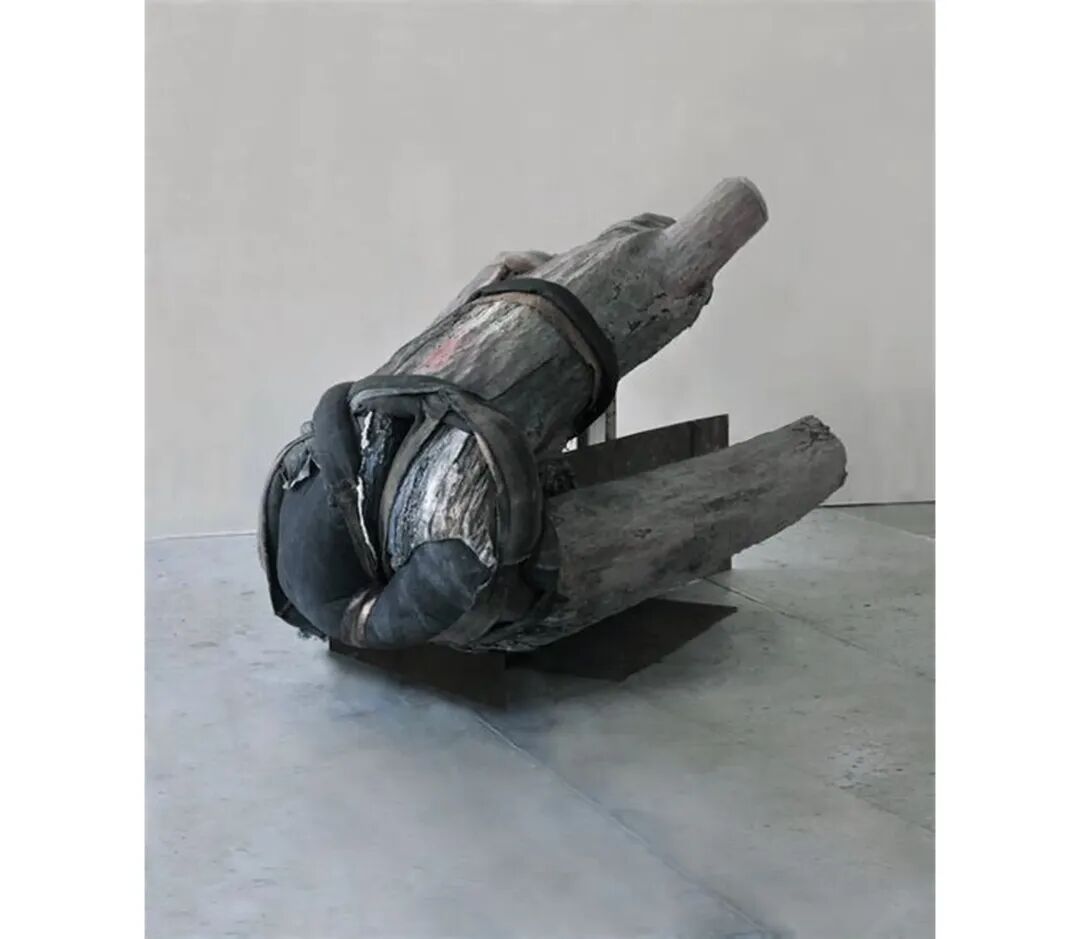
De Bruyckere’s art is, first, a complete stripping of the heroic tradition of the horse. From equestrian statues of ancient Greece, to Renaissance princes, to Xu Beihong’s galloping horses, the horse in Western and Eastern art has long been associated with power, conquest, glory and the divine. What the artist does is systematically dismantle these haloes. By removing the head, she erases the horse’s “individuality” and “spirit”, so that it is no longer a noble “other” to be admired, but merely an anonymous, suffering “body”.
This focus on the body allows her work to transcend the boundary of species and touch a universal experience of suffering. As we gaze at those stitched skins, what we recall is not only the animal’s pain but the vulnerability of we humans ourselves. The wounded soldier in war, the patient in illness, the victim in disaster… the suffering of all lives that endure bodily trauma is essentially shared. De Bruyckere’s horsehide sculptures become a vessel bearing all this pain.
On the other hand, De Bruyckere’s work has an intense materiality and tactility. The horsehide, wax, wool and old blankets she uses carry a warm, organic yet perishable quality. Wax in particular, a material often used in Western religious art for votive offerings, can both imitate the sheen and texture of skin and carry a meaning of freezing and sealing death. Through the use of these materials De Bruyckere creates a blurred zone between life and death, organic and inorganic, attraction and repulsion. The French thinker Julia Kristeva’s theory of “abjection” in “Powers of Horror: An Essay on Abjection” well explains the complex response of viewers before these works. “Abjection” denotes those things we expel from the order of body and culture — corpses, excrement, wounds — which are both part of ourselves and a threat to our identity, thus arousing a contradictory psychology of both fear and fascination. De Bruyckere’s horsehide sculptures are precisely such “abject” objects, forcing us to confront the bodily decay and death that modern civilisation strives to conceal.
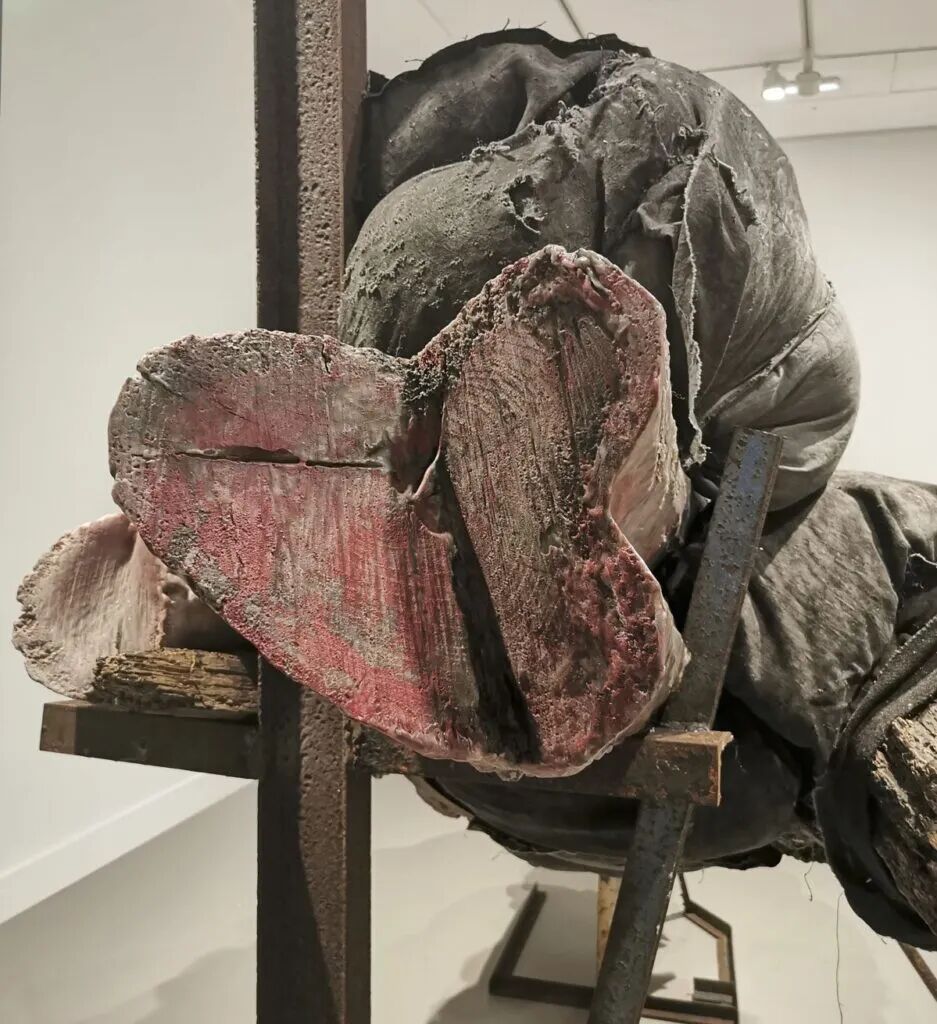
Yet, while representing suffering, De Bruyckere’s work also carries a strange “sacredness”. Her stitching of the wound is both a re-presentation of trauma and a gesture of attempted healing and care. Those quietly reclining bodies, though broken, emanate a serenity and dignity, as if, after extreme suffering, they had reached a certain tranquil transcendence. This recalls the depiction of Christ’s suffering body in Christian art, such as the wounded body of Jesus in Grünewald’s “Isenheim Altarpiece”. In those works, the body’s extreme pain is precisely the path to divine redemption. Likewise, De Bruyckere’s “horse of passion”, through the ultimate presentation of bodily pain, leads us to contemplate such questions as transcendent mercy, sympathy and the dignity of life.
Through De Bruyckere’s hands, the horse is no longer a symbol of spirit, but returns to its most essential material existence — flesh. Yet this flesh, because of the immense suffering it bears and shows, is sublimated into a profound metaphor about the universal predicament of life.
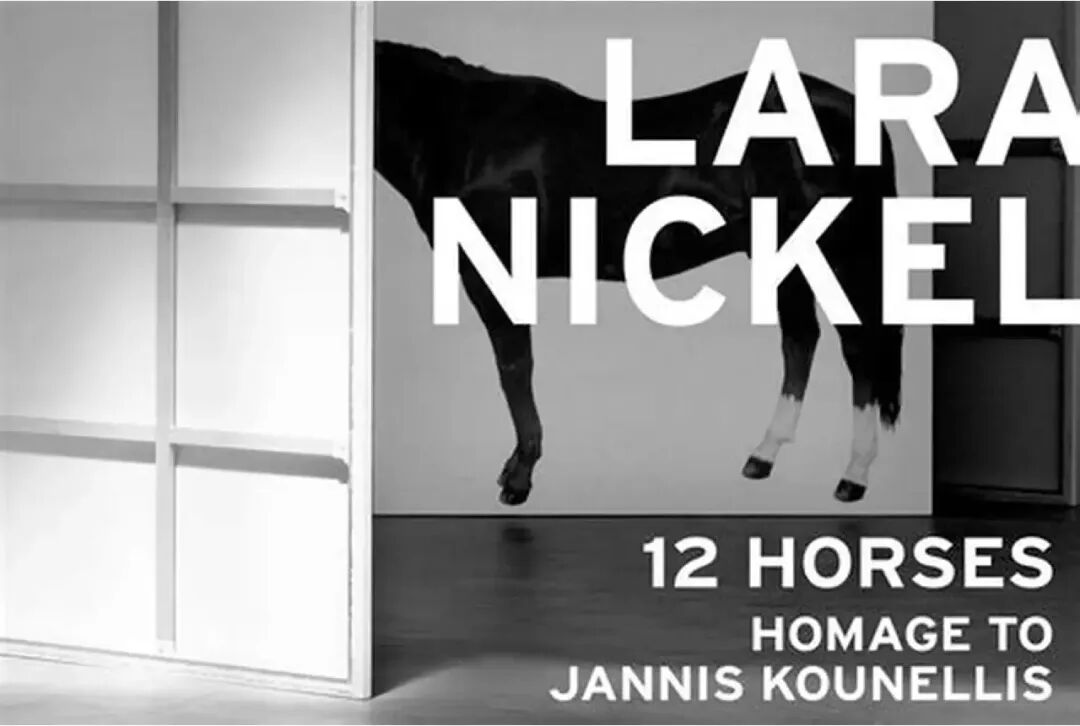
(3) The Invasion of the Wild: Jannis Kounellis, Untitled (Twelve Horses)
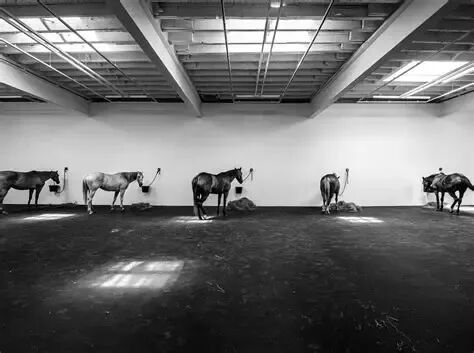
The first two artists dealt with “dead horses” (specimens or hides), whereas the leading figure of Italy’s “Arte Povera” (poor art) movement, Jannis Kounellis, made an even more radical, subversive gesture in 1969: he introduced “living horses” directly into the art space. His work “Untitled (Twelve Horses)” became a milestone in twentieth-century art history that cannot be bypassed; in the most direct, most brutal manner, it explores the tension between nature and culture, life and art.
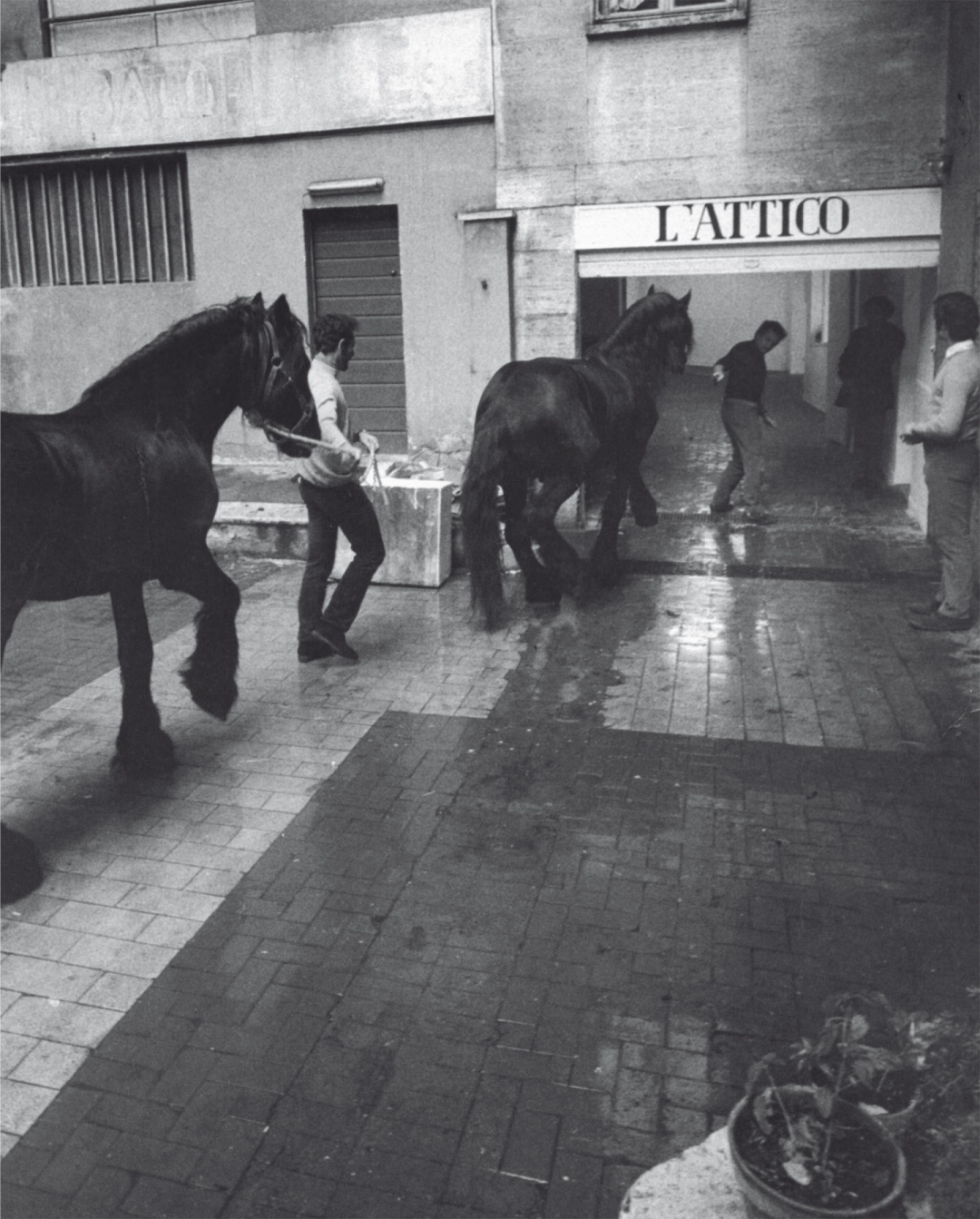
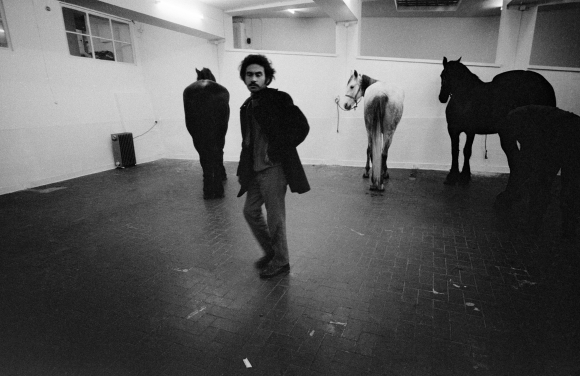
In January 1969, at the L’Attico gallery in Rome — a space converted from a garage — Kounellis realised his “Untitled (Twelve Horses)”. He led twelve live horses of various colours into the gallery and tethered them to cables along the wall, like a scene from classical painting. There was no opening, no paintings, no sculpture — only these twelve living animals. They breathed, neighed, swished their tails, even defecated in the exhibition hall. Entering the gallery, the audience faced no longer a contemplative artwork but a living site charged with smell, sound and unpredictability. The exhibition lasted only three days.
This act caused a huge shock at the time. It directly challenged all definitions of art, gallery and the artist’s role established since modernism. The art historian Germano Celant wrote in his book “Arte Povera” that the aim of artists such as Kounellis was “to cancel any hierarchy or separation between art and life”; by using “poor”, non-traditional materials such as coal, earth, cloth, neon even live animals, they sought to return art to a more primordial, direct and energetic experience of reality.
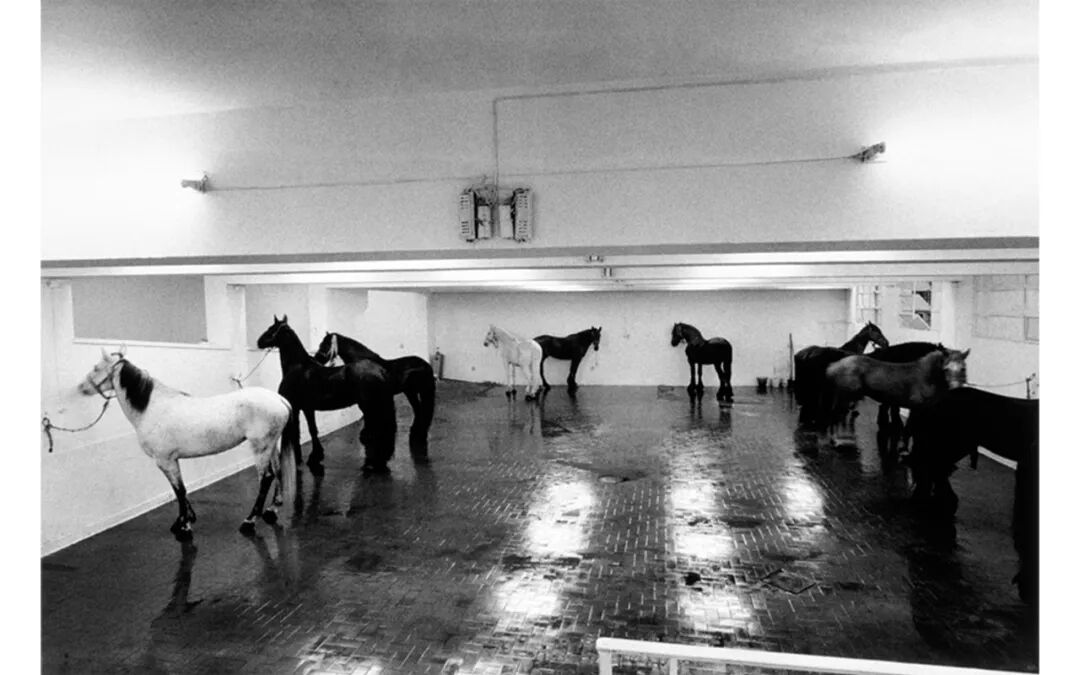
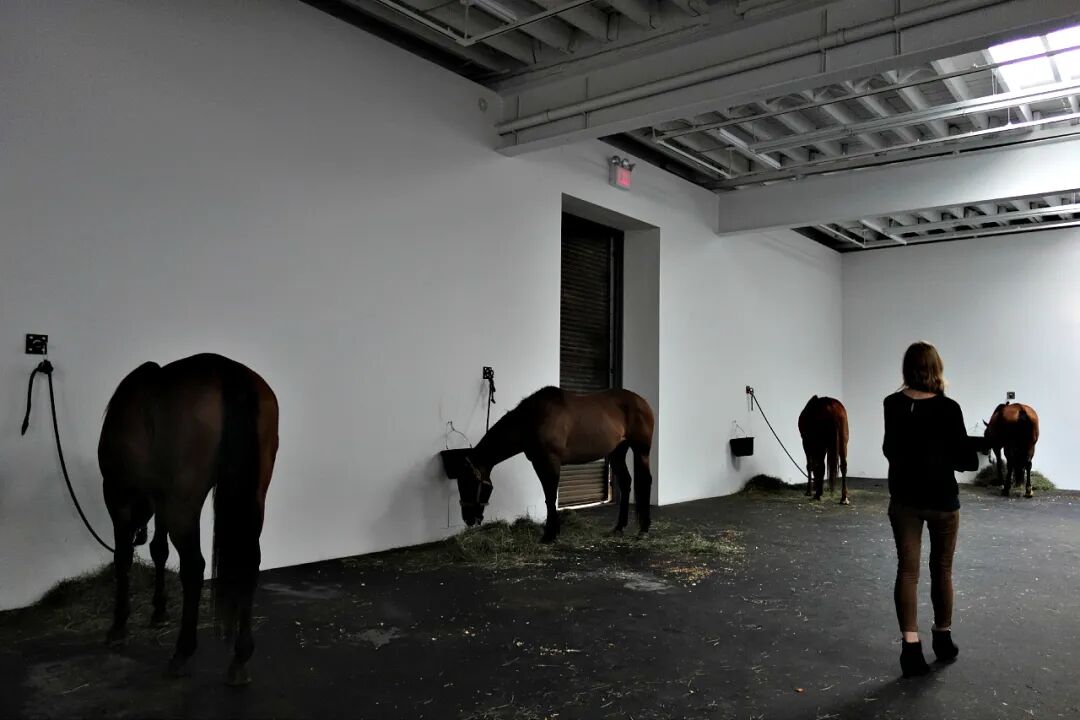
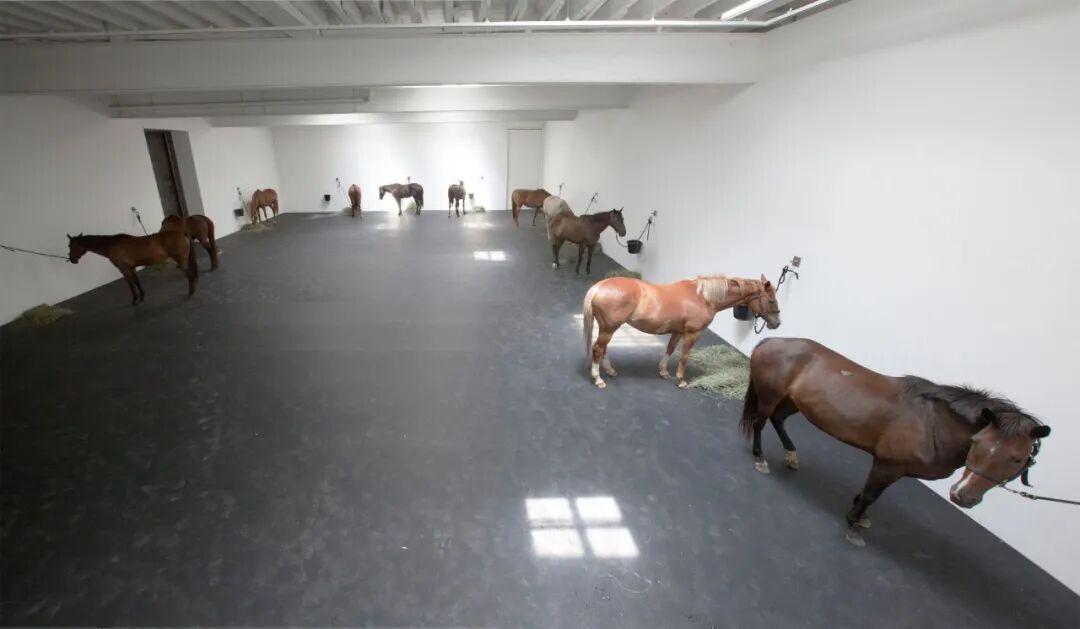
The core idea of “Untitled (Twelve Horses)” lies in the blasting of boundaries. First, it blasts the boundary between “art” and “life”. The gallery in the modern art system is a “sanctuary” highly purified and isolated from the outside world. Here artworks are endowed with a halo; viewers are required to keep quiet and keep their distance. Yet the live horses Kounellis introduced, with their uncontrollable vitality — heat, agitation, smell, excrement — thoroughly polluted this cleanliness and sacredness. The horse, as representative of “nature” or the “pre-cultural”, brutally invaded this refined space symbolising the highest form of “culture”; this act aimed to “restore the natural forces repressed by civilisation”, liberating art from its rigid aesthetic framework.
Second, it blasts the boundary of the artist’s and creator’s identity. In this work Kounellis “created” nothing. He is not a painter depicting the horse with a brush, nor a sculptor shaping it with materials. He is more like a theatre director, or a “presenter of concepts”. All he did was choose a situation (the gallery), some elements (the horses), and set them side by side, letting the tension generated between them “perform” on its own. This continues Duchamp’s notion of the “readymade” — that the core of the artist’s work is no longer manual skill but conceptual choice and the transformation of context. But Kounellis went further: the “readymade” he chose was a living, breathing life.
Art historians such as Giulia Schirripa analyse and point out that “Untitled (Twelve Horses)” also carries profound political allegory. The horse, long a symbol of aristocracy and power in history, saw its status rapidly supplanted by the machine after the Industrial Revolution, reduced to a beast of burden. Introducing the horse into the gallery — a typical middle-class and bourgeois space of consumption — itself constitutes a class provocation. These tethered horses, existing like workers, with their silent yet forceful presence, form a wordless protest against the commercial logic of the art market and the class character of the gallery space.
Moreover, this work is essentially “uncollectable”. When the exhibition ended, the horses were led away, leaving only memory, photographs and a legend. This embodies Arte Povera’s general resistance to the commodification of art. What they pursue is process, is experience, is the instantaneous eruption of energy — not an eternal object that can be appraised and traded.
Through “Untitled (Twelve Horses)”, Kounellis transforms the horse from an object “represented” into a subject directly “presented”. This living horse, with its undeniable material presence, forces art to step down from the wall, down from the plinth, to confront head-on the complexity, conflict and energy of the real world. It is no longer a metaphor for any spirit; it is itself, a wild life imprisoned in a cultural cage.
From Cattelan’s suspended specimen, to De Bruyckere’s stitched hide, to Kounellis’s horses led into the gallery, contemporary art has, through these three prisms, thoroughly decomposed the image of the “horse”. It is no longer a unified, stable, high-spirited sign. It becomes fragmented, suffering, full of contradiction. It is at once an allegory of the end of history, the suffering flesh of the individual, and the site of civilisational conflict. And all these fragmented pieces ultimately point to the true reflection of us humans ourselves in the contemporary predicament.
IV. Having Walked Past the Echoes of History
Having walked past the echoes of history and traversed the unsettling exhibition halls of contemporary art, we return once more to the present of the 2026 Year of the Horse. At this juncture, when we speak of the “horse”, what exactly are we speaking of? If Xu Beihong’s “swift success” feels distant because of the shift in its historical context, and if the artistic explorations of Cattelan and others are too cold and avant-garde for the general public, then what new allegory has the sign of the “horse” evolved into within everyday cultural perception?
(1) The Disenchantment of Speed
For most of the history of human civilisation, the core value of the horse lay in “speed”. It was the fastest land transport, the carrier of information (the post horse), the decisive force in war. The idioms “the horse never stops its hooves” and “spur the swift horse” deeply reflect this worship of speed. Yet since the invention of the internal combustion engine, the advent of cars, trains and aeroplanes has thoroughly dissolved, at the physical level, the horse’s binding to “utmost speed”. By 2026 today, we rely on high-speed rail networks, electric vehicles and instant-messaging software. Speed has been highly technologised and datafied; it no longer needs the horse’s flesh to be realised.
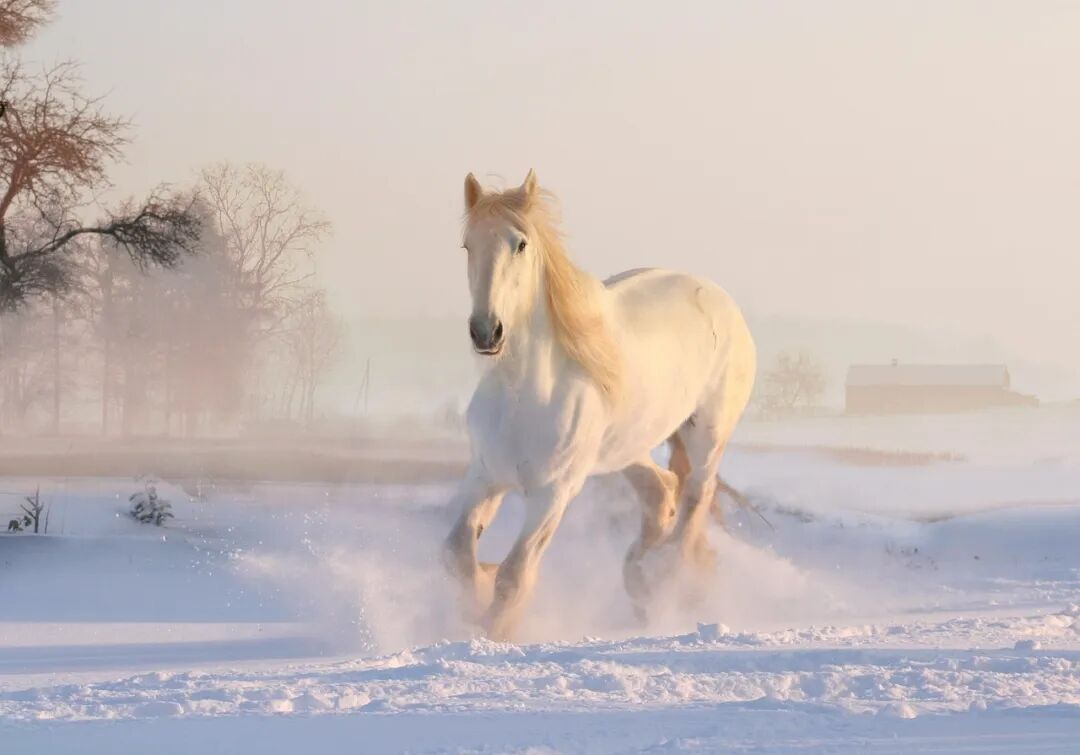
When the horse’s most central practical function is stripped away, its symbolic meaning shifts profoundly accordingly. It is no longer a symbol of “moving forward” and “enterprise”, but increasingly becomes a nostalgic sign that “looks backward”. It represents a pastoral, pre-industrial imagination. When we see a horse, we associate it with vast grasslands, free galloping, the harmonious relation between human and nature. This feeling is essentially a “nostalgia for the wild”.
Modern urban life has highly “domesticated” and “disciplined” each of us. We obey timetables, follow social norms, living on grids and fixed tracks. Our bodies and spirits, to a degree, are like horses put in harness. Thus, when we see an image of a wild horse breaking free and galloping, a strong sense of identification and yearning arises within us. This horse projects our desire to cast off restraint, return to our true selves and release the original vitality of life. It symbolises a “wildness we have lost, or are losing” — one to which we cannot return.
In 1980, the cultural theorist John Berger wrote in his “Why Look at Animals?”: in modern capitalist society, the inexplicable melancholy we feel before zoo animals is because they remind us that the ancient contract once existing between humans and nature is now broken. The process of animals disappearing from our lives is also the process of our own alienation. The horse, as one of the large animals closest to humans, its “departure” and “symbolisation” is precisely the epitome of this grand historical process. Therefore, in 2026 today, the horse no longer represents the speed of the future, but more often represents our romanticised imagination of and deep nostalgia for a “natural” past to which we cannot return.
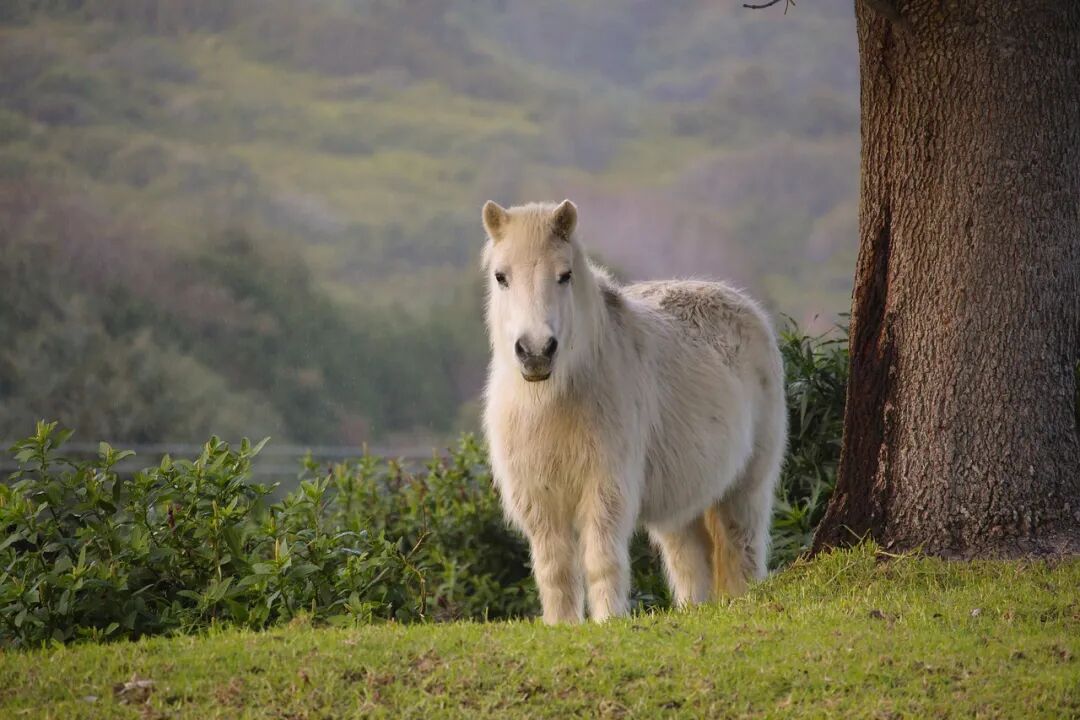
Of course, the horse has not completely vanished from our view. In some highly specialised and ritualised spheres it still plays an important role, the chief among them being sporting competition, such as horse racing and equestrianism. Yet we must recognise that the horses in these spheres are worlds apart from their ancestors on the open range.
The horse on the racetrack is the product of genetic engineering, scientific training and massive capital investment. Its existence has but one purpose: to run faster and win honour and money for its owner. Its life is strictly managed by data — from bloodline and diet to training intensity, everything is precisely controlled. They are machines of speed, pawns of the betting industry. The French thinker Guy Debord said that in late capitalist society real life has been replaced by the “spectacle”, everything turned into images to be watched and consumed. Horse racing is precisely such a typical spectacle. What we see is a meticulously packaged, thrilling performance of speed and power, while the injuries the horses may suffer in brutal training, and their fate after elimination, are skilfully hidden behind the spectacle.
Equestrianism, especially dressage, pushes the control and discipline of the horse to its extreme. This sport is called “the ballet of the horse”, requiring the animal to perform various highly precise and elegant movements that go against its nature. It displays humanity’s absolute control over the animal, the ultimate refinement of transforming wildness into artistic form. Here the horse becomes a “perfect prisoner”; every movement must conform to strict norms, its body an extension of human will and aesthetics.
Whether in racing or equestrianism, the tragedy of the modern sporting horse lies in this: they seem to retain the traits of “running” and “power”, yet this running and power are strictly delimited and exploited by capital and rules. Their wildness is imprisoned by a more refined, more civilised cage. This precisely constitutes yet another metaphor for the modern predicament: we seem to possess the right of free choice, able to “gallop” on the countless “tracks” offered by consumer society, but to what extent are our desires, our goals, our ways of life designed and manipulated by an invisible social system? Are we not also “perfect prisoners” performing a meticulously choreographed “dressage” in the society of the spectacle?
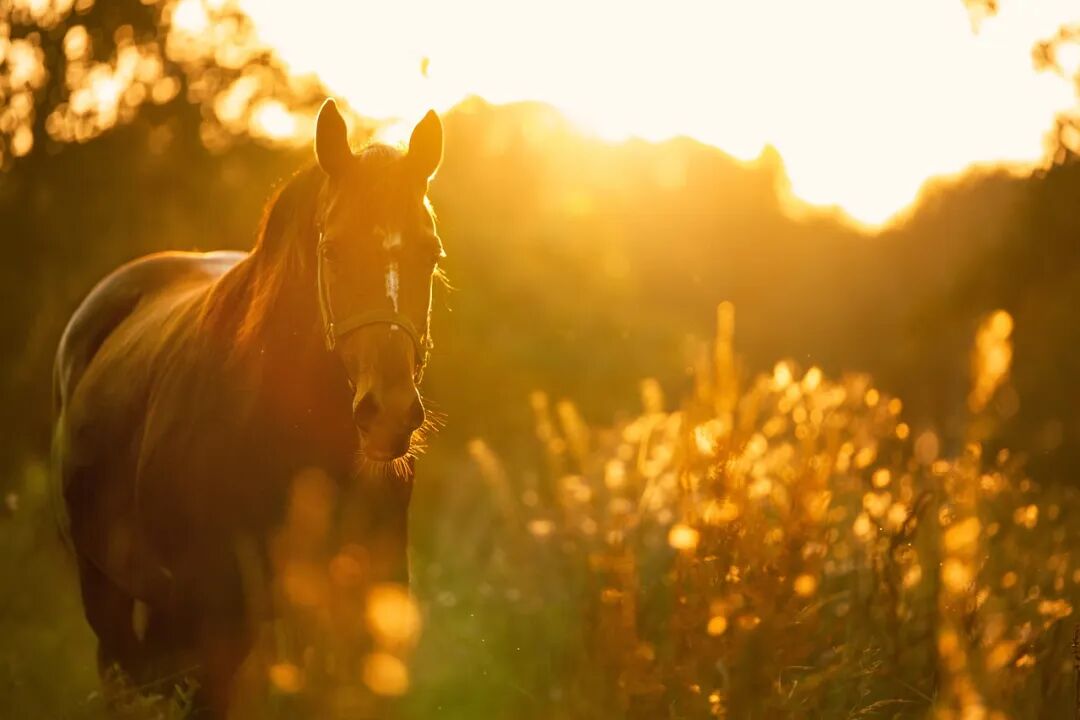
Against this background, looking back at the popularity of the “mood horse” doll (such as the “Crying Horse”) mentioned at the opening, we can better understand the cultural logic behind its traffic.
When the “horse” as a grand-narrative sign of success and power becomes hollow through its disconnection from real life, people begin to seek new emotional connections spontaneously. A horse with a “crying” or “downcast” expression precisely subverts the traditional setting of the “dragon-horse spirit”. It is no longer the forever-high-spirited, forever-forward perfect idol, but an imperfect image that can be sad, tired, emotional.
This image provides contemporary people, especially the young, with an excellent object of emotional projection. Faced with immense social pressure and uncertainty, admitting one’s own vulnerability and expressing negative emotions is no longer a shame but a necessary self-care and psychological adjustment. People embrace the “mood horse” in fact embracing the self that likewise feels powerless, anxious and sad. This marks a shift in the sign-function of the “horse”, from “role model” to “mirror”. We no longer need the horse as our spiritual mentor teaching us how to succeed; we need it more as our spiritual companion affirming the emotional authenticity of our existence.
Thus the new allegory of the 2026 Year of the Horse is a story full of contradiction and tension. It tells how, amid technological progress, we feel nostalgic for a vanished wildness; how, within refined civilisational spectacles, we sense a freedom that is imprisoned; and how, in our alienation from grand narratives, we long to see and soothe our true inner selves through an imperfect sign. This horse no longer gallops toward a certain future, but wanders between past and present, between nature and culture, between public expectation and private feeling. What it bears is precisely the complex and profound collective unconscious of our era.
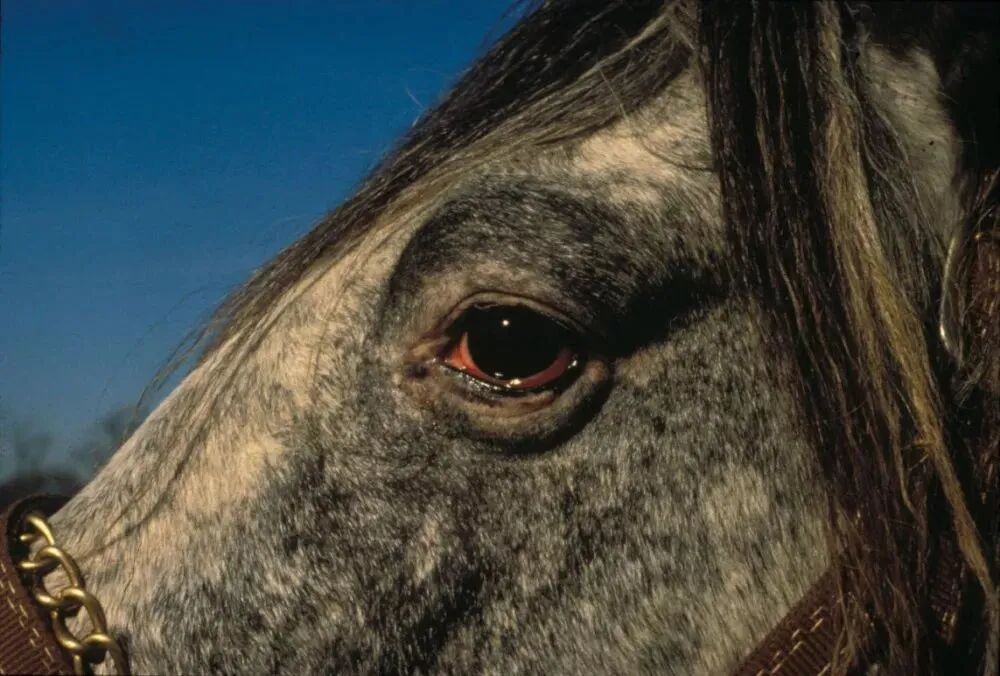
Tonight, as the bells of the 2026 lunar Year of the Horse are about to ring. Amid this feast of signs woven together by traditional wishes, commercial marketing and social media, we have completed a thought-journey across time and space.
Our journey began with the galloping horse in Mr Xu Beihong’s brush — a horse bearing the suffering and hope of an entire nation. Majestic and impassioned, with an unyielding posture, it infused a people in their darkest hour with spiritual strength. This horse is a product of the grand narrative; it clearly points to a unified goal: salvation, survival, national rejuvenation. It is a monument of history, worthy of our eternal remembrance and respect.
Yet when we turn our gaze from the scroll of history to the exhibition halls of contemporary art, we encounter an entirely different scene. Maurizio Cattelan hangs an exhausted horse in mid-air, and with the weight of “Novecento” composes an elegy for a century’s utopian passions, also revealing modern people’s anxiety over suspended faith. Berlinde De Bruyckere strips the horse’s hide and re-stitches it into suffering bodies, forcing us to confront life’s vulnerability and shared pain, dissolving heroism entirely into the reality of flesh and blood. And Jannis Kounellis goes further still: he leads twelve live horses directly into the gallery, and with the intrusion of living bodies blasts the boundary between art and life, nature and culture, staging a live drama of civilisational conflict and institutional critique.
From a banner, to a specimen, a body, an intruder — the image of the “horse” is ruthlessly deconstructed under the gaze of contemporary art. It no longer offers simple answers or cheap comfort, but raises a series of complex and sharp questions. It is no longer a totem we look up to, but more like a shattered mirror that, from different angles, refracts our own predicaments: the sense of an ending of history, the feeling of powerlessness in existence, the vulnerability of the body, and the repression of and nostalgia for wildness in a highly civilised society.
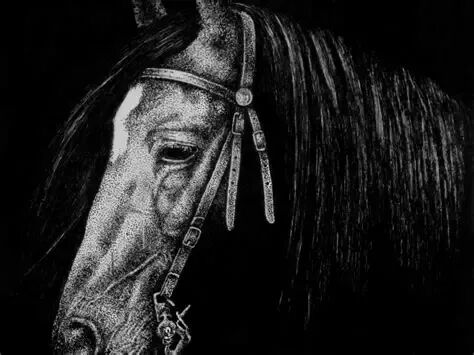
Tonight, when we again send or receive the blessing “may success arrive with the horse” in our social-media circles, perhaps we can add a further layer of thought. In an age whose speed is long since defined by algorithms and chips, the “horse” we truly desire may no longer be that utilitarian mount that helps us run faster on the worldly track. For victory on that track may, like an equestrian performance, be a refined and disciplined success, a “perfection” bought at the cost of repressing part of our nature.
The value of contemporary art precisely lies in offering us another possibility. It reminds us that within that hovering, silent horse, within that scarred body, within that beast that breaks into the gallery and disturbs all order, there resides a more authentic power. It is a power that dares to face failure, a power that dares to admit vulnerability, a power that challenges established rules and preserves the original vitality of life.
Therefore, on this New Year’s Eve of the Year of the Horse, as we bid farewell to the past and welcome new life, the wish I most want to offer is this: may each of us, while chasing “success” in its worldly sense, also carefully guard the “wild horse” within our hearts.
May we retain an untamed curiosity and passion, a courage to deviate from the track, an ability to keep silence and introspection amid the clamour, and a sympathy sensitive to the pain of ourselves and others. For what truly drives us across the wilderness of life is perhaps not the obsession with “swift success”, but that unbridled, wild power arising from life itself.
In the new year, may the wild horse within your heart gallop freely; happy New Year to all!
订阅艺术评论
订阅即赠《2024中国当代艺术关键词》内部思考笔记 PDF
每周免费获取最新当代艺术批评与研究