I. In the Late 1970s
In the late 1970s, when the sculptor Antony Gormley graduated from the Slade School of Fine Art, part of University College London, figurative sculpture had in some sense already ‘died’. Looking back at that moment, the Minimalists—with Donald Judd’s boxes and Carl Andre’s bricks—had stripped sculpture of its narrativity and emotionality, reducing it to a pure dialogue between object and space. Conceptual art went further still, shifting the core of art away from its material vehicle and toward the idea itself; Sol LeWitt’s wall drawings could be executed by others following instructions, and the artwork could even be a purely verbal description. In an era when the logic of the readymade held sway over vanguard discourse, fashioning a bronze or plaster ‘figure’ was widely regarded as a betrayal of the modernist project—an outmoded, even reactionary, academic gesture. Already then, the art historian Rosalind Krauss, in her essay *Sculpture in the Expanded Field*, had declared that sculpture was no longer an isolated monument but a complex relational term between architecture and non-architecture, landscape and non-landscape.
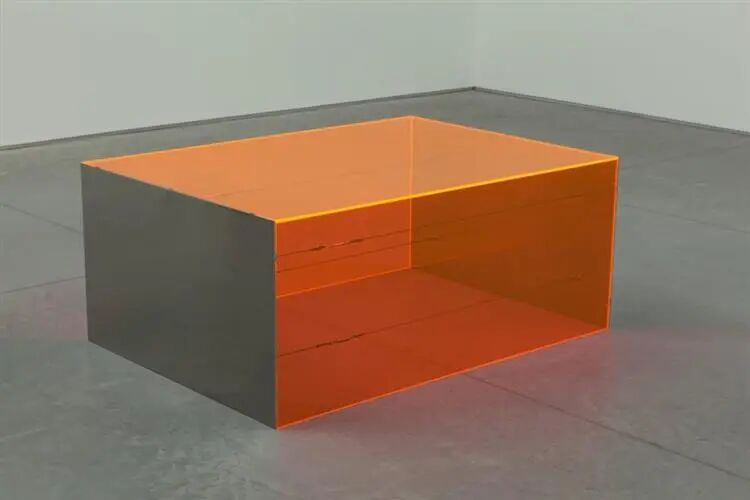
Confronted with this historical context, any artist attempting to reclaim the ‘human form’ faced a formidable theoretical impasse. Gormley’s first core contribution, then, lies precisely in the fact that he did not try to circumvent or repudiate the legacy of Minimalism and Conceptual art, but traversed it in a startling manner. He did not retreat into Rodinesque emotional expressionism or Henry Moore-style organic abstraction; rather, he absorbed deeply the coldness, objectivity, and industrial logic of Minimalism, and riskily reinstated the banished theme of the ‘body’ within it. He accepted sculpture’s ‘objecthood’, but the ‘thing’ he wished to investigate was a special kind of object: the human body—the sole material reality in which we dwell.
For practitioners today, Gormley’s point of departure offers a crucial lesson: the innovation each of us confronts as artistic workers often need not arise from blind adherence to avant-garde trends, but from the recontextualisation of ‘outmoded’ forms. He demonstrated that an artistic motif seemingly exhausted can, upon collision with new philosophical thought, a new material language, and the spirit of the age, erupt with subversive energy. Thus he did not ‘depict’ the body; he deployed the body itself as an instrument of inquiry, a device for measuring the world—and this became the cornerstone of his entire artistic practice.
II. How Gormley Escaped the Trap of Expressionism in His Early Years (1980s)
(1) The Mould as an Anti-Portrait Strategy
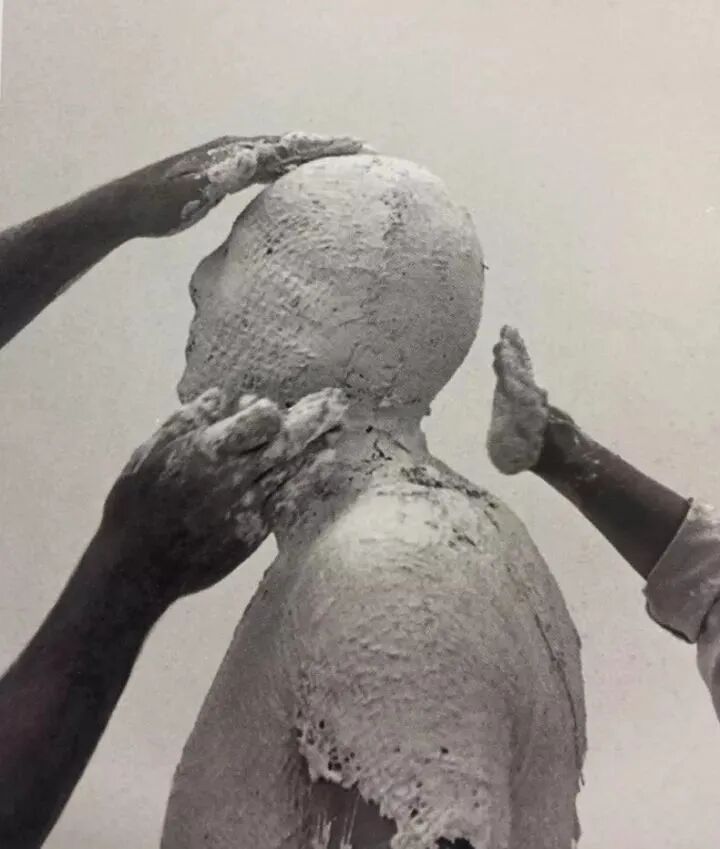
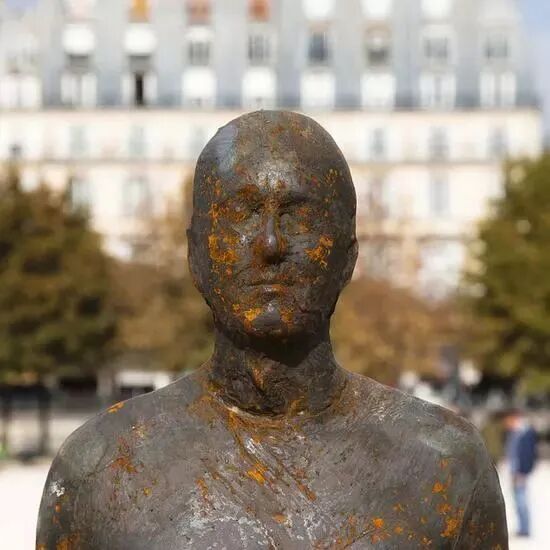
Gormley’s most famous and most revolutionary early strategy was to use his own body as the starting point and the mould for his work. On the surface this appears an act of extreme narcissism, recalling Yves Klein’s performances in which the female body served as a ‘living brush’. Yet Gormley’s intent is exactly the opposite: this is a radical strategy of ‘de-individuation’ and ‘anti-portraiture’.
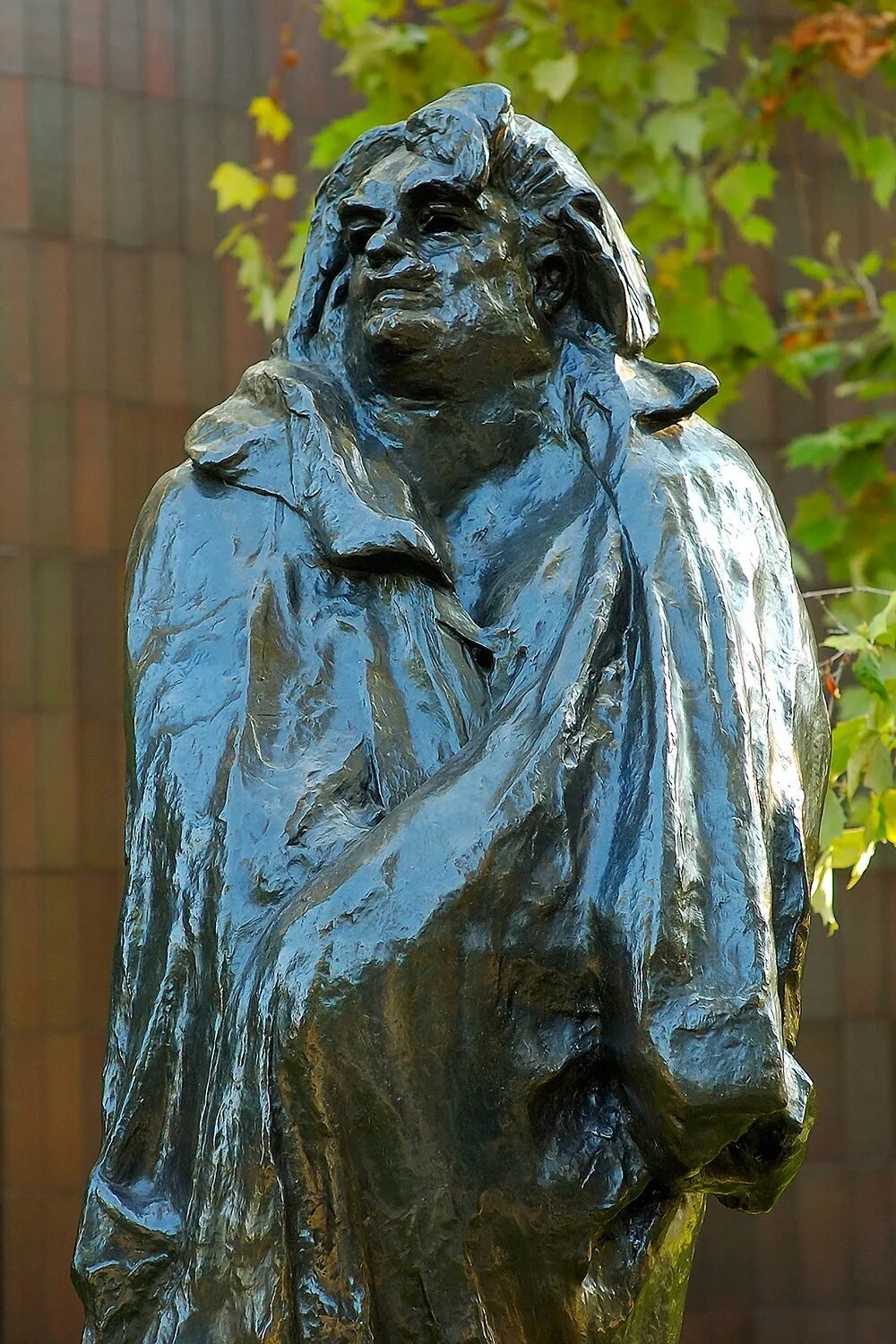
Traditional figurative sculpture—whether Michelangelo’s *David* or Rodin’s *The Thinker*—is fundamentally concerned with ‘representation’ and ‘expression’. Through exceptional hand–eye coordination, the artist observes a model from without and then imitates, in clay, plaster, or marble, the tension of muscle, the structure of bone, and even the sitter’s inner emotion. It is a process of translation, saturated throughout with the artist’s subjective judgement and stylistic signature.
Through direct casting, Gormley bypasses entirely the two stages of ‘imitation’ and ‘expression’. He wraps his own body tightly in cling film, coats it with plaster, and waits in darkness and confinement for it to set. This process is itself an extreme bodily experience, a perception of interior space. When the mould is removed, what it records is not Gormley’s face or emotion, but the physical trace of the space his body once occupied at a specific moment. In the theory of the semiotician Charles Sanders Peirce, a sign produced by physical causality is called an ‘index’—as smoke is to fire, or a footprint to a foot. Gormley’s works are thus neither ‘images’ nor ‘symbols’ of his body, but direct evidence that his body once existed. He himself explicitly uses the term ‘index’ to describe his works, emphasising that, like a fingerprint, they record an activated trace.
Gormley turned his own body into a kind of ‘readymade’, yet one distinct from Duchamp’s urinal. Duchamp chose an industrial product; Gormley chose a biological ‘product’ that everyone possesses. By shifting the creative process of sculpture from a vision-led mode of ‘modelling the external world’ to an ontological mode of ‘experiencing existence from within’, he injected a phenomenological dimension into sculpture. As the phenomenologist Merleau-Ponty insisted, the world is not first ‘thought’ by us, but ‘perceived’ and ‘inhabited’. Gormley’s sculpture is precisely the materialisation of this state of ‘dwelling’.
This can serve as a lesson: when you seek to express the universal, you may begin from the most specific self, yet employ a method that strips away ‘personality’. Gormley’s body in his sculpture is never ‘Antony’s body’, but a generic ‘human vessel’ from which all individualising traits have been erased. Through this means, by using first-person material (his own body), he ultimately achieves a third-person objectivity and universality.
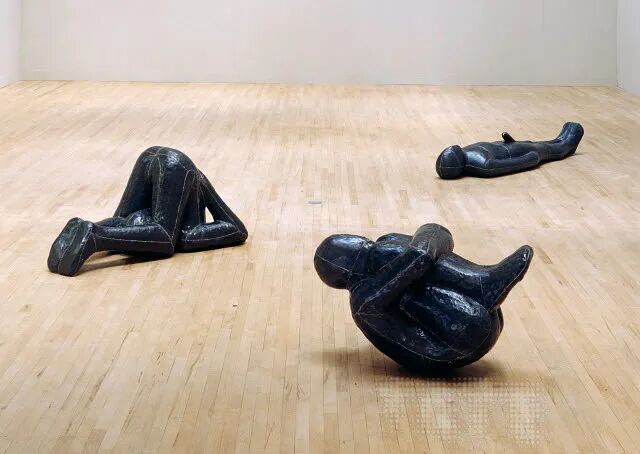
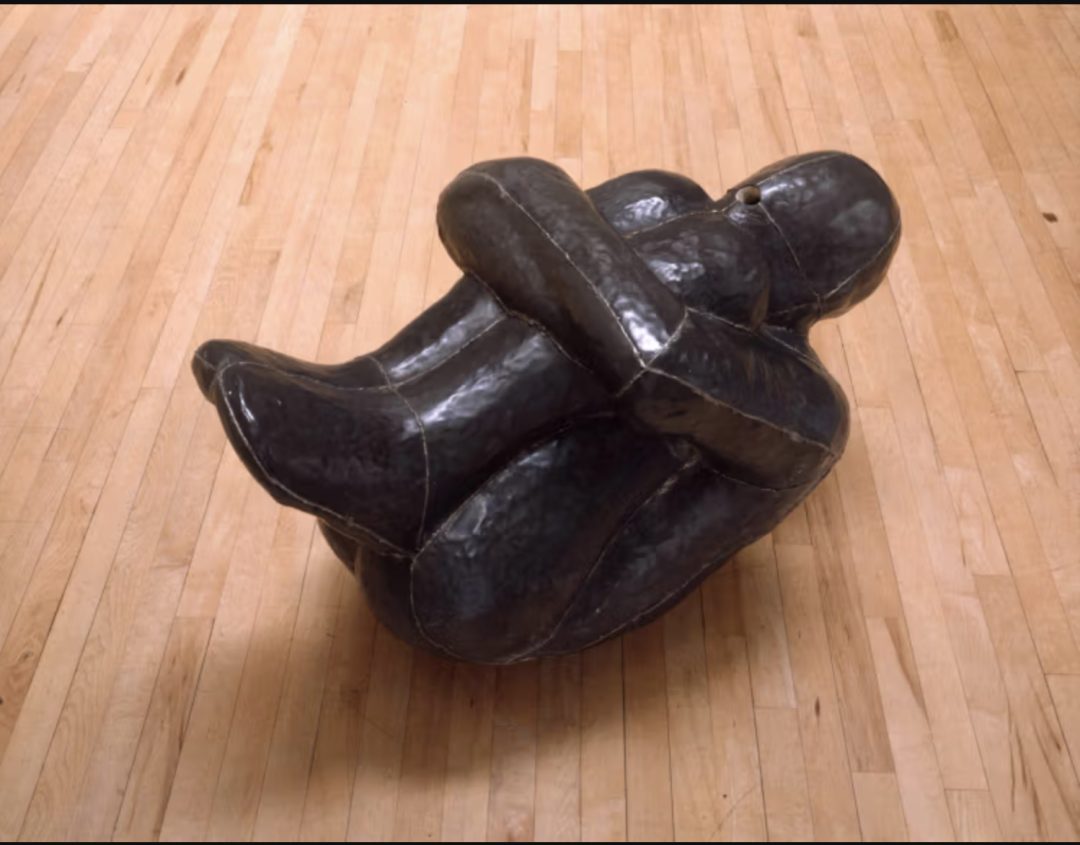
(2) The Skin of Lead and the Anxiety of the Nuclear Age
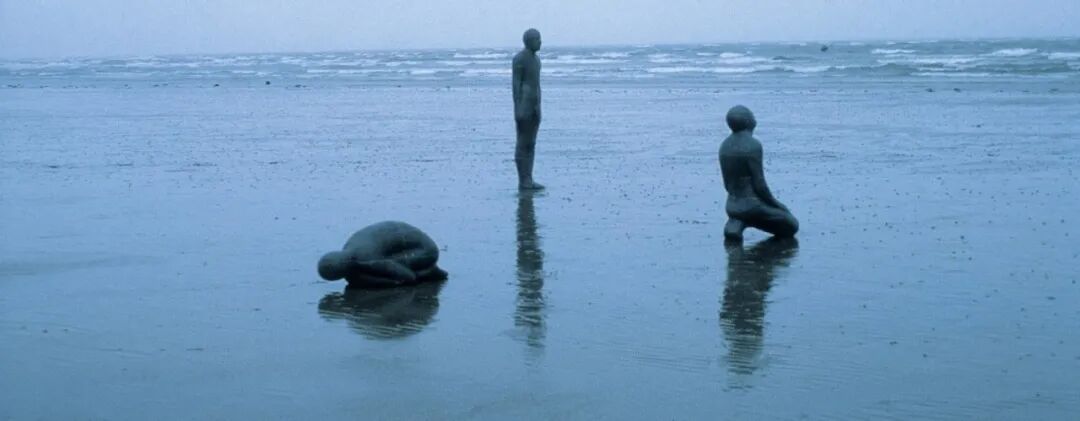
Throughout the works of the 1980s—such as *Three Ways: Mould, Hole and Passage* and *Land, Sea and Air II*—Gormley introduced his signature material language: lead. He cast the plaster moulds into hollow sculptural shells, then sheathed them in sheets of lead, welding along the body’s orthogonal lines (horizontal and vertical). This strategy carries extraordinarily rich, multiple implications:
1. Lead is an extremely dense metal, physically renowned for its radiation-shielding properties. In the late Cold War, beneath the global shadow of nuclear deterrence and the real fear of the Chernobyl disaster, these bodies wholly sealed in lead became a powerful metaphor for the age. They intimate an ultimate anxiety about survival: at once a protection of the body against lethal external energies and a imprisonment that severs life from the outside world entirely. This shell is both armour and cage.
2. The Weight of Silence: lead’s surface is a dark grey that hardly reflects light. It absorbs light rather than reflecting it, thereby producing, visually, an absolute ‘silence’ and sense of weight. When viewers confront these leaden figures, they gain no visual pleasure or information. The gaze seems swallowed by the heavy matter. This quality forces the viewer’s attention away from the work’s ‘surface’ and toward an imagining of its ‘interior’.
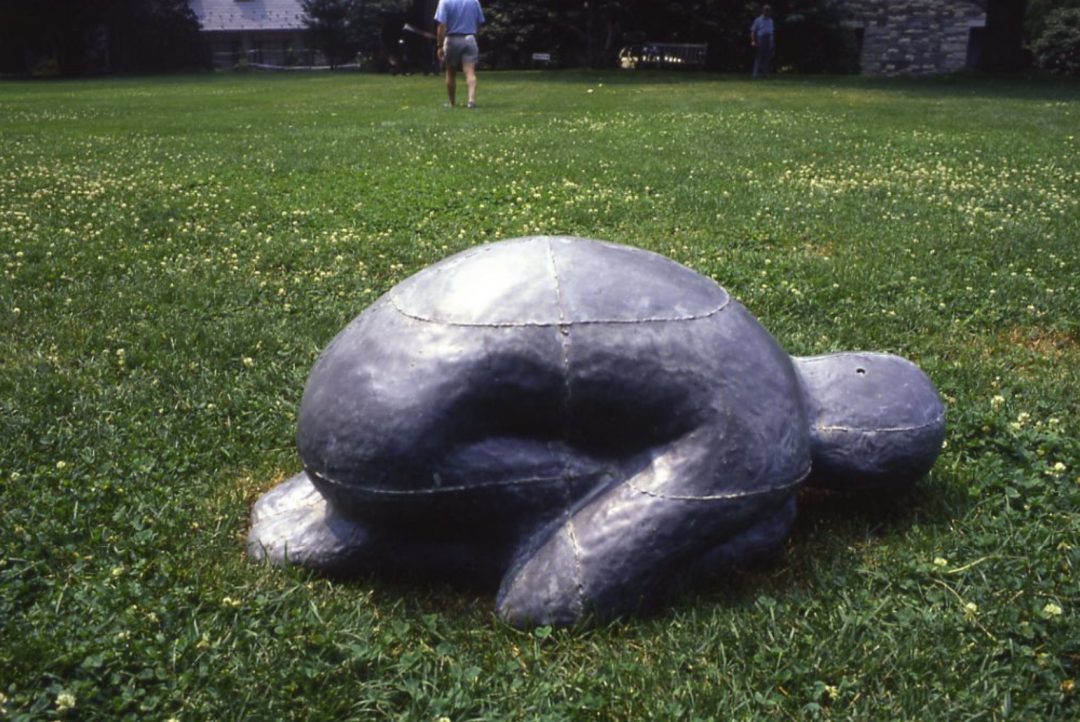
3. The Juxtaposition of Industrial Grid and Organic Body: the clearly visible welded seams form a rational, geometric grid. It is an architectural, industrial, Cartesian coordinate-system language, imposed upon the surface of an organic, soft, and utterly uncertain living body. This handling again echoes Gormley’s strategy of traversing Minimalism: he uses Minimalism’s grid language to ‘capture’ and ‘define’ the human body once exiled by modernism.
The true brilliance of this ‘shell’ strategy lies in how, by thoroughly concealing the interior, it activates the viewer’s bodily self-awareness—our capacity to perceive our own body’s position, posture, and internal state—as never before. What we see is not a living body, but the body’s ‘container’ or ‘dwelling’. As we gaze upon those heavy, sealed, silent blocks of lead, we instinctively project our own bodily experience onto them, imagining the sensations of that other body enclosed in a dark, oppressive space. We seem to feel its weight, its confinement, its breath. Thus the place where Gormley’s sculpture truly completes its meaning is not the physical space of the gallery, but within the viewer’s bodily perception and psychological space.
(3) Bread
Tracing his lineage further back, this bodily consciousness of his can be dated to the 1970s,
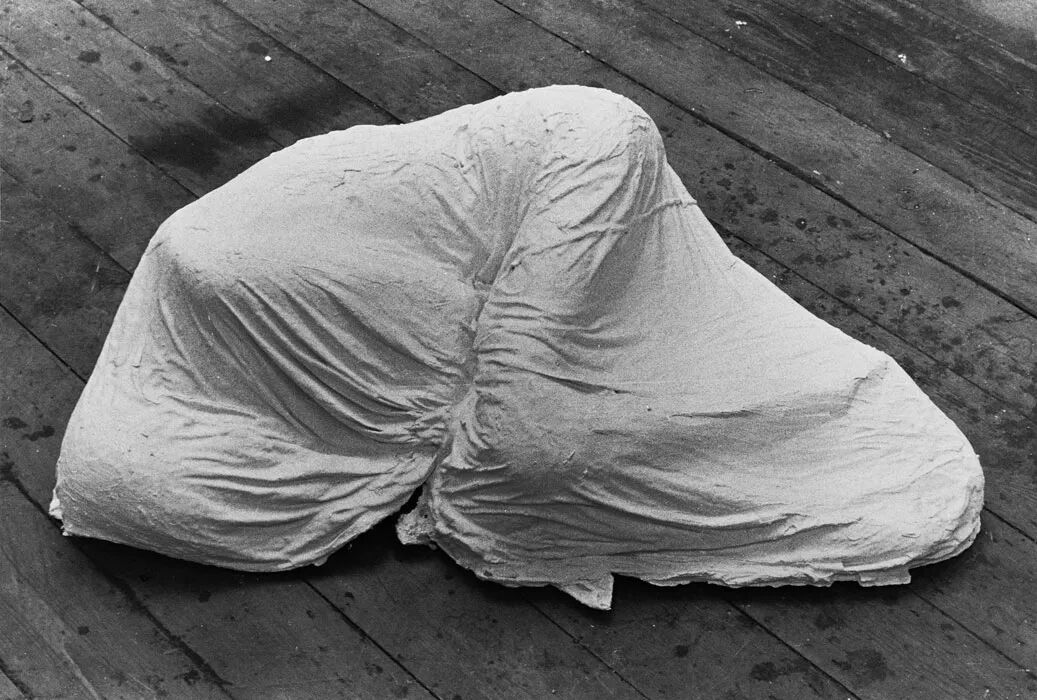
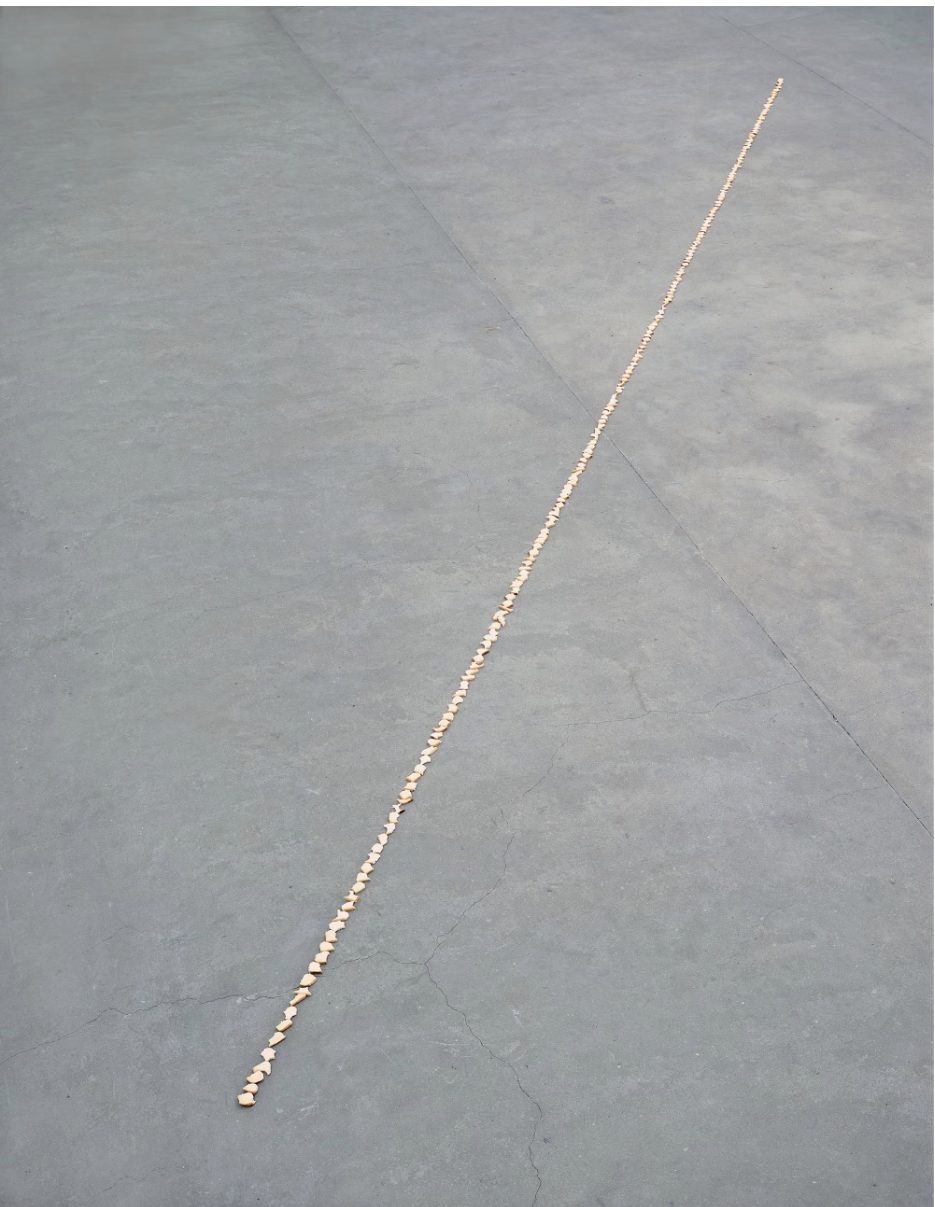
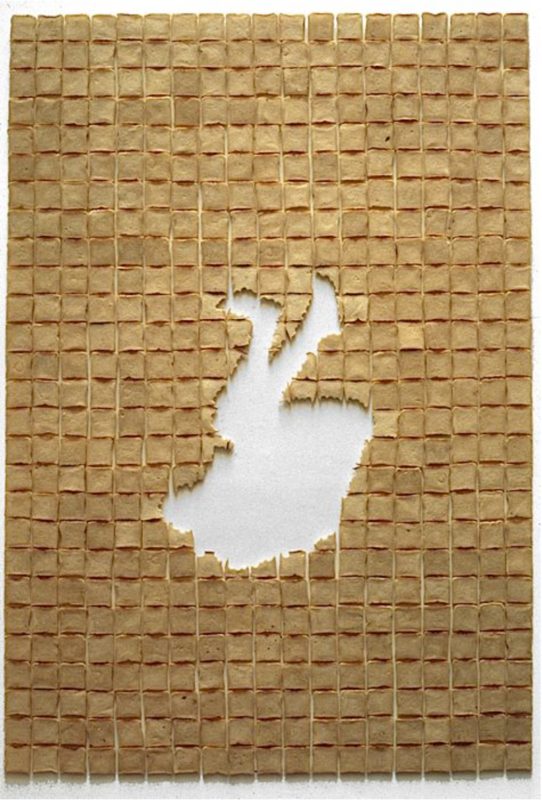
One of his earliest sculptural series was made after his return from India in 1973, before he had entered art school. Inspired by people he saw sleeping on the streets of India wrapped in saris (the traditional garment of Indian women), in these works figures lie on the ground—sometimes curled in a foetal posture, sometimes sprawled at random—as if asleep, yet always wholly enveloped by a sheet; this gave rise to *Sleeping Place*. His *Bread Line* (1979), a work exploring the relation between body and food, simply arranged strips of bread into a line. In *Mother’s Pride* (1982), bread signifies life and consumption and also metaphorises the body’s process of transformation; by eating bread to create the body’s outline, he probed the relation between existence and space, and this bread-medium series treats the body as the subject, material, and tool of art.
III. From Singular to Plural: the Aggregate and Social Sculpture (1990s)
Entering the 1990s, Gormley’s artistic practice underwent a profound turning. He gradually realised that the single, isolated body, though it could probe the predicament of individual existence profoundly, could hardly reach the collective destiny and social relations of the human species as such. If the lead-shell sculptures of the 1980s were an existential philosophy of the ‘I’, then from the *Field* series onward his art turned toward a sociology and politics of the ‘we’.
(1) *Field*: the Radical Strategy of De-Skilling
The *Field* series—above all *Land of the British Isles*, created for and ultimately awarded the 1993 Turner Prize—marks a giant leap in Gormley’s artistic strategy and stands among his most socially impactful works. The project’s premise is extremely simple, yet its effect and its implications are exceedingly complex and subversive. He was no longer the artist wrapping himself alone in his studio, but a social project’s organiser and catalyst.
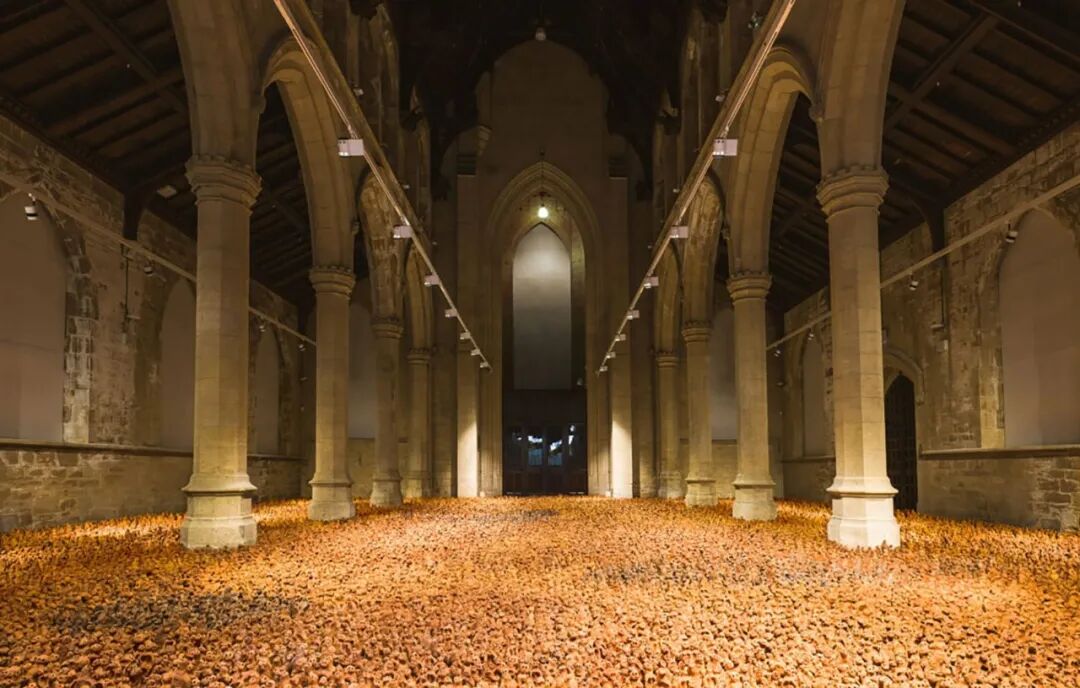
The rules were extremely simple. Gormley and his team would go to a place—a community such as St Helens, for instance—find local residents, typically the families of brickworks workers or students, and give each person a fist-sized lump of clay. His instructions numbered just three: model a human figure; it must have eyes; and it must be able to stand. Beyond that, there was no aesthetic requirement whatsoever.
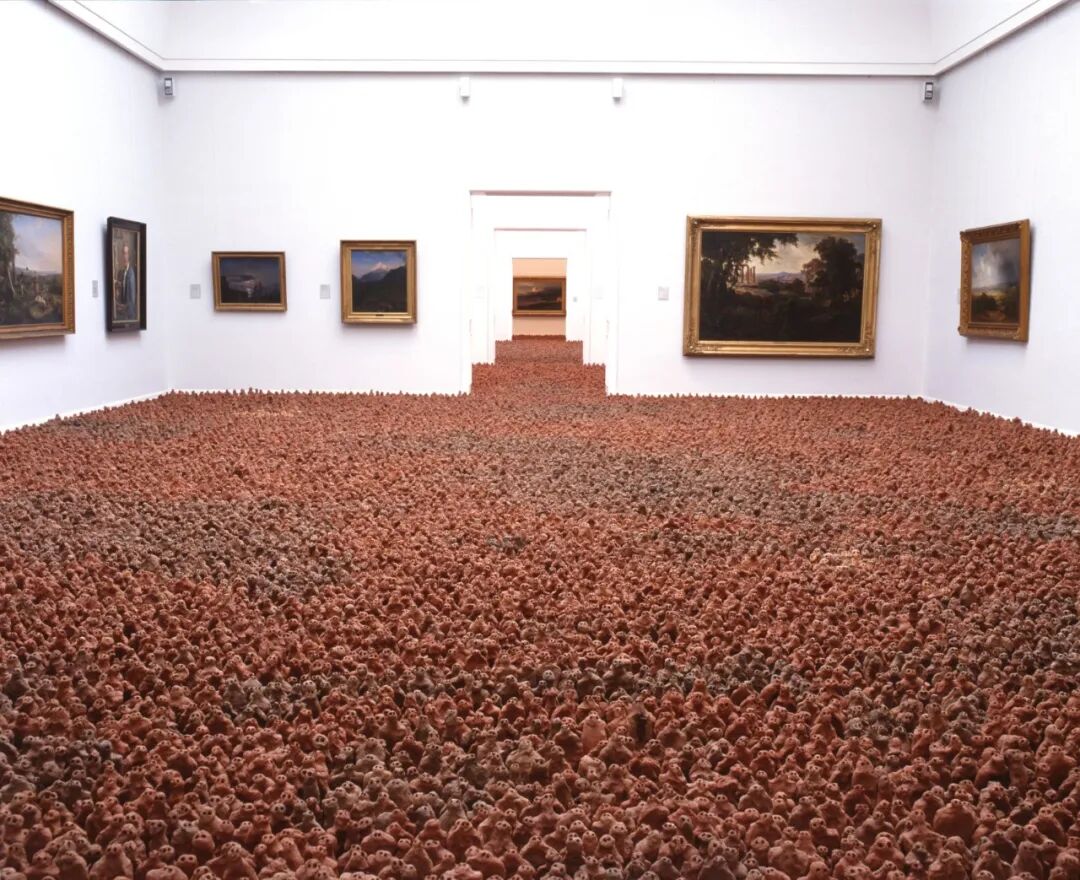
In the event, hundreds of volunteers took part, ultimately producing some 35,000 to 40,000 small clay figures of varying size and form. These figures were transported to the museum and packed tightly across the entire gallery floor, forming a boundless ‘land’.
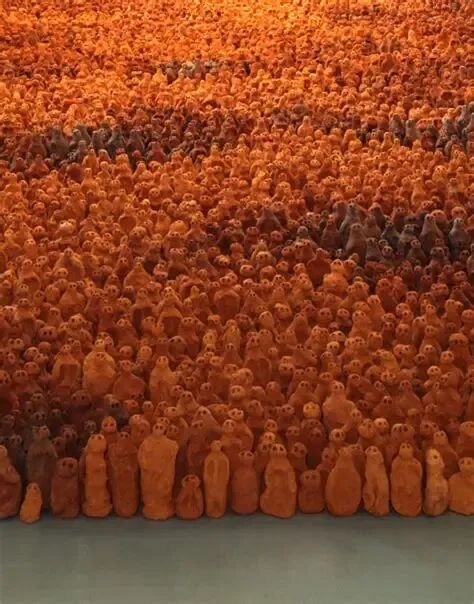
Several strategic threads in this work merit attention:
1. De-skilling and the Sharing of Authorship: this was a thorough subversion of the traditional identity of the artist. He relinquished control over the ‘craft’ that lies at the creator’s core. Each clay figure differs in form because the hands that shaped it differ, as do each person’s experience and skill. This infinite differentiation was not designed but emerged spontaneously from collective making. Here Gormley’s role approximates that of a practitioner of the ‘social sculpture’ concept advanced by the German artist Joseph Beuys, who held that ‘everyone is an artist’ and stressed art’s social function and its power to change society. Through the *Field* project, Gormley put this idea into practice on a vast scale.
2. The Reversal of the Gaze and the Inversion of Power: the installation mode of *Field* is central to its concept. Viewers were strictly forbidden to enter the area occupied by the figures; they could only stand at the gallery’s single entrance and look in through a fixed doorway. Standing there, the viewer confronts thousands upon thousands of empty, upward-gazing eyes. At this moment, the traditional relation of looking is utterly overturned. Normally the artwork is the object looked at; but in *Field* the viewer becomes instead the object scrutinised. These thousands of clay figures, as embodiments of the ‘silent majority’, seem to interrogate the viewer: ‘Who are you? Where do you come from? Where have you placed us?’ This immense psychological pressure born of numerical absolute superiority constitutes a contemporary reinterpretation of the Kantian aesthetic concept of the ‘sublime’. It is no longer awe before the might of nature, but awe and unease before the collective existence of humanity itself.
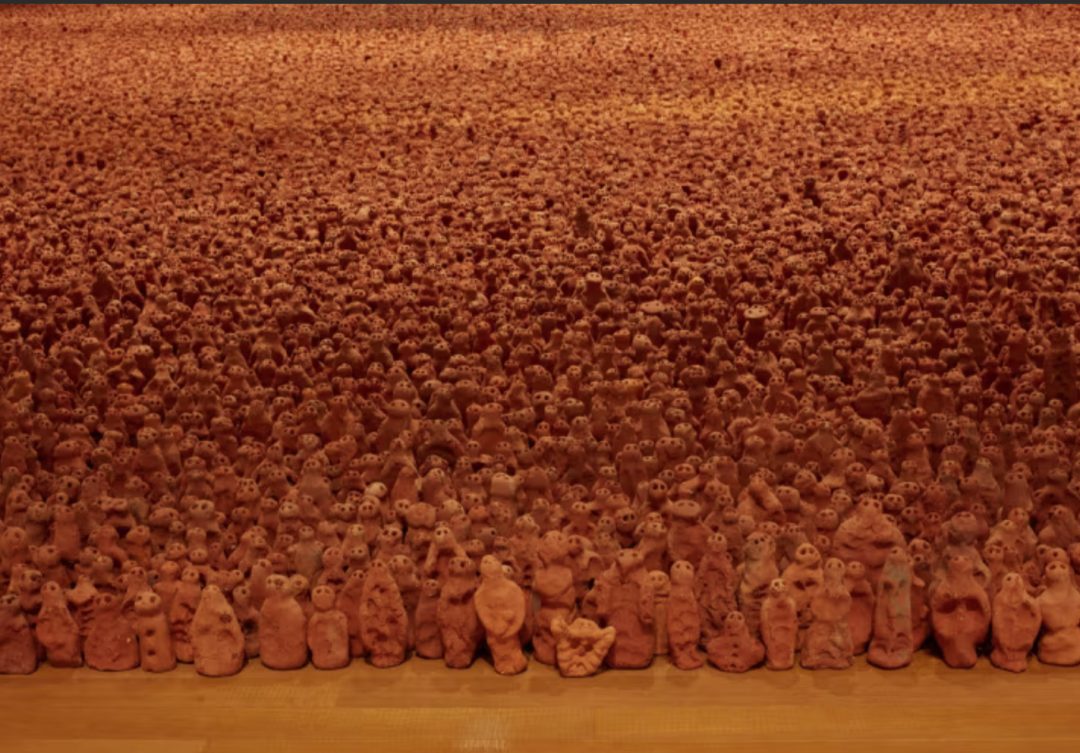
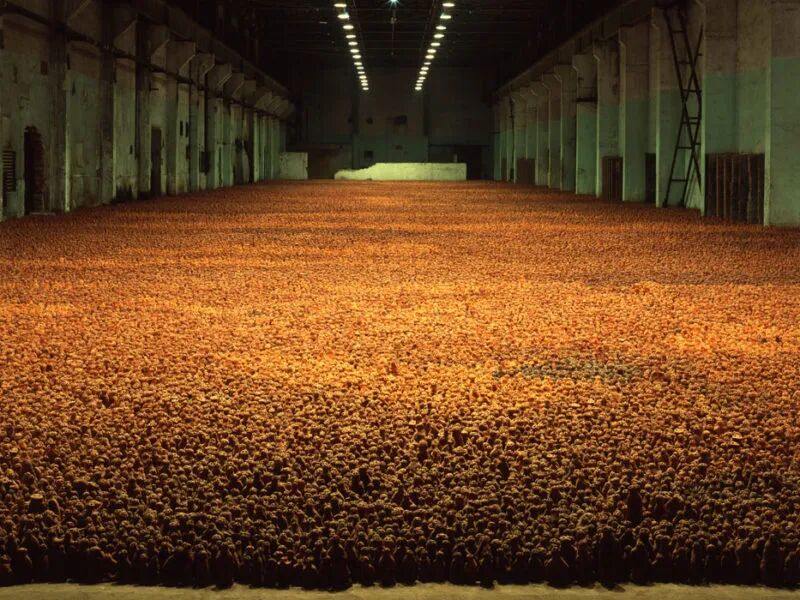
3. The Ontological Relation between Land and Human: the work’s material (clay) and title (land) point directly to its core metaphor. Clay is earth itself, the raw material from which life is created in human myth. These figures, drawn from the earth, shaped by human hands, and fired into form, symbolise humanity’s most ancient and fundamental bond with the land. In the accelerating globalisation of the 1990s, this emphasis on ‘place-based’ belonging and collective identity carried urgent contemporary significance. *Asian Field* (2003), for instance, was realised with over 300 villagers in Xiangshan village, Guangzhou, and became the largest work in the series, profoundly reflecting the rapid urban–rural transformation of China at the time and the remaking of collective memory.
Quantity itself becomes a quality: when a simple gesture or an unadorned object is repeated tens of thousands of times, it transcends its own form and becomes a political manifesto or a philosophical meditation. Learn to mobilise social force as your creative medium, not merely clay or pigment. In such projects the artist’s role shifts from a solitary ‘maker’ to an open ‘catalyst’ who sets the rules and ignites energy, while the final work is accomplished through collective intelligence and labour.
IV. Intervening in the Landscape (late 1990s–2000s)
Antony Gormley is among the few figures in contemporary art capable of successfully commanding public art on a colossal scale. At a time when public art often lapses into an ‘object fallen from the sky’ or a ‘plaza ornament’ for lack of profound dialogue with its environment, his strategy appears all the more composed, precise, and rich in place-based wisdom. He regards his sculptures as ‘acupoints’ placed within a specific site, activating the entire environment’s energy field through precise intervention.
(1) *Angel of the North*: Totem, Industrial Memory, New Folk Legend
Completed in 1998, *Angel of the North* is undoubtedly among the most successful public artworks of the late twentieth century—not merely a colossal sculpture but an engineering marvel, a regional psychological landmark, and a complex text on post-industrial identity.
Worth noting is the precision of the work’s siting strategy, which is well worth studying. It stands in Gateshead, in North East England, a region that endured the severe pain of deindustrialisation after the Thatcher era and was once thick with coal mines and shipyards. The sculpture’s base sits on the former site of an abandoned coal mine. Gormley’s choice of this site is in itself a homage to and response to history. He has said the work aims to commemorate the end of the industrial age and to look toward a new future in the information age.
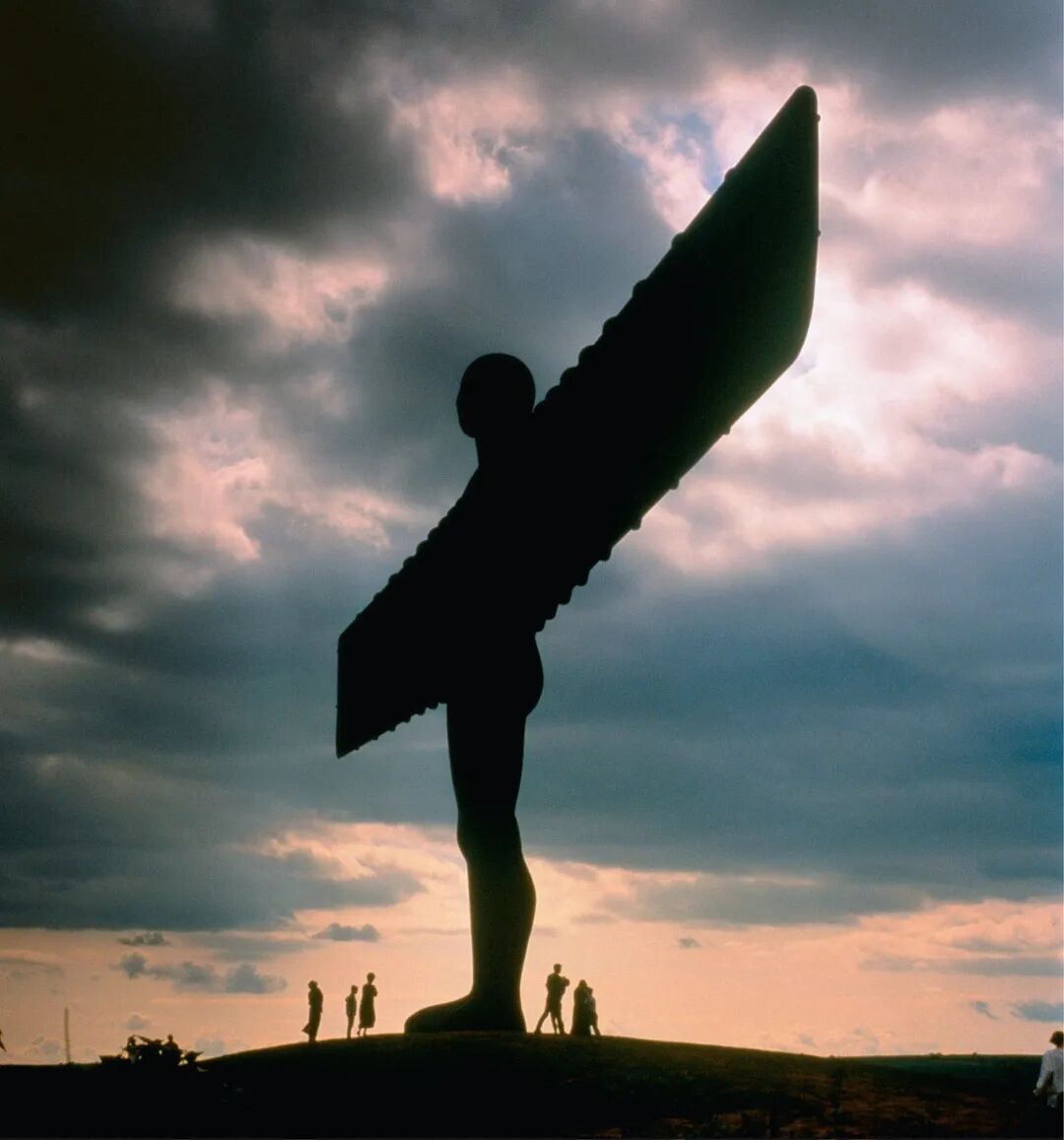
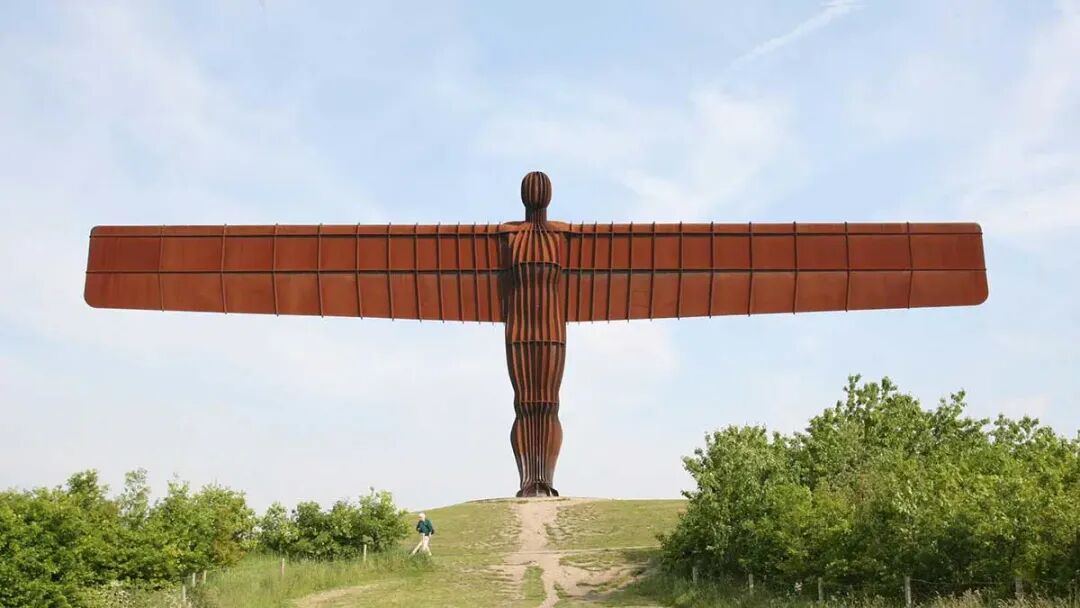
The sculpture’s principal material is steel, a metal that over time develops a stable rust-red protective patina on its surface. This colour and texture resonate deeply, visually, with the coal buried beneath this land, the steel frames of abandoned factories, and the local red-brick architecture. It does not use gleaming stainless steel or traditionally noble bronze, but a material that can breathe and age together with the land.
In its very form, Gormley’s angel possesses none of the softness or sanctity of the traditional angel. Its form is industrial, structuralist; the ribbed structure of its wings is clearly visible, like the wing of an aeroplane or the truss of a bridge. Standing 20 metres high, its wings—with a 54-metre span—do not rise vertically like a bird about to take flight, but spread almost horizontally, with a slight 3.5-degree forward lean. This posture is not one of ‘ascension’ but rather of ‘embrace’ or ‘shelter’. This strong horizontality enters into a powerful dialogue with the undulating horizon of the earth, drawing the gaze toward the vast sky and the distant horizon rather than toward an unreachable heaven.
Here Gormley resolved a formidable problem: how, in a post-religious, post-modern secular age, does one create a totem capable of consolidating communal consensus and possessing spiritual force? He chose no specific heroic figure or historical event as his subject, since that would inevitably provoke controversy. Instead, he employed an abstracted, universalised human form.
Rather than classical aesthetics, he drew on the industrial aesthetics most familiar to locals (rivets, steel plates, ribbed structures), thereby evoking the identity of the local working class instead of the alienation of the intellectual. In the end, *Angel of the North* succeeded in becoming that region’s guardian deity—a ‘new folk legend’ woven into locals’ daily life. Like a gigantic cross, it is seen by over 30 million people each year, a measure of its interpretive reach and impact, and proof that contemporary art can and should be capable of serving as a vehicle for new collective memory.
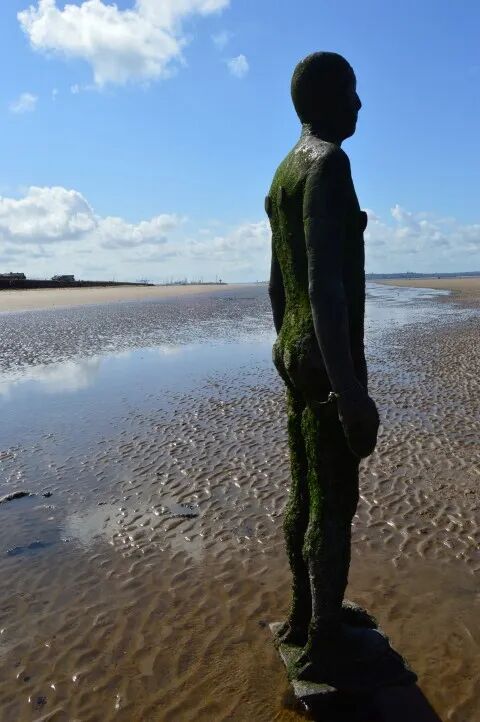
(2) *Another Place* and *Horizon*: Breaking Down the Museum’s Walls
If *Angel of the North* is a fixed, monumental anchor, then many of Gormley’s later public projects are more like mobile ‘viruses’ that constantly undergo chemical reaction with their environment.
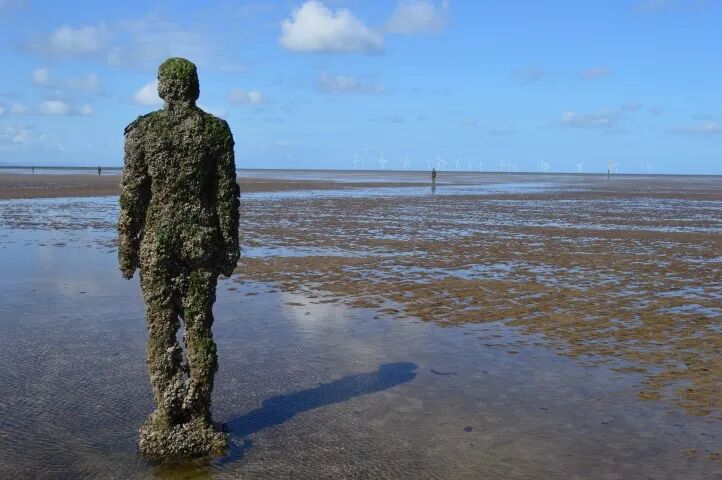
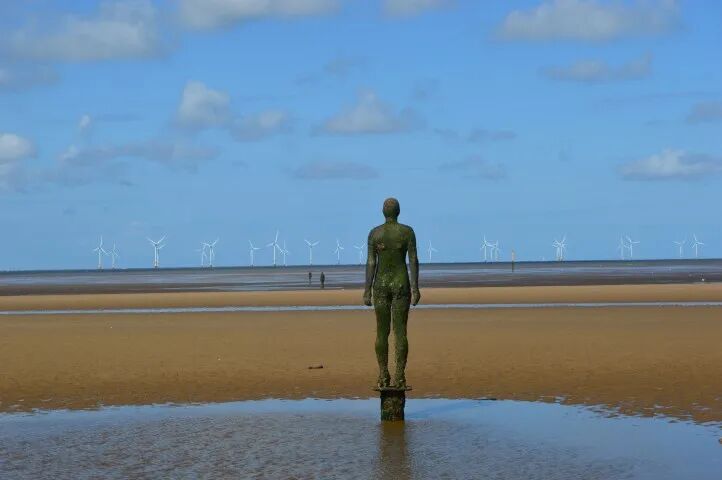
*Another Place* (1997–present): this project comprises 100 cast-iron figures moulded from the artist’s own body, permanently scattered across Crosby Beach near Liverpool. These iron figures are distributed along the coastline, facing the sea, submerged and corroded by the daily rise and fall of the tides, then re-emerging. This strategy ingeniously introduces time and natural force as co-creators of the work. Barnacles and seaweed attach to the iron bodies; the salt in the seawater continually erodes their surfaces. The work thus becomes a live performance about ‘entropy’, probing the fragility, persistence, and evolution of the artificial object within natural cycles. Each iron figure is a ruler for measuring time, recording the shifts of light, weather, and season.
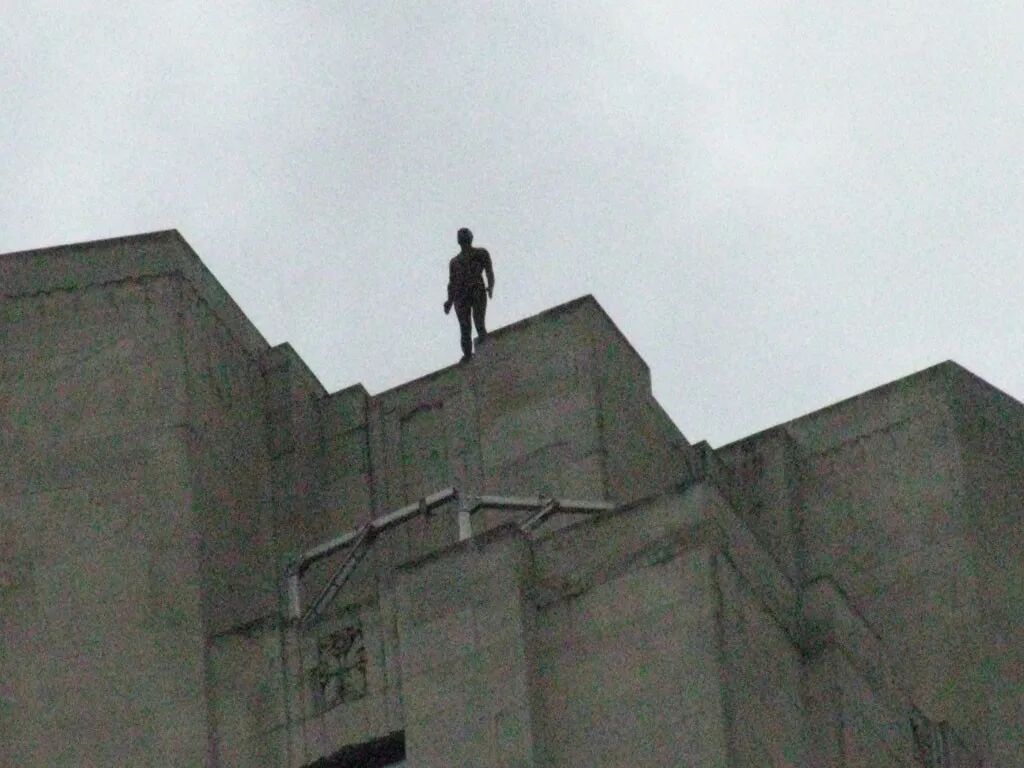
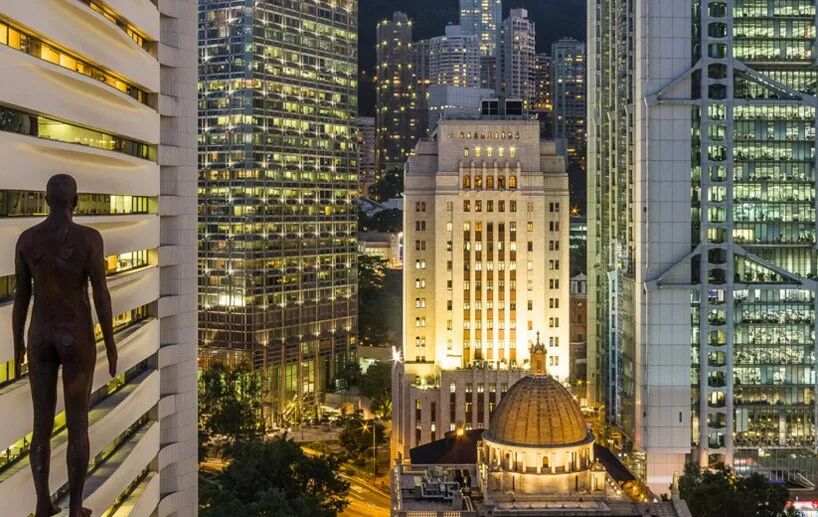
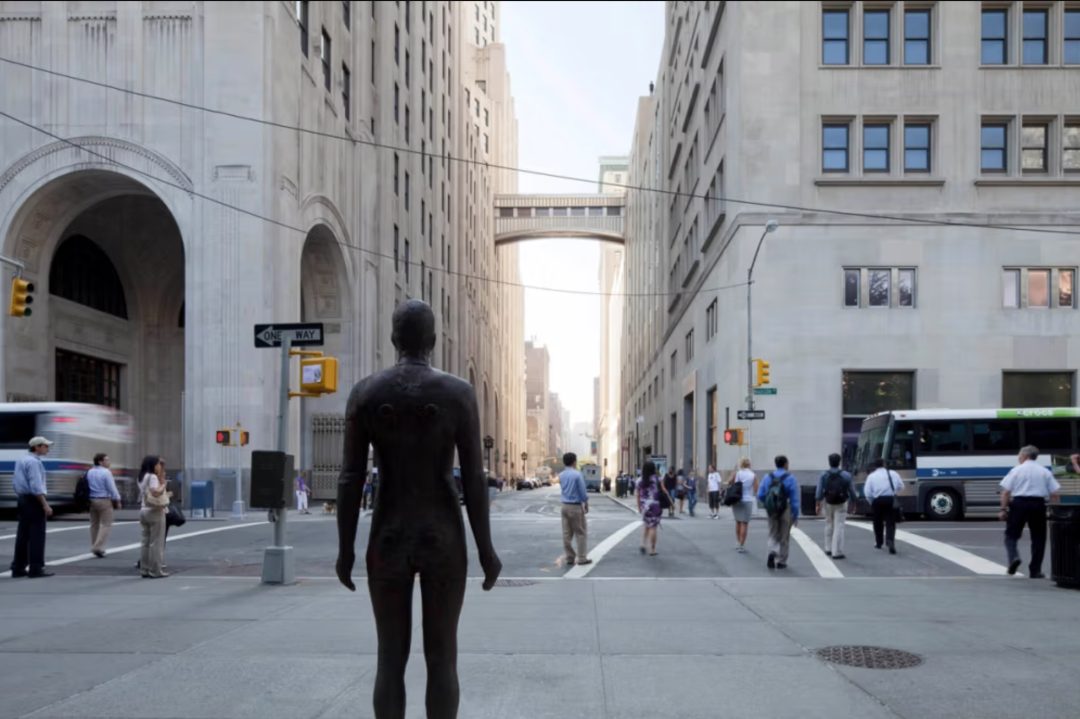
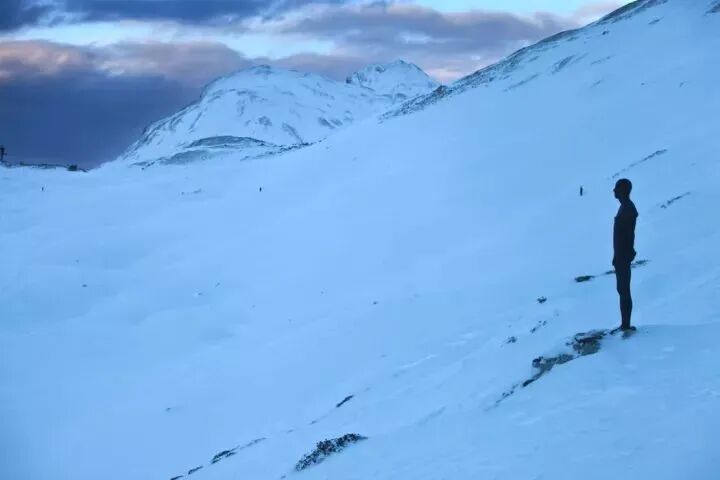
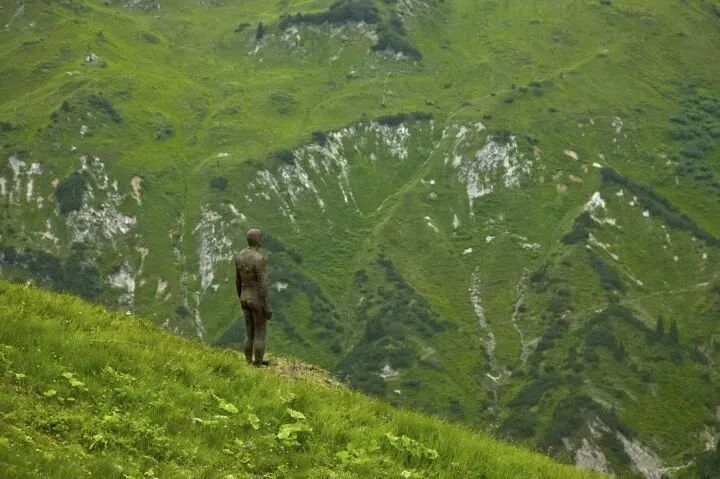
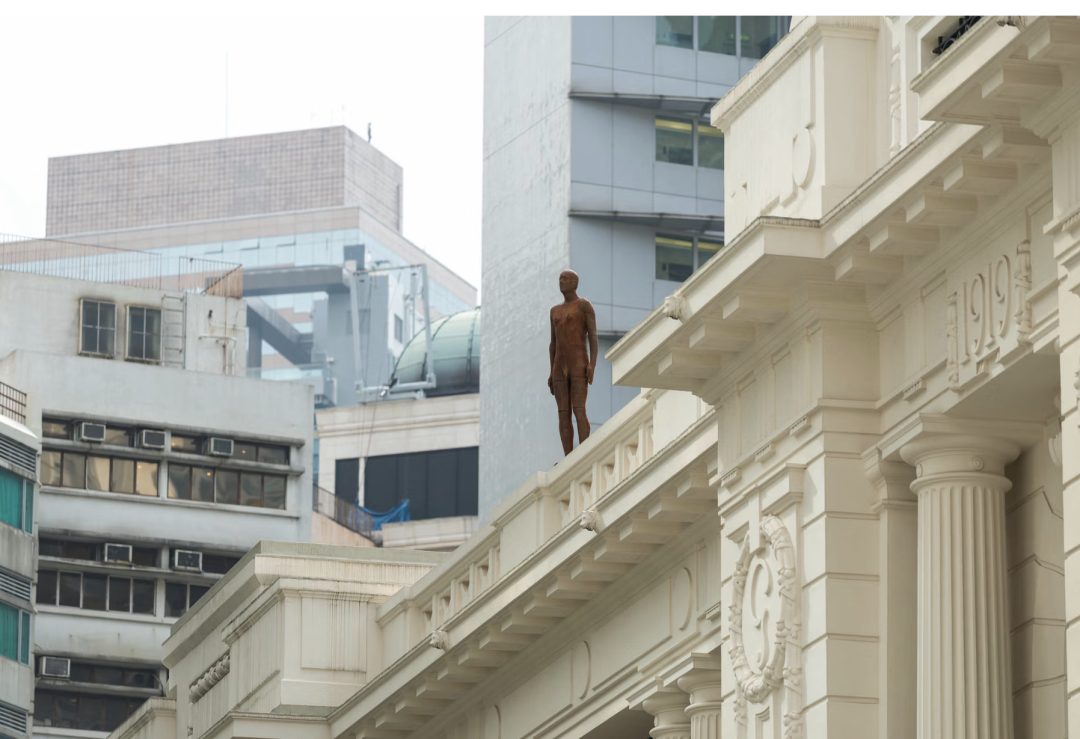
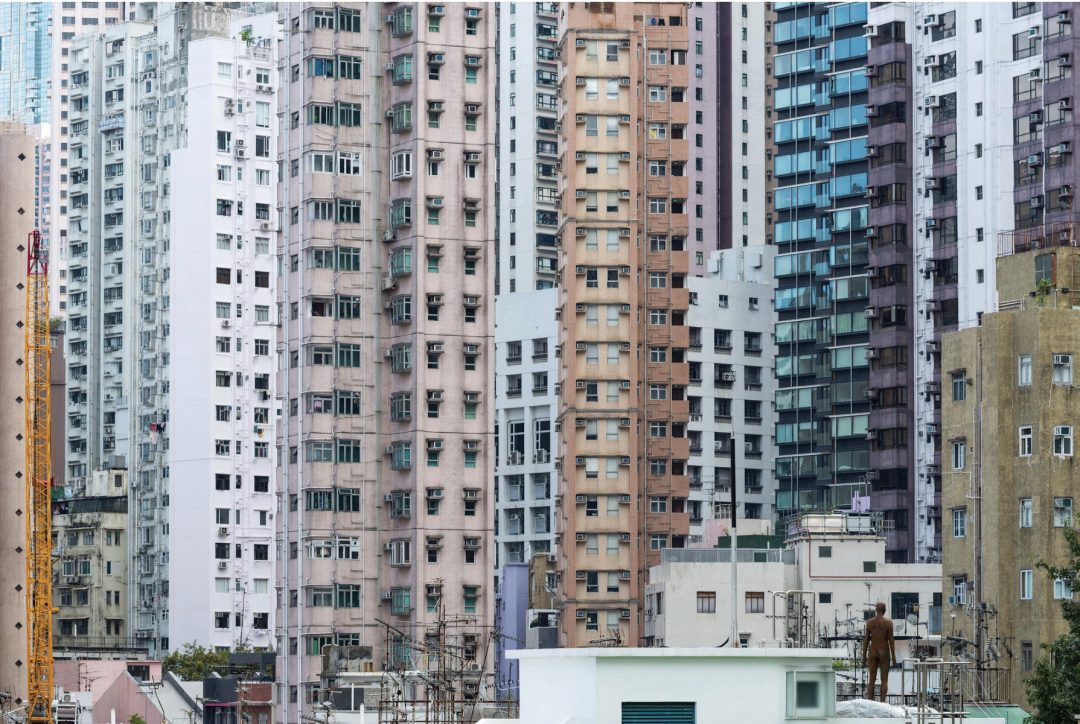
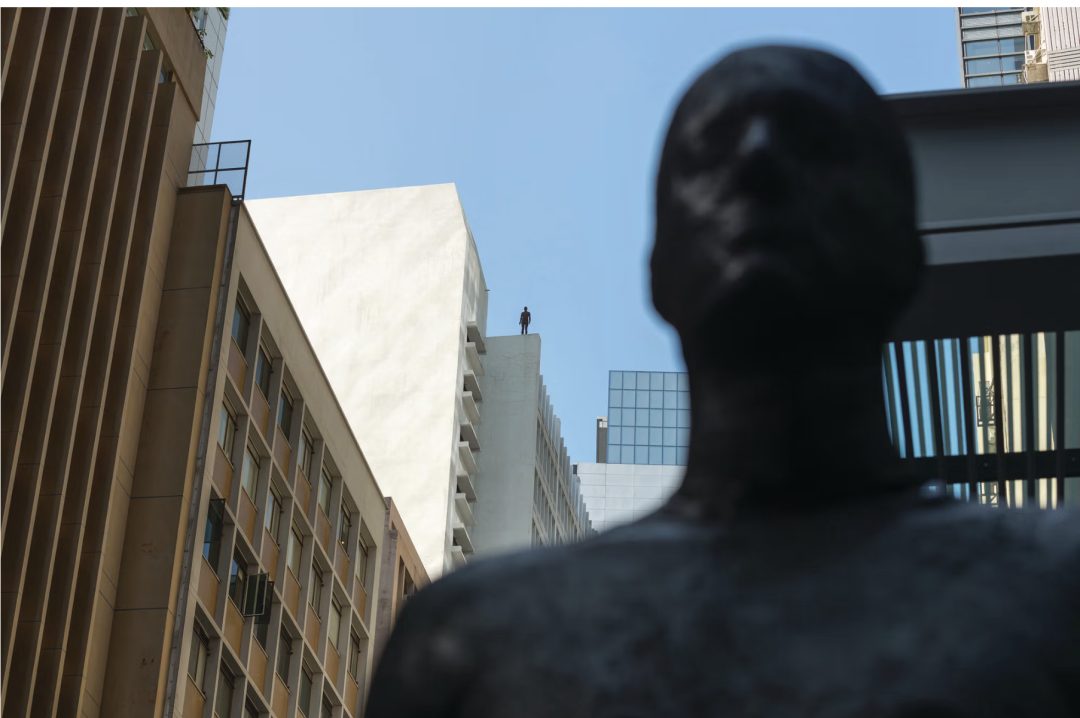
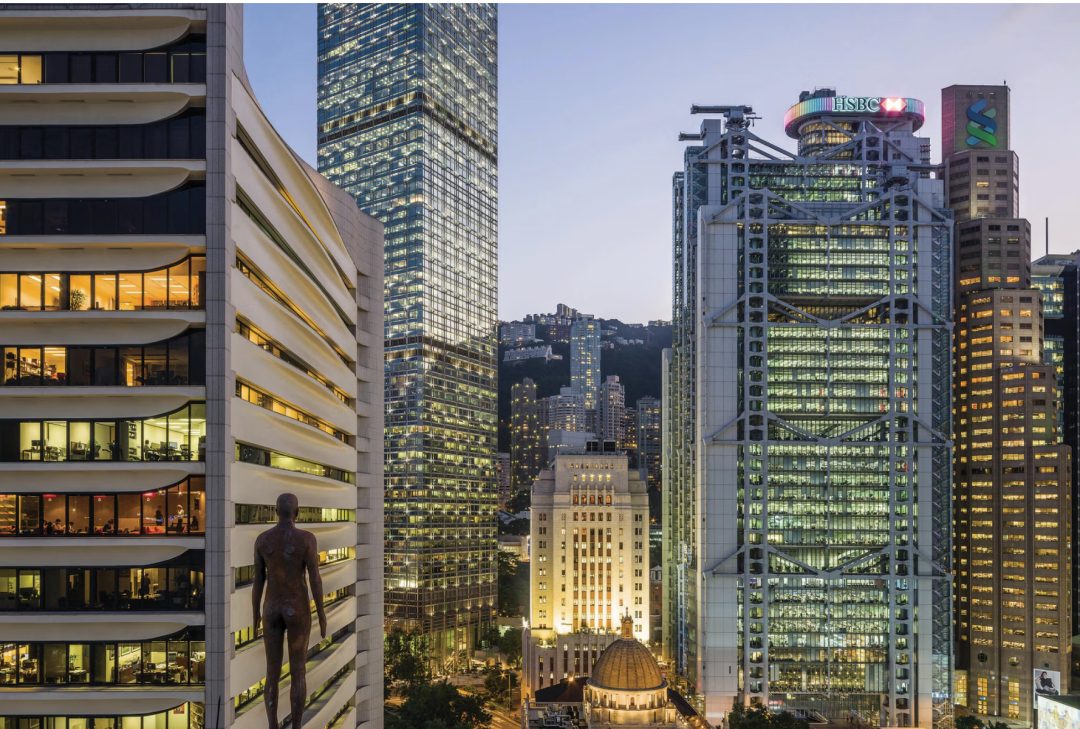
*Horizon* (2007–present): in this project Gormley placed the same human figures on the roof edges of skyscrapers in major world cities such as London, New York, São Paulo, and Hong Kong. This strategy has been called ‘urban acupuncture’ by some critics. When you walk the streets of Manhattan and, glancing up by chance, spy a vague human silhouette standing at the edge of a distant building, your first reaction is likely shock and panic (is that someone about to jump?). Once you realise it is a sculpture, the shock turns to confusion, and finally to prolonged gazing.
The subversiveness of this strategy lies in its forcible interruption of the automated rhythm of urban life. It forces pedestrians forever bowed over their phones or hurrying on their way to stop, look up, and re-examine their relation to the architecture above, the sky, and the vertical dimension of the city. These silent figures standing on the city skyline are like so many philosophical question marks, interrogating the existential condition of modern urban dwellers, their loneliness, and our place within gigantic artificial structures.
This teaches us to utilise the existing narrative and energy field of an environment. The success of public art lies not in how exquisite the object itself is, but in what kind of ‘chemical reaction’ it generates with its environment. Whether on a vast natural beach or in a vertical urban jungle, do not merely ‘place’ an object—‘activate’ the space’s latent emotion, history, and tension. Let the work become a sensitive surveyor of the environment, a silent questioner—not an intrusive interloper that steals the show.
V. The Body in the Quantum Age (2000s–2010s)
With the advent of the twenty-first century, as digital technology, network culture, and new scientific notions such as quantum physics gained currency, humanity’s understanding of the ‘material’ underwent a fundamental change. Gormley acutely captured this shift in the zeitgeist. He began to doubt the very core of his art—the bodily shell that he had once laboured to wrap in lead and to cast solidly in iron. He embarked on a new series of explorations, attempting to deconstruct this material entity and transform it into an assemblage of energy, information, and probability.
(1) Pixelation and Cloud: *Quantum Cloud*
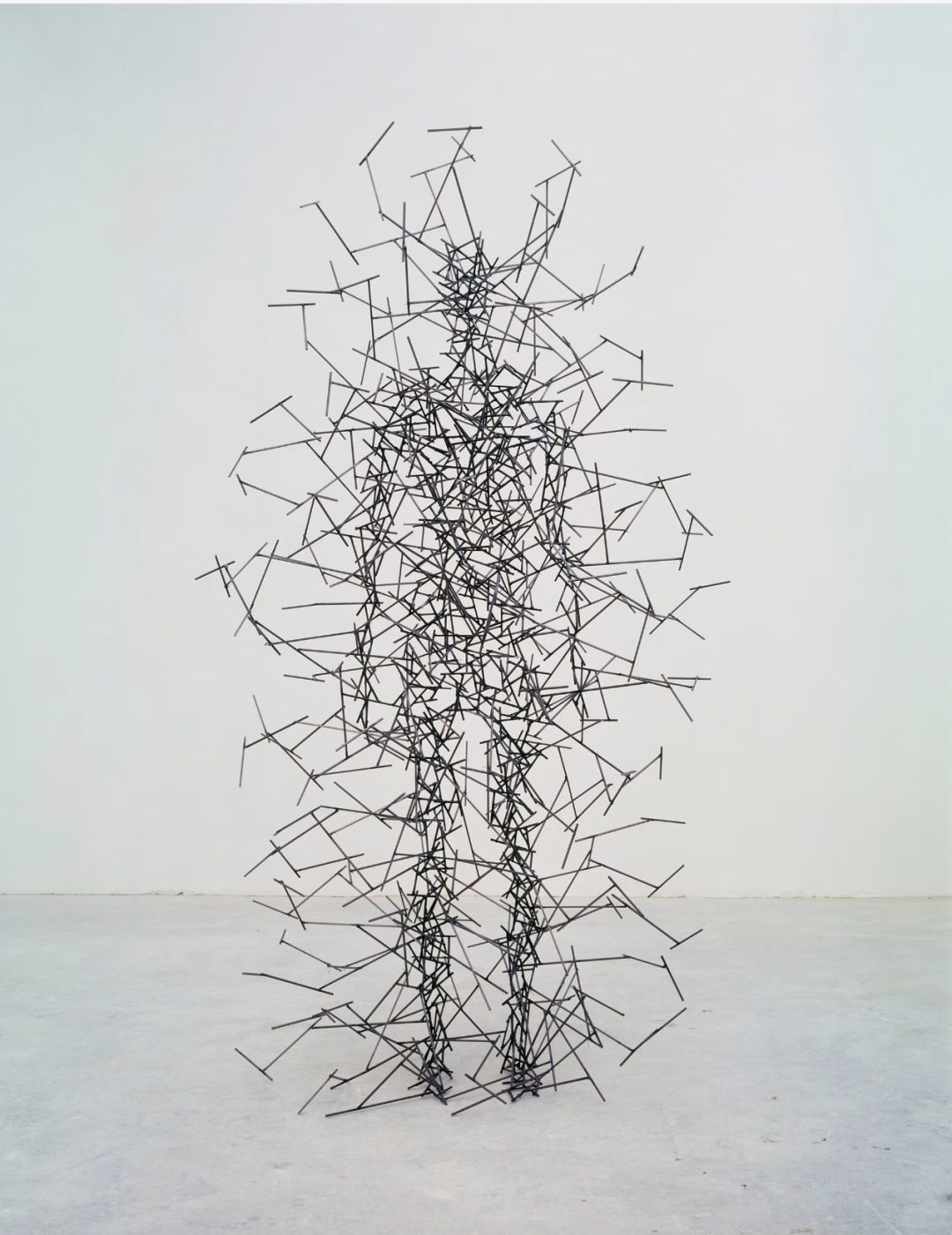
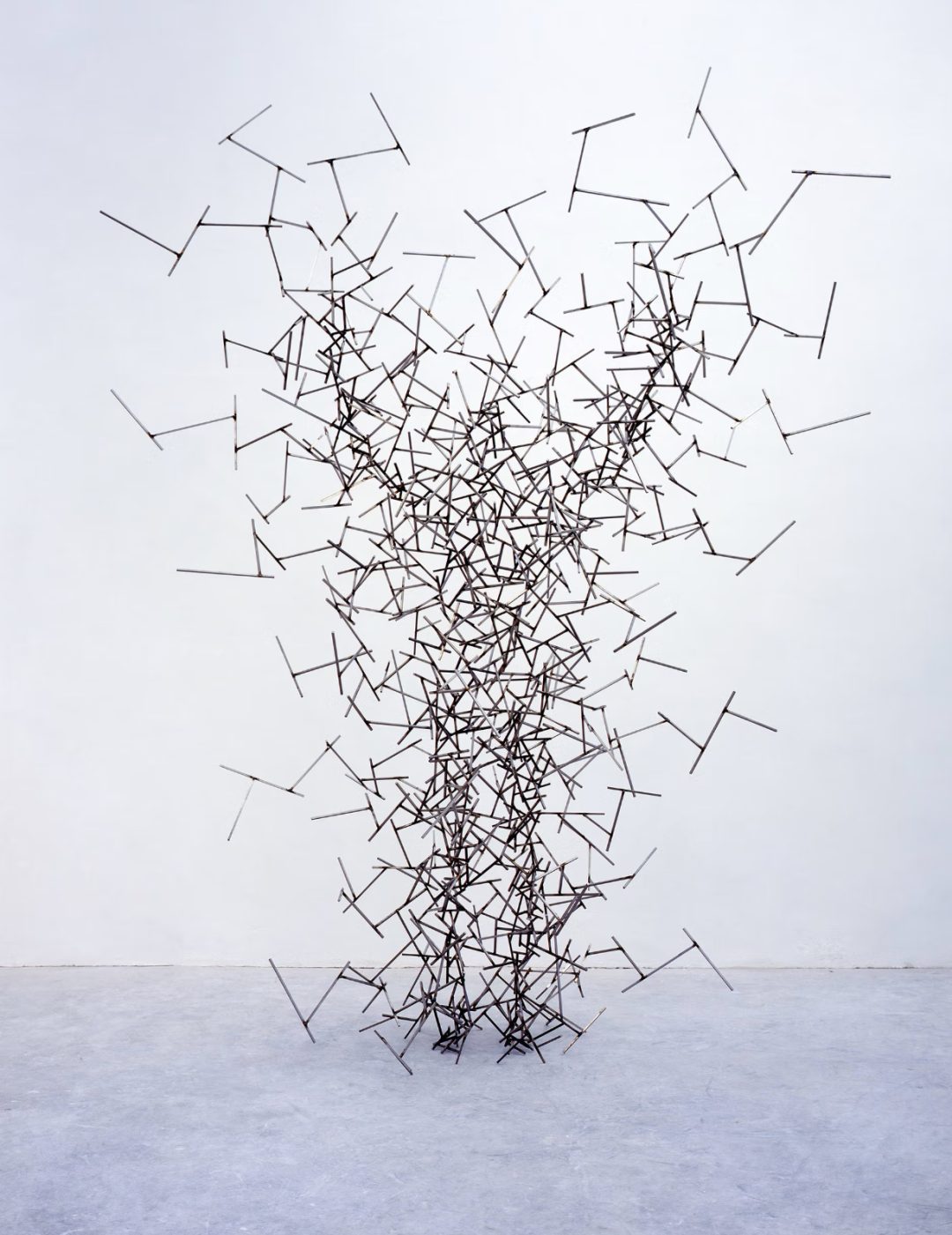
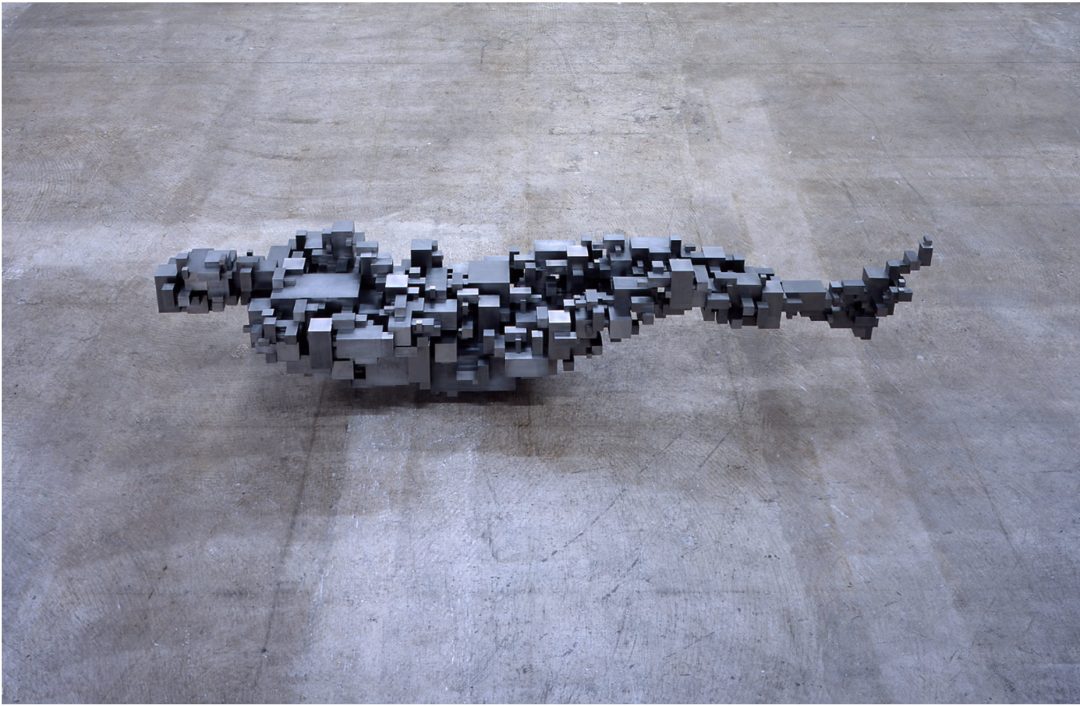
Created at the turn of the millennium, *Quantum Cloud* (1999) is the emblematic work of this transition. In this and the subsequent series of works, the body is no longer a closed container with a clear boundary separating inside and outside, but more like a probability field.
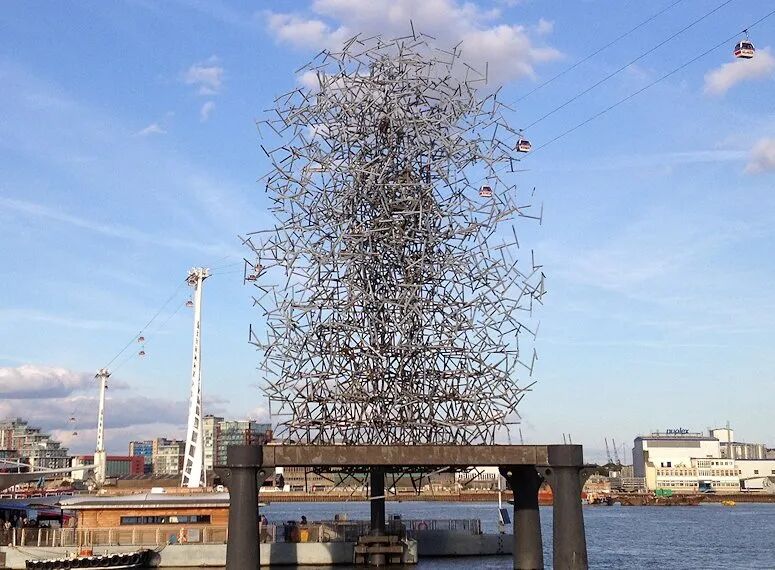
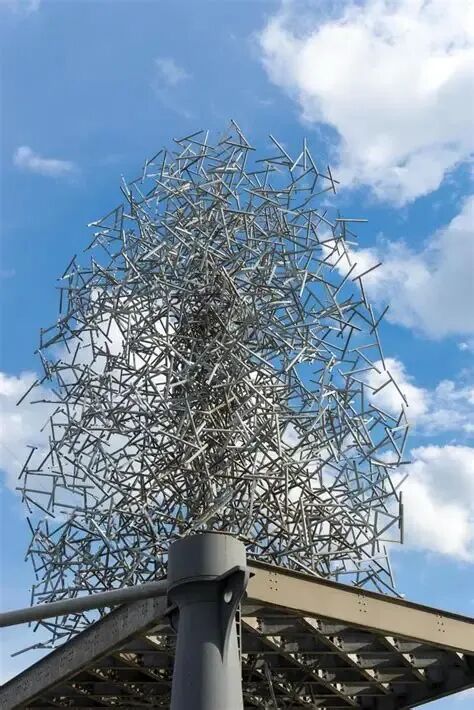
Gormley typically uses thousands of square steel bars of varying lengths, welded—through random algorithm and careful construction—into a seemingly chaotic, disorderly metallic cloud. Within this three-dimensional ‘graffiti’, the human outline is not explicitly modelled; rather, in the cloud’s central core, because the density of the bars rises markedly, a standing human figure faintly emerges. From some angles the figure is clearly discernible; from others it dissolves entirely into the chaotic lines.
The work’s title directly invokes a concept from quantum physics. It corresponds perfectly to Heisenberg’s ‘uncertainty principle’ in quantum mechanics—that we cannot simultaneously know both the position and the momentum of a particle with precision. Gormley’s ‘quantum body’ is exactly this: not a fixed, determinate material entity, but a temporary aggregation of countless energy particles at a given instant. Its edges are blurred and open; its interior is permeable and fluid. This is not only a visual translation of physical theory but a profound metaphor for human identity in the twenty-first century: in the network age, our ‘self’ is likewise no longer a stable core, but a constantly changing ‘cloud’ composed of data flows, social links, and virtual identities.
(2) *Blind Light*: Light and Fog as Sculpture
If *Quantum Cloud* remains a deconstruction of object form, then *Blind Light*, shown at the Hayward Gallery in London in 2007, marks an even more radical turn in Gormley’s artistic thinking. He abandoned the ‘object’ altogether, pushing the definition of sculpture to a phenomenological extreme.
In the exhibition hall stands a gigantic glass chamber, filled with dense white fog produced by ultrasonic humidifiers and uniformly illuminated by a glaring, intense light. Viewers are invited into this chamber; once inside, vision almost entirely fails, with visibility of less than an arm’s length. You extend a hand yet cannot see your own fingertips. Amid the white halo of light, you lose your sense of direction and your judgement of spatial scale, becoming a ‘sightless being’. Your senses are forced to recalibrate; hearing, touch, and the body’s sense of balance become abnormally acute.
In *Blind Light*, sculpture is no longer the ‘object looked at’ placed within space; sculpture becomes the very ‘environment of looking’. The viewer is no longer a detached observer but becomes part of the content of the sculpture. As you move cautiously through the mist and suddenly encounter another vague, unfamiliar human figure, the experience of an encounter that is at once fearful and intimate is profoundly arresting. In that moment, both your body and the other’s become part of this fluid, immaterial ‘sculpture’.
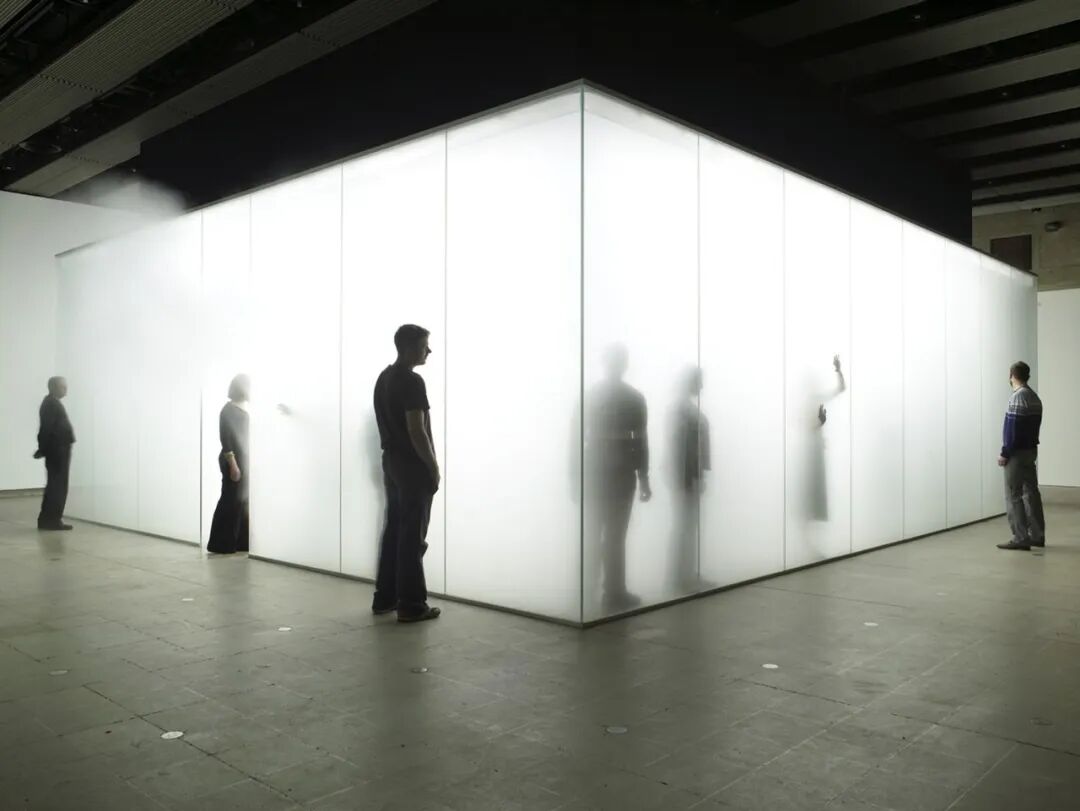
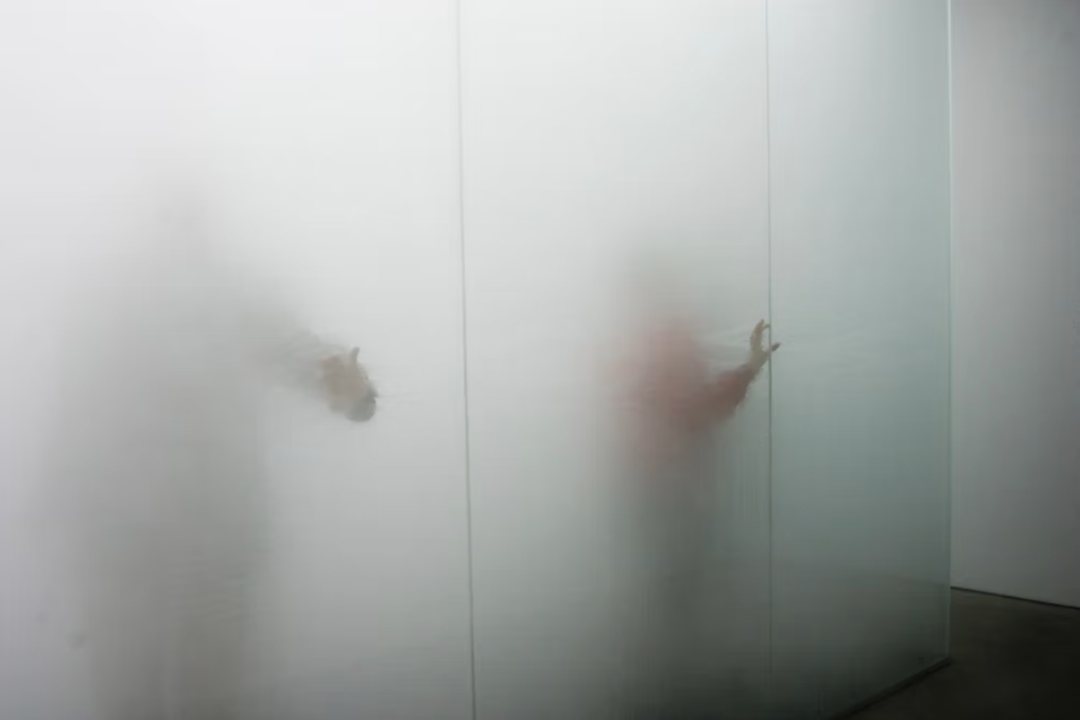
Through works such as *Quantum Cloud* and *Blind Light*, Gormley accomplished a significant evolution in his career: a shift from ‘making objects for people to look at’ to ‘constructing situations in which people experience their various states of being’. The centre of gravity of his art shifted decisively from object to phenomenon. This provided an important theoretical and practical precedent for the later development of immersive and experiential art.
VI. The Body as Architecture (2015–2020)
If Gormley’s early lead sculptures were concerned with the body’s ‘enclosure’ and ‘introversion’, then in his work after 2015 his interest turned toward the body’s ‘expansion’ and ‘structuring’. No longer content to regard the body merely as a biological container, he began to treat it as an architectural construct that can be deconstructed, recombined, and infinitely magnified. Body is architecture, architecture is body; the boundary between the two grows indistinct in his hands.
(1) The Body as Dwelling: *Room* and *Cavern*
One of Gormley’s most radical and best-known strategies in this period was to transform a figurative sculpture into a functional space that people could actually inhabit.
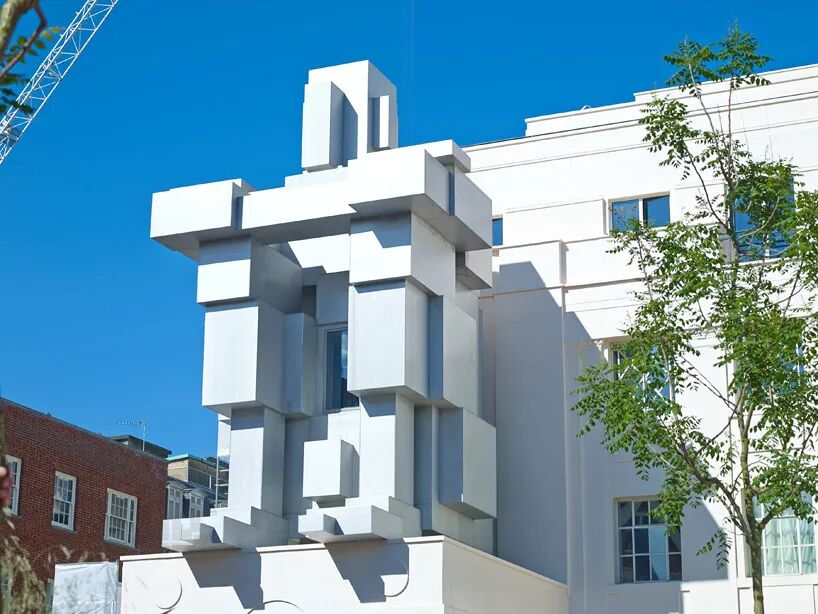
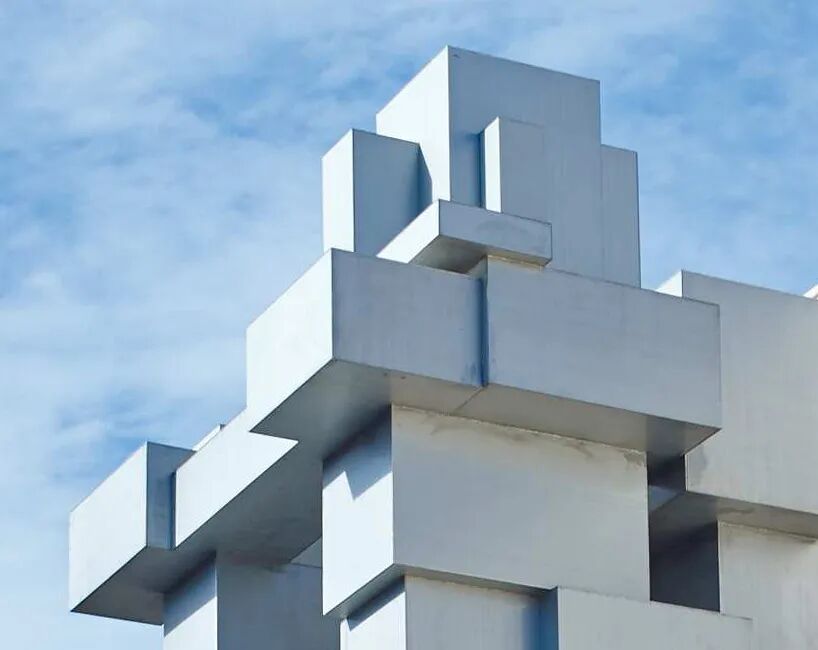
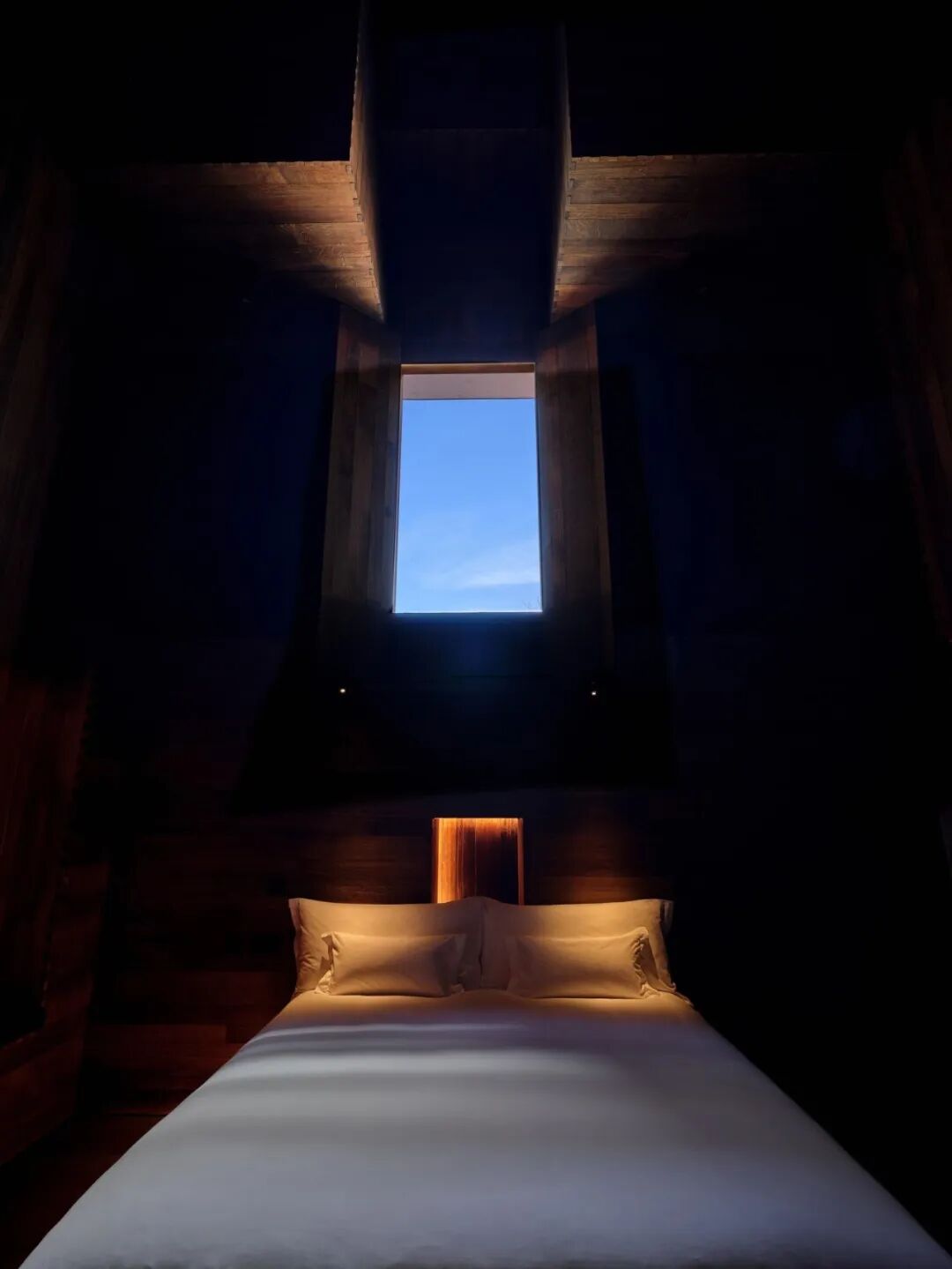
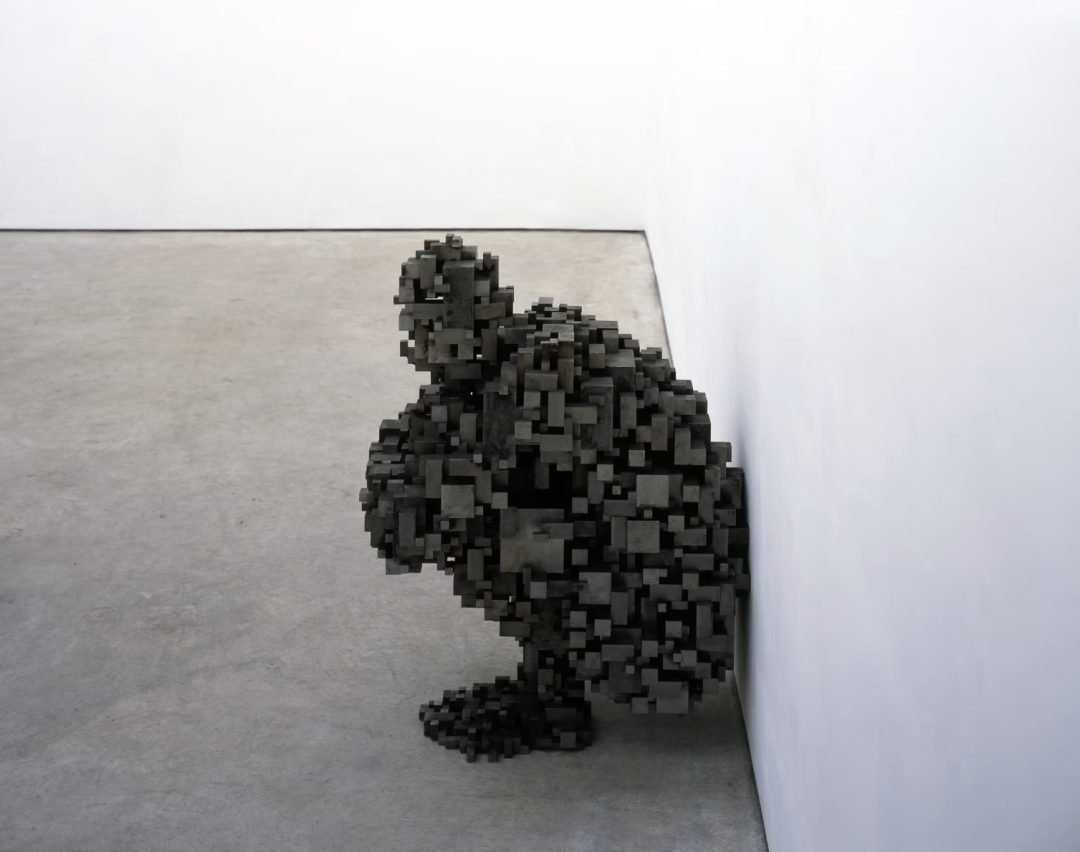
*Room*, created in 2014–2015, is a gigantic sculpture attached to the façade of the Beaumont Hotel. Composed of stacked cuboid blocks of varying size made of stainless steel, it presents as a vast, contemplative crouching human figure. The interior of this sculpture is a singular luxury suite within the hotel. Yet the suite’s core—the bedroom—is a ‘cavern’ wholly lined in dark wood, utterly soundproofed, and with no window or light source except a bedside lamp.
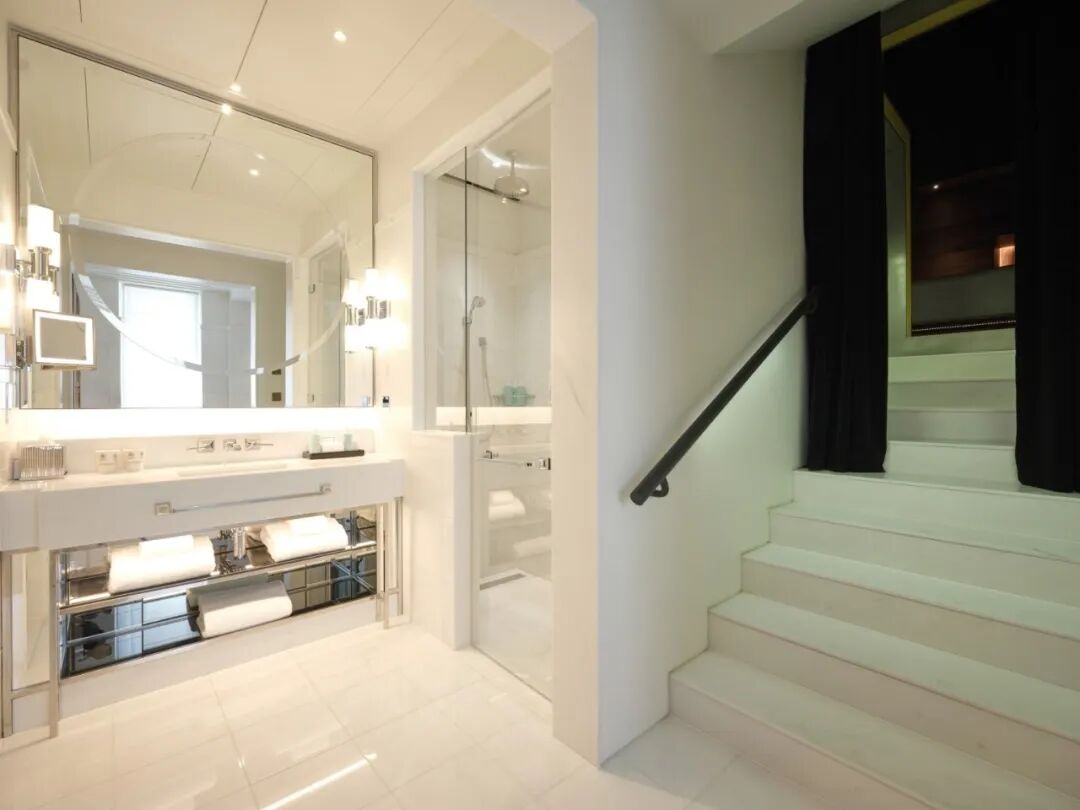
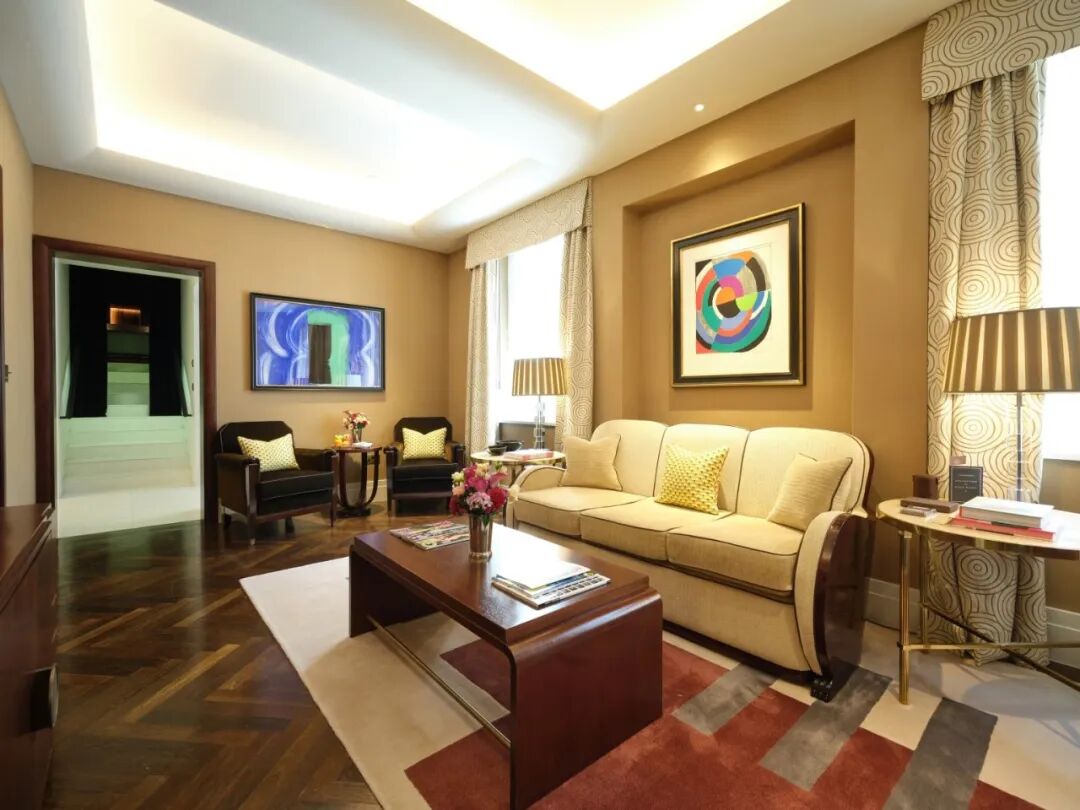
Here Gormley thoroughly breaks down the categorical boundary between the two traditional art forms of ‘sculpture’ and ‘architecture’. He exploits the extreme experience of ‘interiority’. When a guest sleeps inside this sculpture, you in effect enter the body of a giant, sleeping within its brain or abdominal cavity. It is an experience of returning to the mother’s womb, a state stripped of all external visual information and forced to examine the self from within. Gormley proposes a concept of ‘reverse architecture’. Ordinarily architecture provides shelter and functional space for the human body; here, a symbolic body itself becomes architecture. For today’s spatial designers, architects, and artists, this offers a highly suggestive idea: space is not merely a container that holds people; space itself can be endowed with the attributes of a body—posture, temperature, memory, breath.
(2) The Digitised Flesh
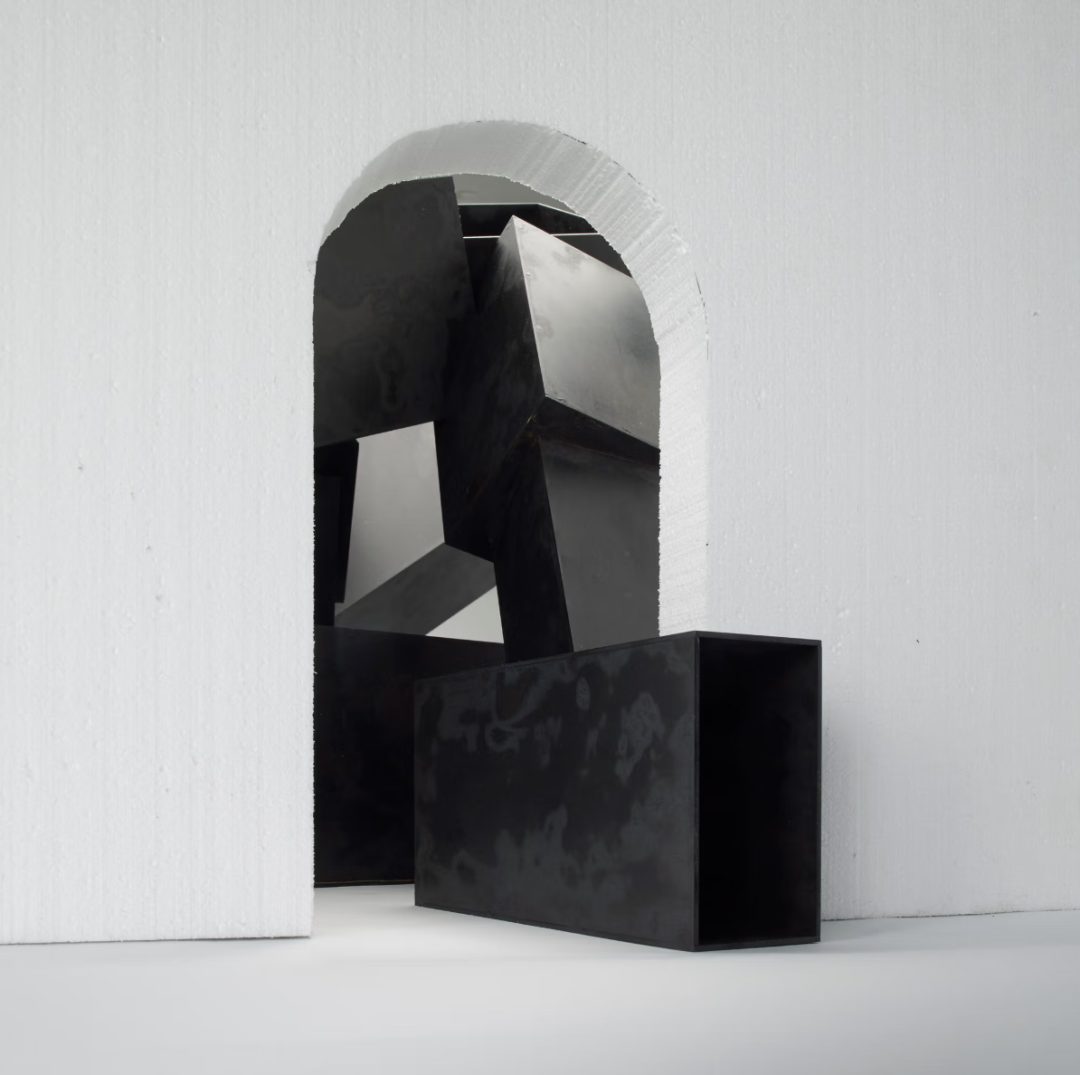
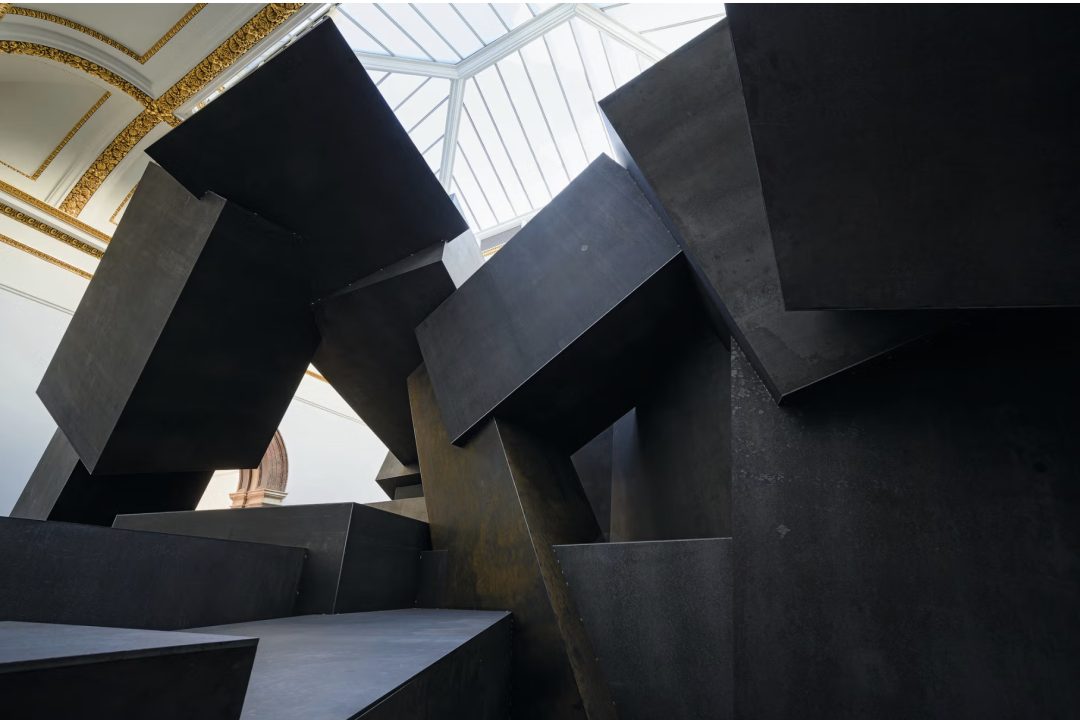
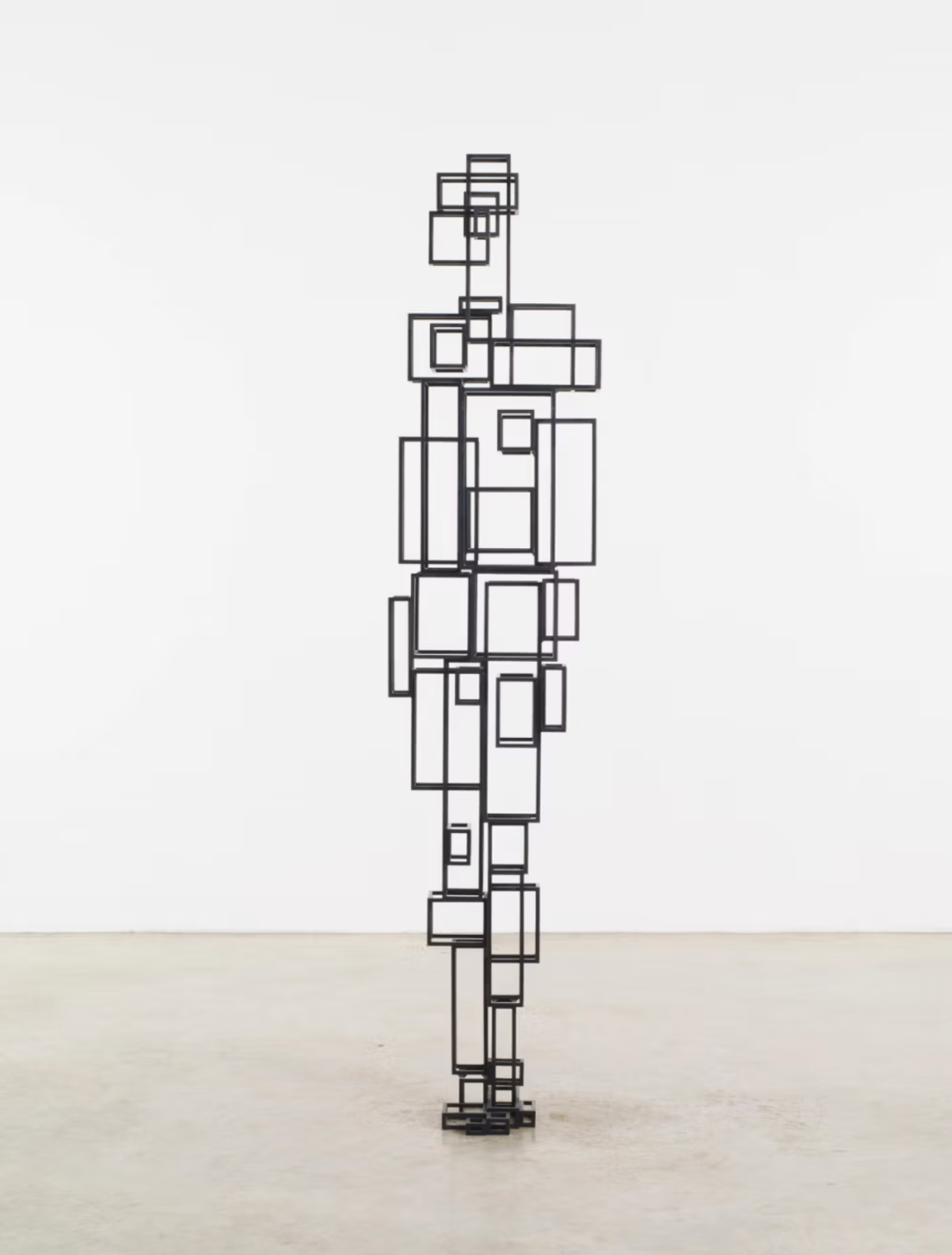
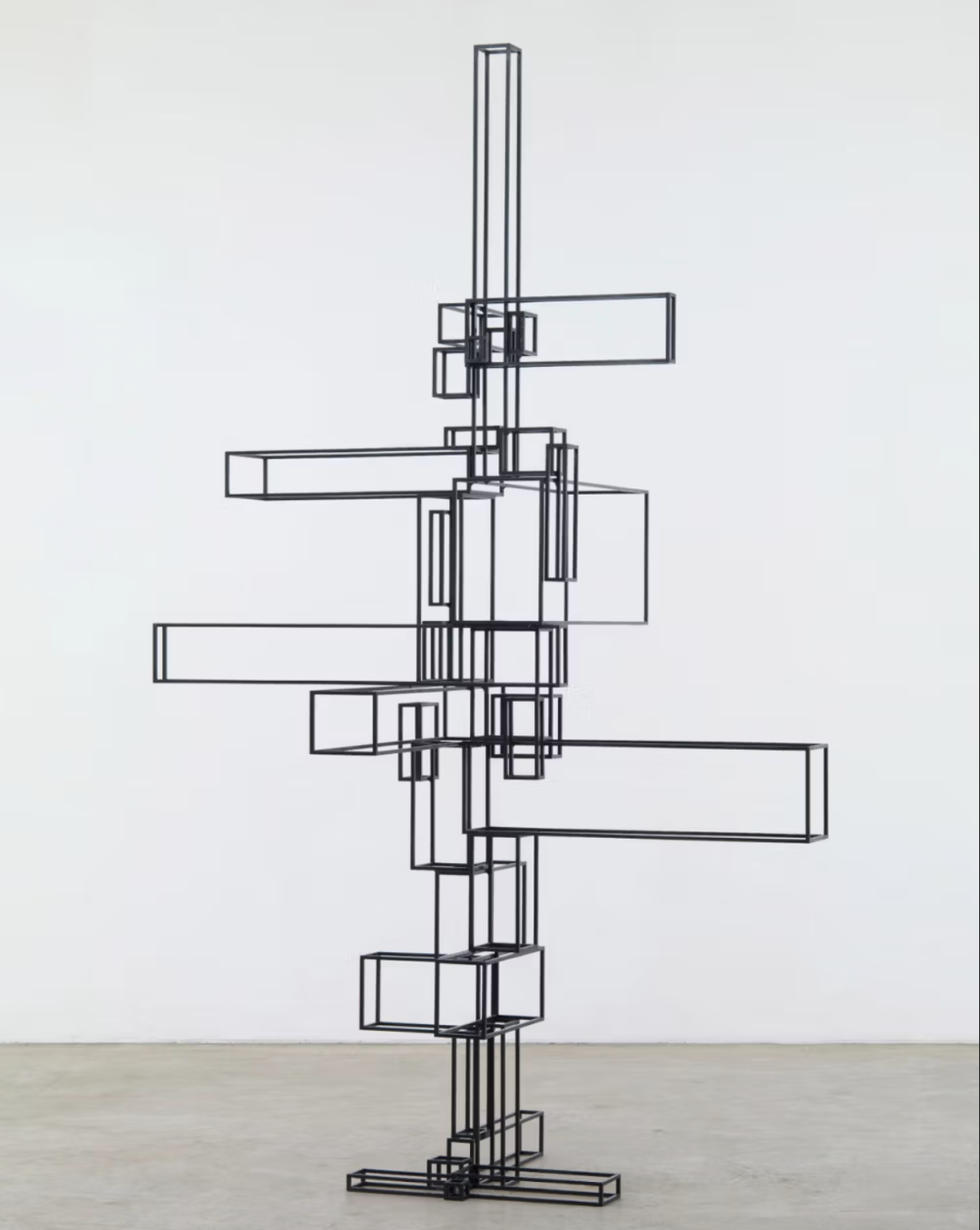
In series such as *Polyhedra*, *Framing*, and *Dwelling*, Gormley persistently explores the reconstruction of the human body using the language of architecture and the digital age.
Using industrial cast-iron blocks or stainless-steel frames, in a manner akin to building with toy bricks, he stacks up the body’s various postures—standing, walking, crouching, or falling. The visual effect of these works is highly distinctive: they look like human figures that have ‘glitched’ or been ‘pixelated’ in computer software because of low resolution. They are at once figurative and abstract, solid and permeable.
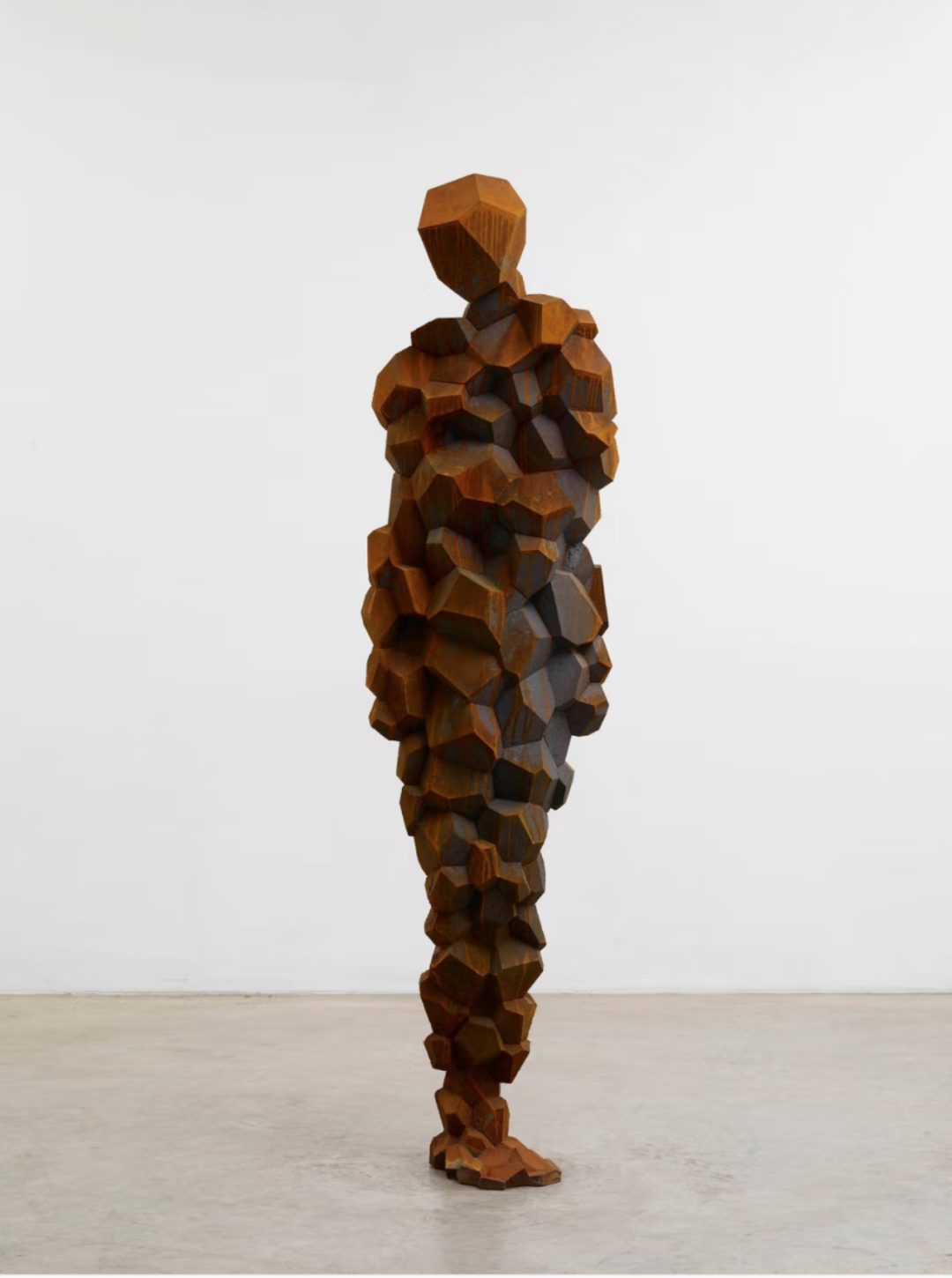
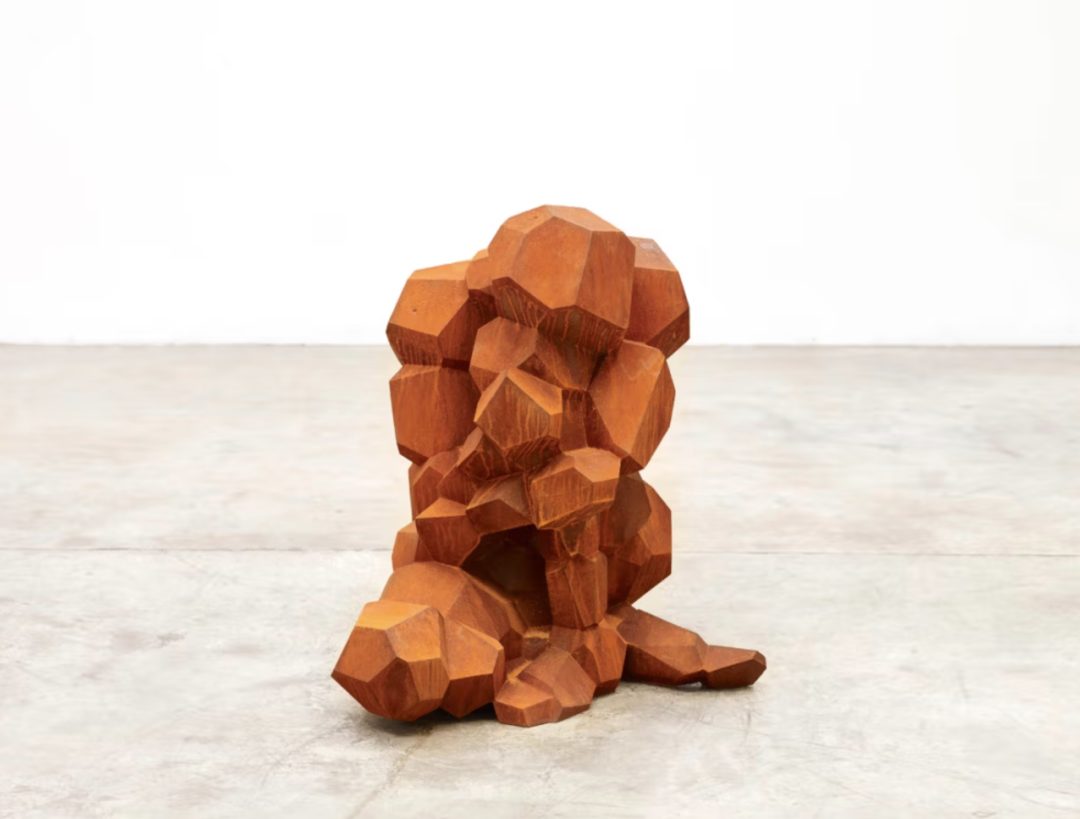
This series captures with precision the existential condition of humankind in the twenty-first century. Our flesh still exists in the physical world, yet our consciousness, sociability, and identity have become highly digitalised, networked, and fragmented. We live in an age where a virtual world of pixels and data overlaps with a physical world of atoms. Unlike some artists who simply embrace or criticise digital technology, Gormley adopts a more speculative strategy: he uses the heaviest, oldest, most physically tangible material (iron) to express the lightest, most virtual, most contemporary concepts (pixels, data). This enormous tension between material and concept is precisely the core source of these works’ affective power. They remind us that, even in the virtual world, our experience ultimately remains rooted in a flesh that feels gravity, temperature, and pain.
This reminds us that sculpture today should be adept at using contradictory materials to express complex concepts—for instance, using heavy materials to express lightness, eternal materials to render the fleeting, rough materials to construct precise logic. Such seemingly incongruous combinations often break the viewer’s habitual thinking and create a deeper, more enduring poetic and philosophical tension.
VII. The Energy Field: Escaping Gravity (2018–2022)
Having completed his deep exploration of the body as ‘substance’ and ‘structure’, Gormley’s art evolved once more in the late 2010s: he sought to shed entirely sculpture’s ‘mass’ and ‘volume’ and turn toward an exploration of pure ‘line’, ‘energy’, and ‘space’ itself.
(1) *Clearing*: Sculpture as Three-Dimensional Drawing
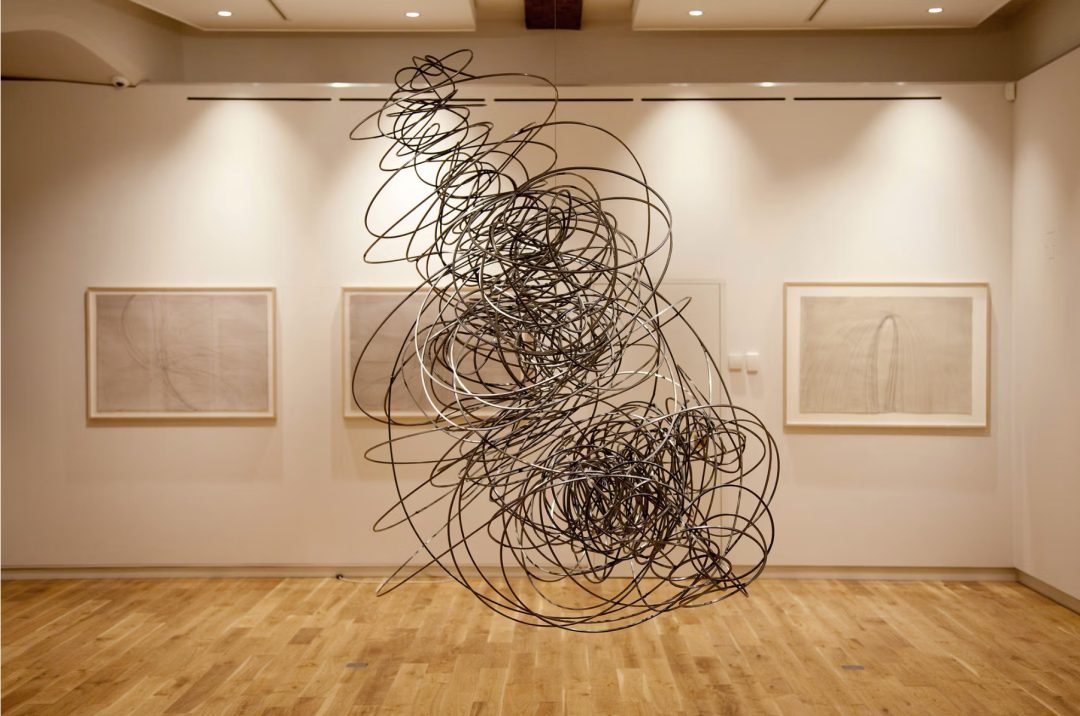
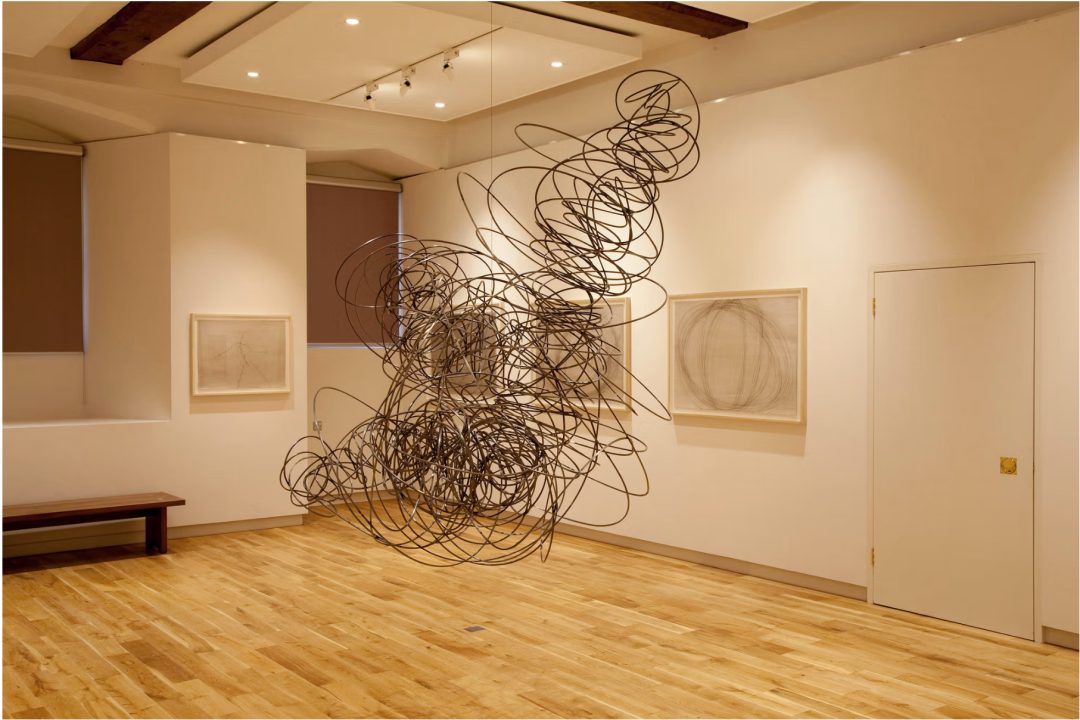
The *Clearing* series began in 2004 but grew increasingly radical in its later development. The artist uses kilometres-long, elastic square aluminium tubes that coil and knot through the exhibition space like a mad, runaway graffiti. These aluminium tubes have no fixed welding points or support structures, maintaining their form entirely through the tubes’ own tension and their mutual compression and support against walls, floor, and ceiling.
Traditional sculpture is ‘an object in space’ that viewers can walk around and look at. In *Clearing*, sculpture is the space itself, and viewers must carefully pass through it and enter it. You are no longer a safe bystander but are drawn into this chaotic, dynamic energy field. You must lower your head and lift your legs, stepping cautiously over those metal lines; every movement of your body becomes part of the interaction with the work. Gormley himself calls this work a ‘drawing in space’. He breaks not only the viewing perspective of traditional sculpture but also its stasis. The work’s name is a verb—‘Clearing’ (to clear, to cleanse, to open up a space)—rather than a noun, suggesting a continuously changing, ever-generating process rather than a finished result.
(2) *Breathing Room*: the Mandala of Light and Art within the Nervous System
In the *Breathing Room* series, Gormley pushes the exploration of immateriality to another extreme.
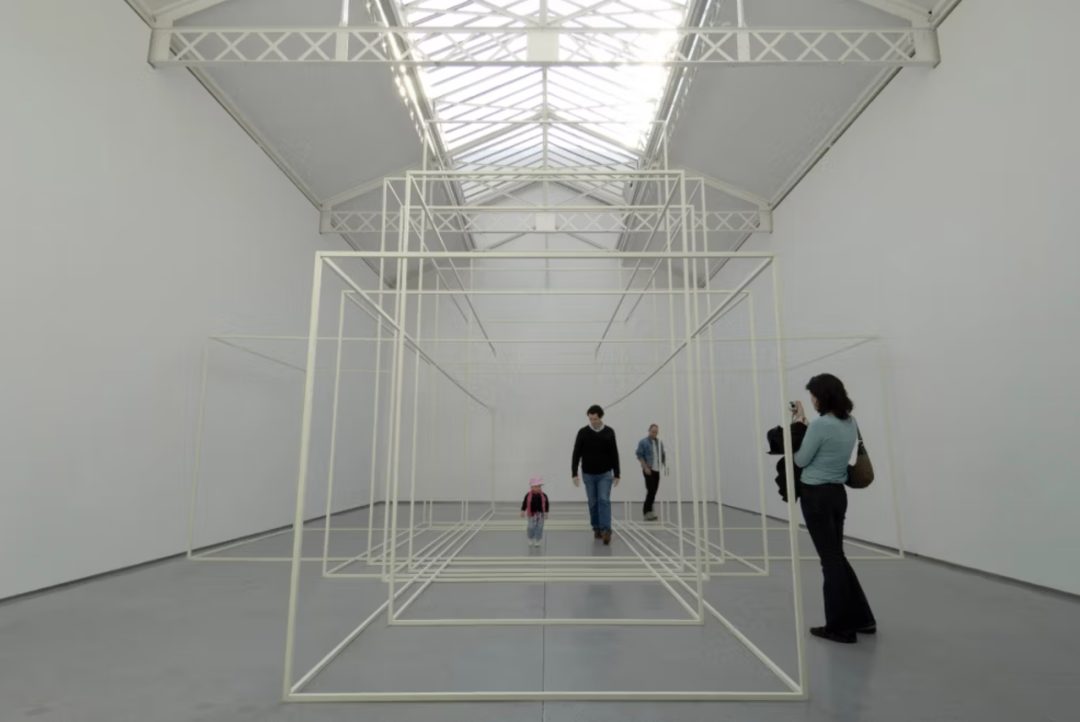
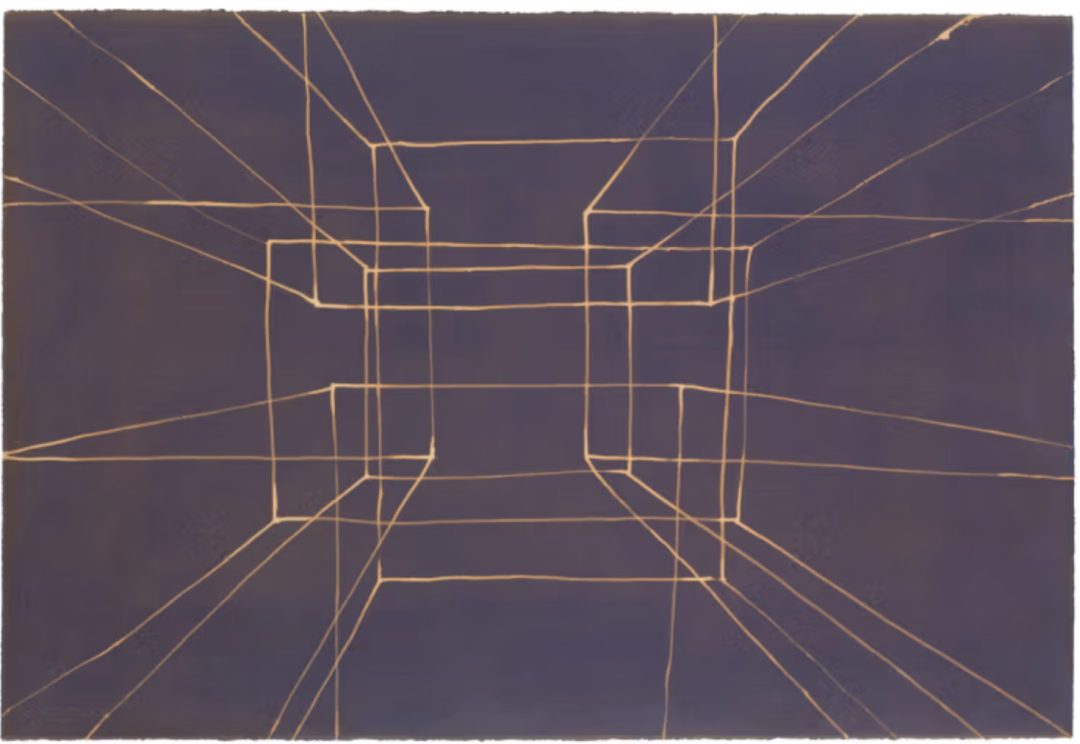
The artist coats a gigantic three-dimensional grid structure made of square frames with a glowing phosphorescent paint. The gallery is in complete darkness; every few minutes a brilliant light flashes for an instant, ‘charging’ these phosphorescent frames. After the light goes out, what the viewer sees in the absolute darkness is those spatial frames emitting a faint green glow. And when this faint glow too gradually fades, the afterimage left on your retina forms new, illusory frames.
The medium of this work is no longer metal or light, but the viewer’s own physiological mechanism. The artwork no longer exists wholly in external physical space, but is ‘produced’ within the viewer’s eyes and nervous system. This is an ultimate exploration of the concept of ‘dematerialised art’, turning the viewer’s body directly into the site and vehicle through which the artwork comes into being. Each flash of light is like a breath, creating in the darkness a briefly existing spatial structure like the stars of the cosmos or a Buddhist mandala, before returning to nothingness.
VIII. An Elegy for the Anthropocene (2023–2026)
Entering the mid-2020s, as global ecological crisis and climate change become ever more central anxieties of human society, Antony Gormley’s artistic vision has completed a grand-scale shift from ‘individual psychological space’ to ‘planetary consciousness’. His works no longer attend merely to the interior experience of the single body or to the social relations between people, but begin to consider the collective existence of the human species within the earth’s profound geological time and vast ecosystems. Exhibitions up to 2026—at Houghton Hall in Norfolk, among other sites—mark the maturity and culmination of his late style.
(1) *Time Horizon*: a Specimen of Geological Time
The large-scale outdoor installation *Time Horizon*, on view from 21 April to 31 October 2024 at the historic Houghton Hall, is the representative work of Gormley’s thinking in this period.
The exhibition comprises 100 life-size cast-iron sculptures, each weighing 620 kilograms. These sculptures are scattered across the estate’s 300 acres (approximately 121 hectares) of parkland, forest, and lakes. The work’s crucial core rule is this: all 100 sculptures, regardless of their position on the surface, are precisely installed on one and the same absolute horizontal datum.
This means that, on a rolling hill, a sculpture set high up may have most of its body buried underground, with only the crown of its head showing;
on flat grassland, a sculpture may stand precisely on the ground with both feet;
while in a low-lying valley or by a lake, a sculpture may be hoisted high atop a metal column to keep its feet at that uniform altitude.
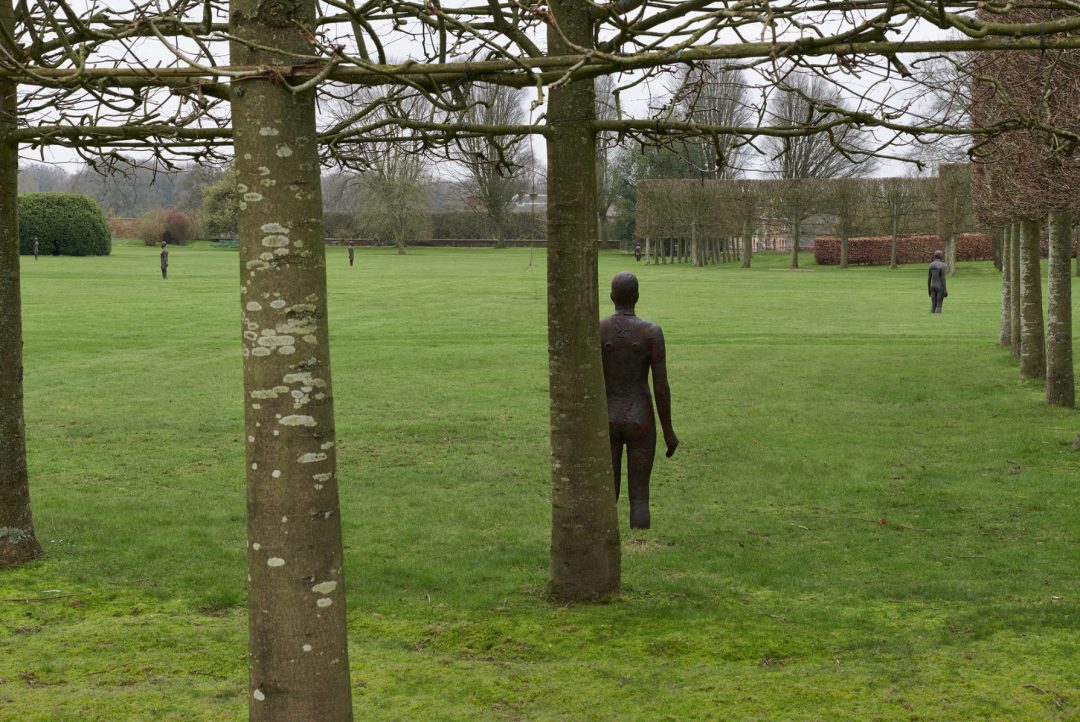
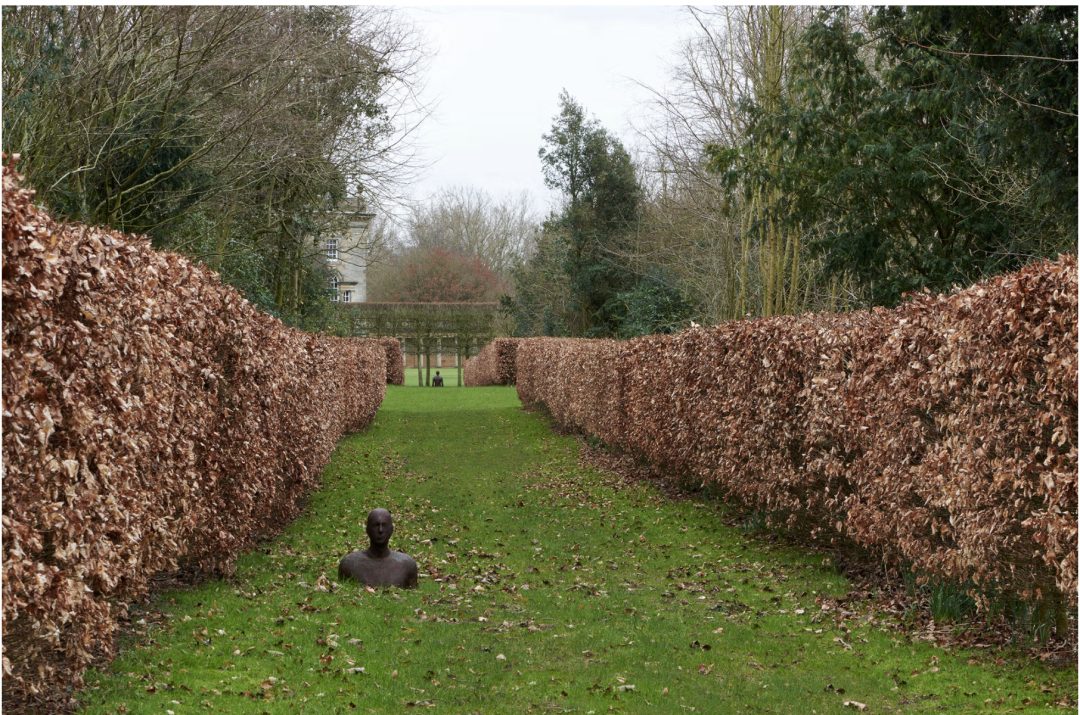
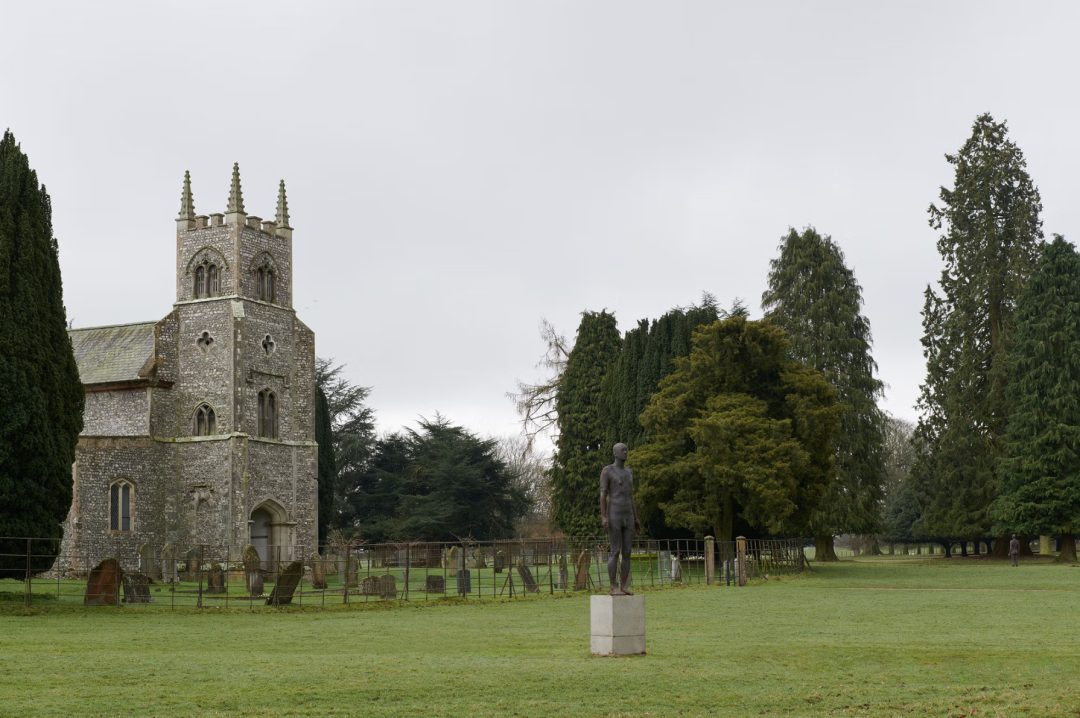
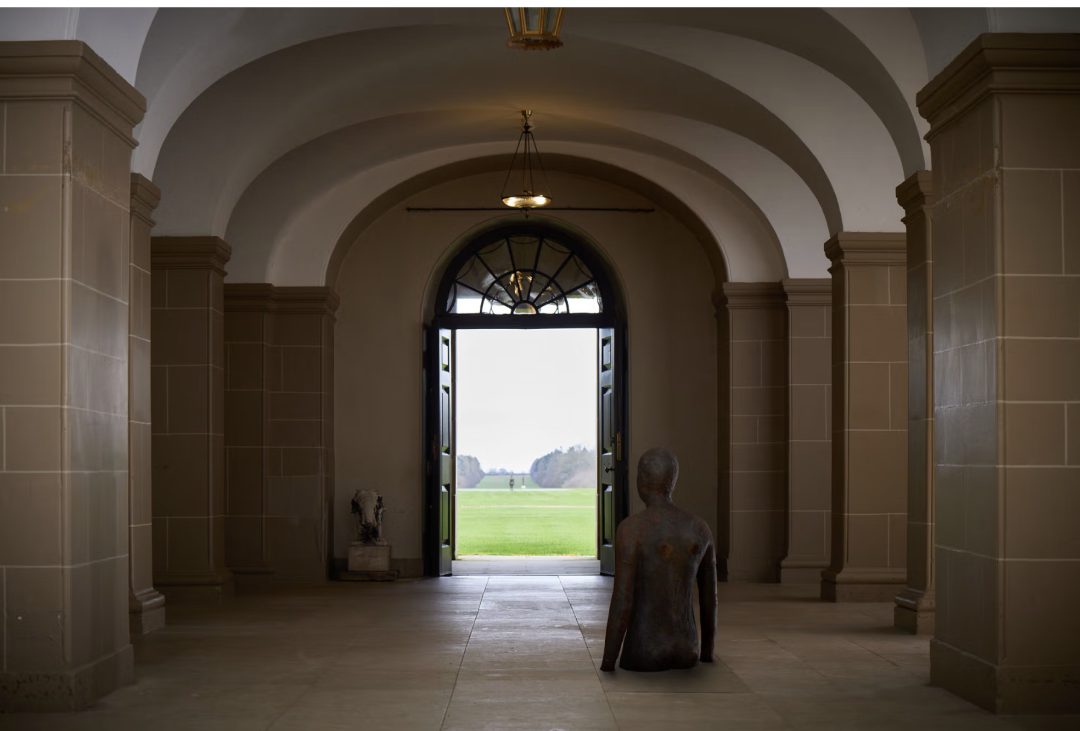
This sculptural ensemble carries profound conceptual and multiple meanings, analysed as follows:
1. First is the visualisation of geological time. This horizontal line, traversing the entire estate—invisible to the eye yet logically absolutely present—is like a gigantic scalpel that dissects the ‘landscape’ we ordinarily perceive. It is no longer a Romantic pastoral scene but a sample slice of geological time. This line represents an imagined geological stratum, an ancient sea level, or a future flood line. Through this means Gormley compels us to realise that the ‘ground’ we stand on and depend upon is not eternal and unchanging; it is merely an extremely brief and fragile skin within the earth’s hundreds-of-millions-of-years evolutionary history.
2. This sculptural ensemble also contains a reflection on the ‘Anthropocene’: these silent, industrialised human figures scattered across a seemingly ‘natural’ landscape are themselves a visual annotation of the Anthropocene, this new geological concept. They resemble surveyors measuring the land, or sentinels awaiting an unknown future, or even remains partially excavated from future strata. They juxtapose humanity’s brief, century-counted life cycle with the earth’s profound, hundreds-of-millions-of-years timescale, provoking meditation on humanity’s role, impact, and ultimate fate within the earth’s ecosystem. Some commentary notes that these sculptures, like ‘acupuncture’, precisely pierce the environment’s acupoints, entering into complex dialogue with trees, buildings, animals, and the ever-changing weather.
3. The Relation between Collective and Individual: although each sculpture’s specific environment and outward form differ, they are ontologically equal, co-belonging to that single ‘time horizon’. This metaphorises the human condition: though each of our lives differs vastly, we co-inhabit one and the same planet, facing a shared ecological future.
What we artists can learn is to find and set a ‘constant’. In an apparently chaotic environment full of variables, establish an absolute, immovable rule (a uniform altitude, a uniform orientation, a uniform time interval, and so on). Then let the environment’s own variables (terrain, light, vegetation, foot traffic) continually strike against, challenge, and interpret that rule. In this collision, meaning emerges naturally, as in a chemical reaction. This is a sophisticated creative strategy of ‘using four ounces to deflect a thousand pounds’.
(2) A Look Back from 2026: Synthesis and a New Starting Point at the Nasher Sculpture Center
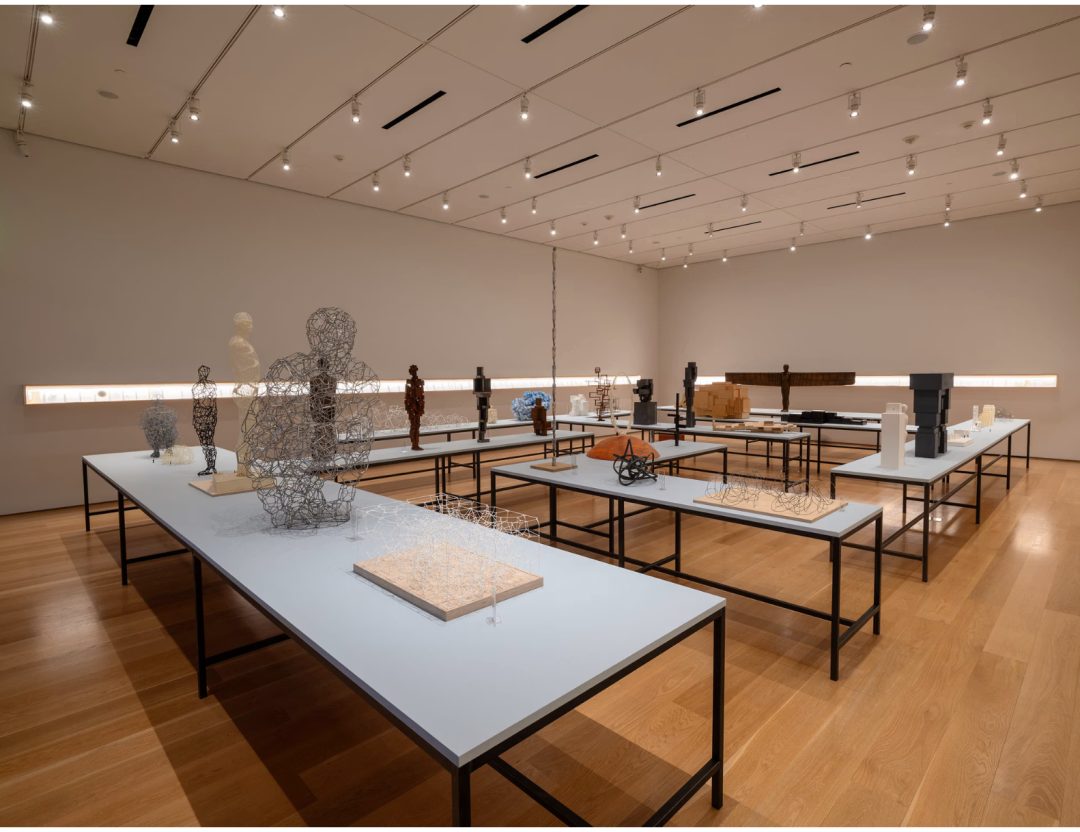
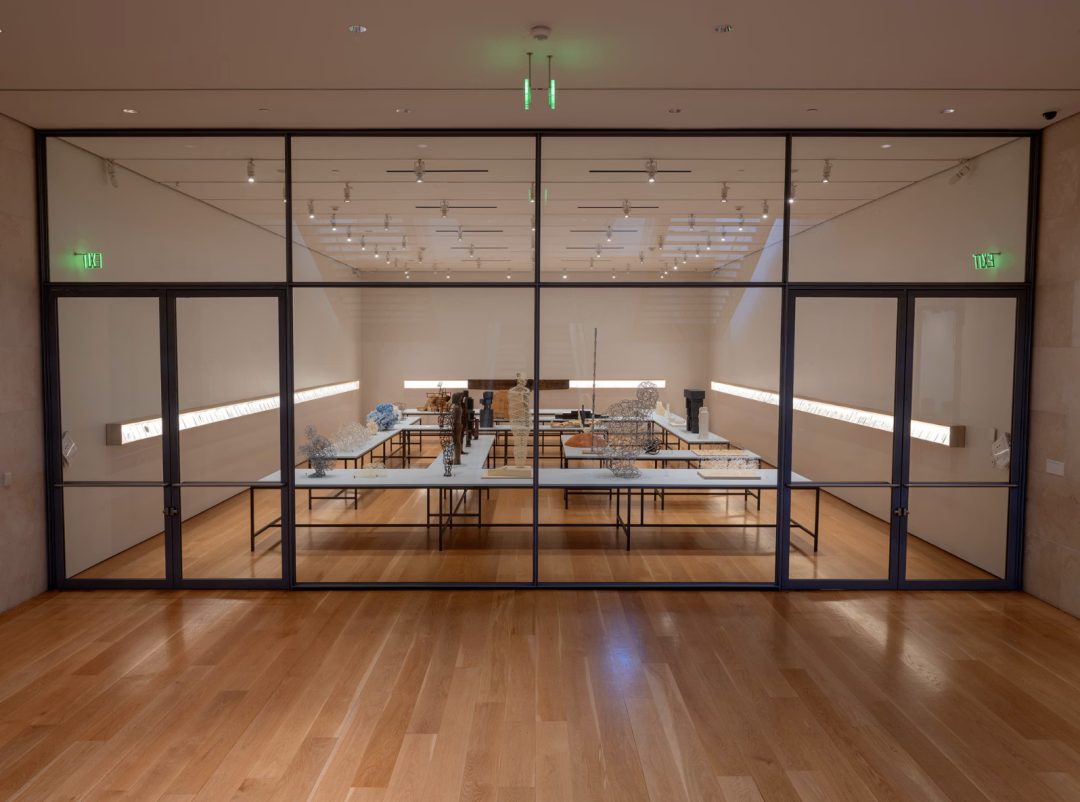
In the large-scale retrospective *SURVEY: Antony Gormley*, held at the Nasher Sculpture Center in Dallas, USA, from 13 September 2025 to 4 January 2026, Gormley undertook a comprehensive review and synthesis of his nearly fifty-year artistic career. Curated by the Nasher’s chief curator Jed Morse, the exhibition not only traced the evolution of his work from the experimental pieces of the early 1980s to the present, but also, through the display of numerous models, manuscripts, and working notes, revealed the inner logic of his creative thought.
As of early 2026, a new direction evident in this exhibition is his final reckoning with ‘the skin of the body’, the starting point of his career. In his newest works, made specially for this exhibition, he has begun to experiment with more permeable organic materials combined with traditional metal structures, probing more deeply the more complex osmosis between body and environment. In these new works the body is no longer the solid fortress defended by lead sheeting of the 1980s, nor the rigid structure assembled from architectural modules of the 2010s, but more like a semi-permeable membrane—a fragile, sensitive filter in constant exchange of matter, energy, and information with the external world.
This marks the final movement of his thought from a ‘modernist confrontation’ (body against space, human against nature) toward an ecologically infused ‘symbiosis’ more resonant with Eastern philosophy (the body as part of the environment, human and nature mutually permeating one another). This opens new possibilities for his future work and for sculpture as a whole in the post-human age.
IX. Ten Strategic Lessons for Artists
Looking back over Antony Gormley’s nearly half-century-long artistic career, we can distil the following ten core strategies for later practising artists. These strategies are not merely techniques for ‘how to make art’ but a methodology for ‘how to think’ and ‘how to exist’:
1. Indexical Truth: Reduce the Subjective, Embrace the Trace of Reality.
Do not attempt to ‘depict’ or ‘beautify’ the world; instead design a mechanism by which the world directly leaves its ‘trace’ in your work. Gormley moulds directly from the body; his truthfulness derives from physical contact rather than artistic skill.
Seek out media and means that record reality directly—rubbings, sound sampling, data capture, chemical reaction, and the like—minimising as far as possible the artist’s subjective embellishment as ‘translator’. Trust the power of reality itself; it is often more impactful than any fabricated beauty.
2. Transform Constraint into a Unique Resource: What You Have Is What You Need.
Gormley’s early creative conditions were extremely limited: no large studio, no budget to hire models—so he could only use his one free resource: his own body. This very constraint, in turn, gave rise to his most distinctive artistic language.
Thus, poverty of circumstance, a cramped room, the cheapest materials at hand—these apparent ‘constraints’ are precisely the artist’s most distinctive, irreproducible starting point. Do not wait for perfect conditions; begin from the real state you already inhabit.
3. The Power of Repetition and Aggregation: Quantitative Change Triggers Qualitative Change.
One clay figure is a craft object; the 40,000 figures of *Field* form a spiritual ocean. One iron figure is a sculpture; the hundred iron figures scattered across the beach in *Another Place* constitute a landscape phenomenon.
When you cannot find a breakthrough in form or concept, try extreme accumulation of quantity. Repeating a simple gesture, or gathering a great many identical objects, yields a visual and psychological effect far greater than the sum of its parts.
4. Silence Is the Loudest Noise: Create a Field of Silence Amid the Clamour.
Gormley’s sculptures never shout; they have no expression, no exaggerated gesture, tell no specific story. This ultimate silence, in today’s society of information overload and visual explosion, constitutes instead the most forceful counterpoint and the most striking presence.
So learn to ‘subtract’. In an age when everyone tries to speak loudly, to create a space where viewers fall silent and hear their own heartbeat is itself a radical artistic act.
5. Activate Residual Space: Art Is Everywhere.
The stage of art is far more than the central plinth of the museum. Gormley placed sculpture at the overlooked edge of a roof, in the forgotten intertidal zone of a beach, even in the corner of a gallery ceiling.
Observe your surroundings closely; seek out those neglected, marginal, transitional ‘residual spaces’. Let your work, like acupuncture, precisely intervene in these forgotten corners and activate the energy of the entire space.
6. De-Skilling and Social Participation: the Artist as Catalyst.
In the *Field* project, Gormley relinquished the privilege of ‘the artist’s hand’, letting hundreds and thousands of ordinary people become co-creators. He moved from being a maker to becoming a setter of rules and a guide of process.
This prompts a rethinking of the artist’s role. You need not complete every detail of the work by your own hand. You can design an open system or a simple set of rules, invite public participation, and let their energy and wisdom complete the work together. This not only gives the work a broader social foundation; the unpredictability of the result is itself full of allure.
7. Material as Metaphor: Let the Material Speak for Itself.
Lead’s toxicity and impermeability, iron’s rust and sense of time, light’s immateriality and instantaneity, clay’s primitiveness and plasticity. Gormley never chooses materials at random; each choice extends his concept.
When choosing materials, do not consider only their formal properties (colour, shape); investigate their physical and chemical attributes more deeply, and unearth the cultural, historical, and symbolic metaphors behind them. Let the material itself become part of your work’s narrative.
8. The Body as Place, Not Object: Begin from Within
This is the core of Gormley’s entire philosophy. Do not see the body as a ‘thing’ to be looked at and depicted, but understand it as a complex ‘place’ that carries memory, perception, emotion, and cosmic energy.
So, in your practice, try to shift your perspective. Construct the work from the internal (first-person) perception and experience, rather than scrutinising it merely from the external (third-person) visual vantage. Reflect on how, through the work, to make viewers more aware of the existence of their own bodies.
9. Accept Fragility and Entropy: Collaborate with Time.
Gormley allows his sculptures to rust in seawater, to be overgrown with barnacles, to be eroded by time. He regards the process of natural change as part of the work’s life, not as a defect.
Do not cling to creating an eternal, perfect, unchanging object. Learn to let go, and let time, natural forces, the viewer’s touch, and chance become your collaborators. The work’s evolution and ‘decay’ may be more meaningful than its initial state.
10. Universality Arises from Extreme Specificity: Strip Away Narrative, Touch the Core.
Although Gormley always uses his own unique body as a starting point, he transforms it—by erasing facial features, simplifying form—into a generic, anonymous ‘human’ archetype.
As an artist, begin from your most personal, most specific experience and feeling, but through abstraction, distillation, and simplification, strip away those overly trivial personal narratives meaningful only to yourself, thereby reaching the shared human emotions and existential predicaments capable of wide resonance.

Afterword
Antony Gormley’s excellence lies in how, throughout his life, he has used the oldest, most cumbersome, most materialised medium—sculpture—to answer the most contemporary, most urgent, most future-bound question: in an increasingly digitalised, virtualised, globalised, and ecologically fragile world, what does it mean to possess a finite, real, flesh-and-blood body?
From the claustrophobic, solitary individual wrapped in lead sheeting in the 1980s to the planetary citizens standing together on the horizon of geological time and resonating with all ecological beings in 2026, his art has always done one and the same thing: measure the distance between the human body and space, time, others, and the universe itself. His works offer us silent coordinates, enabling us, amid the immense uncertainty of existence, to perceive and re-establish our own position.
For fellow artists in 2026 and beyond, perhaps the greatest inspiration Antony Gormley leaves is not those iron figures or steel structures scattered across the world, but a firm conviction: art need not always chase the rapid turnover of technical media; it can choose to slow down, return to the body, return to the earth, and re-establish human value and dignity in profound silence.
His works never offer cheap consolation or clear doctrine. On the contrary, they often place us in a state of unease, bewilderment, even fear. Yet it is precisely within this perceptual shock jointly built by matter, space, and body that we are forced to stop and re-examine our own existence. His sculpture, in the end, points not to the artist himself but to each of us who looks—that conscious being dwelling within the body, briefly existing in time and space.
As the philosopher Wittgenstein said: ‘The limits of my language mean the limits of my world.’ Through half a century of practice, Antony Gormley has vastly expanded the boundaries of ‘sculpture’, that ancient language, enabling it to speak the most ineffable inner experiences of existence. His contribution lies not in how many tonnes of steel he left behind, but in the powerful ‘bodily method’ he bequeathed us—a means of probing, through matter, who we are and where we are, which for every age and every individual remains eternal and unfinished.
订阅艺术评论
订阅即赠《2024中国当代艺术关键词》内部思考笔记 PDF
每周免费获取最新当代艺术批评与研究