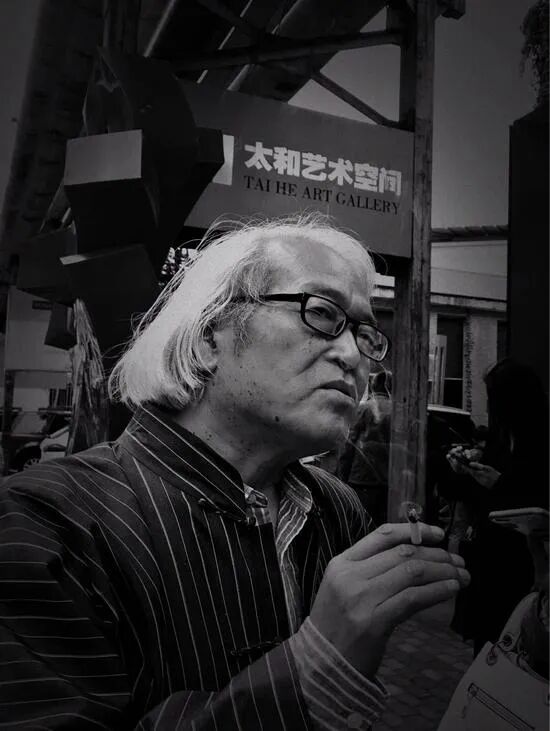
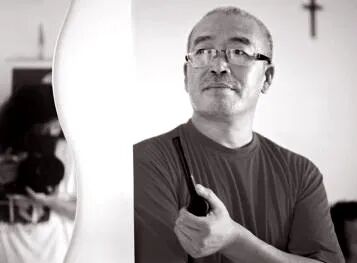
On 1 September 2025, the world of Chinese contemporary art lost a quiet and profound seeker. The veteran art critic, poet and painter Dao Zi (né Wang Min) passed away after a long illness at the age of sixty-nine.
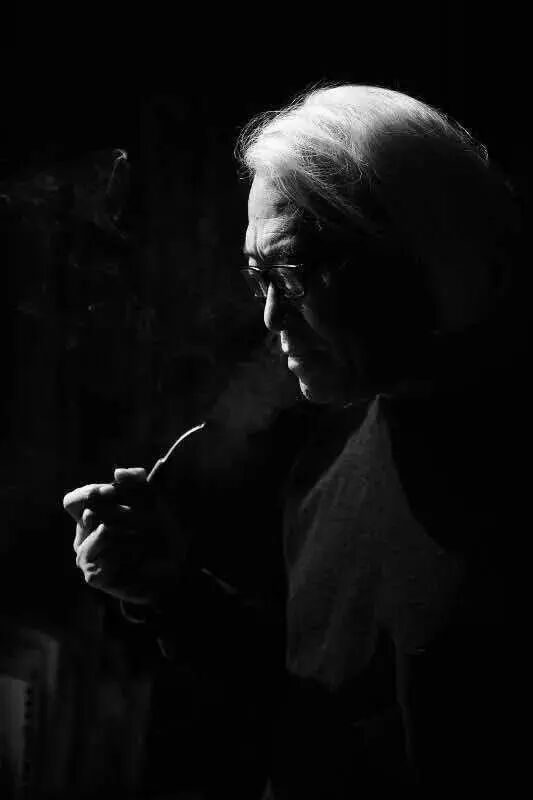
The news was met with grief throughout the art world. What we mourn is not only a learned and sharp-witted scholar, a critic who raised the banner of contemporary art theory during the ’85 New Wave, but also a solitary pioneer who lived his faith with his whole life, seeking to graft a divine radiance onto the ancient roots of Chinese ink painting. His departure leaves a long resonance for an era, and a legacy of thought concerning art, faith and existence for those who come after.
As a younger member of the community of art theory, the most I can offer this elder is a tentative account of his life’s contributions. This is more than an elegy for the dead; it is a return and a revisiting, an attempt, in this cacophonous age, to listen once more to the enlightenment conveyed by his ‘Holy Ink’ and to understand the spiritual steadfastness and tireless inquiry of an intellectual amid the transformations of his time. Of course, the richness of his life can never be exhausted by these few words. The fragility of life lies beyond our control; all we can do is inherit his will and continue his ideals, so as not to betray this weighty reflection.
I. Origins
1.1 Qingdao: The Coast of Poetry and the Awakening of Literature
In November 1956, Wang Min was born in the coastal city of Qingdao. Steeped in the sea and in European architecture, the city endowed his life with a dual temperament of romance and reflection. His pen name, ‘Dao Zi’, perhaps grew from this memory of home: an intellectual raised between land and sea, at the intersection of native culture and foreign currents of thought, was destined to spend his life searching between ‘this shore’ and ‘the further shore’.
Dao Zi’s scholarly career did not begin with art but with literature. He displayed exceptional poetic gifts in his youth and emerged as an experimental poet on the Chinese poetry scene of the 1980s. In 1987 he published *Selected Experimental Poems of Dao Zi*; with its modernist idiom and deep excavation of the inner world, this collection stands as a witness to an era of intellectual emancipation and cultural renewal. Poetry, as the starting point of his thought, shaped the defining qualities of his criticism and his art: a sensitivity to language, an ultimate concern for metaphysical questions, and a passion that reached beyond surface appearances to the very essence of life.
This literary cultivation also surfaced in his early work as a translator. In the 1980s, as the country opened its doors and Western currents of thought poured in, Dao Zi’s keen scholarly instinct led him to translate *Selected American Confessional Poems* (1988) and *The Burning Witch: Selected Poems of Sylvia Plath* (1992). The ‘confessional’ poets, with their courage to confront inner wounds and tear away disguise, left a deep mark on him. What he saw was not merely a literary technique but an attitude of existence — an honesty that refused falsehood and dared to reveal the abyss of human nature. This pursuit of ‘truth’ runs through all his later criticism and art.
1.2 Xi’an and Chongqing: Speaking from the Frontlines of the Era
In the 1980s, Dao Zi graduated successively from the Chinese Department of Northwest University and the programme in literary theory at Beijing Normal University, earning bachelor’s and master’s degrees in literature. Thereafter his life became closely entwined with the turbulent rise of Chinese contemporary art. He served as deputy editor of the literary monthly *Chang’an*, published by the Xi’an Federation of Literary and Art Circles; this post allowed him to observe and take part, at close quarters, in the ’85 New Wave — the most important enlightenment movement in the history of Chinese contemporary art.
The ’85 New Wave was the concentrated expression of an intellectual emancipation movement in the field of art. With great enthusiasm, young artists challenged the previously monolithic, instrumental conception of art, embraced the various schools of Western modernism, and conducted bold formal and conceptual experiments. Within this current, Dao Zi — a critic who was at once poet and scholar — played the vital roles of ‘interpreter’ and ‘theorist-promoter’. Drawing on his deep grounding in literary and art theory, he provided this seemingly chaotic art movement with an intellectual compass and theoretical support. What concerned him was not only the revolution in artistic language but, more profoundly, the awakening of humanist spirit behind it: how art might once again become the expression of individual spiritual freedom.
He then went south to teach at the Sichuan Fine Arts Institute, where he served as director of the Department of Art History and Theory and vice-chair of the Chongqing Literary Critics Association. The Sichuan Fine Arts Institute was a stronghold of the ’85 New Wave, birthplace of ‘Scar Art’ and ‘Ruralist Painting’, and home to such far-reaching artists as Luo Zhongli and Zhang Xiaogang. There, Dao Zi combined his theoretical reflection with the practice of art education, nurturing a cohort of incisive new art critics. His courses — ‘The Study of Art Criticism’, ‘The History and Theory of Modern Art’ — opened a window onto the avant-garde theories of the West for his students, urging them to examine the development of Chinese contemporary art with an independent and critical eye.
1.3 Beijing: The Maturing of Thought and the Return of the Spirit
At the turn of the millennium, Dao Zi’s scholarly career entered a new phase. He moved to the Academy of Arts and Design at Tsinghua University as a professor and doctoral supervisor. In Beijing, the nation’s cultural centre, the reach of his thought expanded further. It was precisely in this period that the centre of gravity of his scholarship and creation underwent a profound ‘turn’ — from the introduction and critique of Western postmodern thought toward an exploration of the synthesis of Christian theology and indigenous Chinese art.
This turn was no accident. As early as 1989 Dao Zi first encountered Christianity, and in 1998 he was formally baptised. The establishment of faith gave him an entirely new, transcendent vantage point from which to reflect on the modernisation of Chinese society and the predicament of contemporary art. He saw that, amid the tides of consumerism and the market economy, art was gradually losing its critical edge and spiritual dimension, reduced to a vassal of capital and a plaything of the market. With anguish he observed: ‘Since the turn of the new century, contemporary art has in fact sunk into a rather wretched state: on the one hand the official promotion of the industrialisation of art, and on the other the spirit of avant-garde art being erased by the hegemony of capital.’
He keenly realised that the ‘deconstructive’ power of Western postmodern theory alone was no longer sufficient to resist this spiritual nihilism. Art needed a force of ‘reconstruction’, a spiritual resource capable of settling the soul and providing ultimate concern. He therefore turned his gaze to his own faith and began an unprecedented artistic experiment — the creation of ‘Holy Ink’.
From the poetic coast of Qingdao to the artistic frontlines of Xi’an and Chongqing, and on to the heights of thought in Beijing, Dao Zi’s life was a path of continually crossing boundaries and searching ever inward. From literature to art criticism, from introducing Western theory to returning to his own faith, every step fell upon the pulse of the spirit of his age. He was not merely a scholar in his study but a thinker and practitioner who invested his entire life in the attempt to find a spiritual way out for Chinese contemporary art.
II. Reflection
In Dao Zi’s career as an art critic, two works stand as unavoidable monuments: first, his translation of the French philosopher Jean-François Lyotard’s *The Postmodern Condition: A Report on Knowledge* (1995), and second, his monumental own book *A Genealogy of Postmodernist Art* (2001). Together these established his standing as one of the earliest and most systematic Chinese scholars to introduce and study postmodern art theory.
2.1 The End of the ‘Grand Narrative’: What Lyotard’s Translation Taught Us
In 1995, Dao Zi’s translation of *The Postmodern Condition* was published and sent shockwaves through Chinese intellectual and artistic circles. Lyotard’s central claim — that the ‘postmodern’ is precisely incredulity toward ‘metanarratives’ or ‘grand narratives’ — fell like a bolt of lightning, illuminating a China then in the painful throes of transition.
By ‘grand narrative’ is meant those vast theories that provide a society with its foundations of legitimacy and a universal explanatory power — such as the Enlightenment’s ‘narrative of liberation’ or Marxism’s ‘narrative of revolution’. In the ’85 New Wave, what the artists rebelled against was precisely the dominant, politically servile grand narrative of ‘revolutionary realism’. Yet once the old narrative was broken, where was the new direction?
Lyotard’s theory offered an explanation for the ‘crisis of legitimacy’ in Chinese contemporary art. It made people aware that the era in which a single theory and uniform style sought to govern all artistic creation was gone for good. Art entered an age of ‘little narratives’ — an age of pluralism, difference and uncertainty. The artist was no longer an illustrator of grand ideas but a presenter of individual experience.
Through translating Lyotard, Dao Zi did more than transmit knowledge; he introduced a profound ‘problem consciousness’. He forced the Chinese art world to think: after bidding farewell to the collectivist grand ideal, how is art to face a fragmented, value-plural society? How can individual experience acquire public significance? This clear-eyed awareness of the ‘postmodern condition’ became the ground tone of Dao Zi’s later criticism.
2.2 The Theoretical Ambition of *A Genealogy of Postmodernist Art*
If translating Lyotard was a matter of ‘bringing in’, then writing *A Genealogy of Postmodernist Art* was Dao Zi’s monumental effort to systematise this complex current of thought and to think it through in local terms.
The book’s subtitle hints at its distinctive method. It is not a traditional, linear, chronological art history, but adopts the ‘genealogical’ method of the French philosopher Michel Foucault. Foucault’s genealogy is concerned not with the origins and continuity of ideas but with their ruptures, dispersals and mutations across different historical periods and fields of power-discourse.
In the book’s preface, Dao Zi states explicitly that he regards the entire postmodern phenomenon as ‘a contested field of multiple power-discourses and an organically connected apparatus of knowledge’. What he sets out to do is ‘explicate the historical conditions and theoretical roots behind the phenomena’ and to interrogate ‘the plural standpoints that follow the linguistic-aesthetic turn’.
The book is divided into three parts — ‘Historical Genealogy’, ‘Theoretical Genealogy’ and ‘Artistic Genealogy’ — revealing the author’s vast intellectual horizon. From Nietzsche’s ‘death of God’ to Heidegger’s ‘ontology’ and on to Derrida’s ‘deconstruction’, he systematically traces the intellectual sources of postmodernism. On this basis he offers a penetrating analysis of the principal postmodern genres — Pop Art, performance art, installation and concept art — revealing how, through a subversive language, they challenge traditional artistic institutions, elitist aesthetic notions and the cultural logic of capitalism.
The significance of this book for Chinese contemporary art is evident in at least three respects:
First, it provides a systematic theoretical framework. Before this, Chinese art circles understood postmodernism only fragmentarily and impressionistically. Dao Zi’s book, like a detailed map, clearly marks the positions of the various schools and thinkers and their interrelations, greatly deepening the theoretical rigour of Chinese art criticism.
Second, it injects a critical spiritual force. Dao Zi did not simply embrace postmodernism. Throughout the book he maintains a vigilant posture, ‘interrogating the paradoxical logic of capitalist culture’ and criticising the possible tendencies toward ‘kitsch’ and ‘play’ in postmodern art. He saw that postmodern ‘deconstruction’ is a double-edged sword: even as it breaks authority, it can also dissolve meaning and reduce value to nihility. This criticality lifts his research above pure scholarly discussion and endows it with a strong concern for reality.
Finally, it opens the possibility of localised reflection. By sorting through the genealogy of Western postmodern art, Dao Zi was in effect holding up a mirror to Chinese contemporary art. He prompted people to ask: how does China’s ‘postmodern’ differ from the West’s? How can Chinese artists, while drawing on Western experience, respond to their own cultural tradition and social reality? This question leads directly to his later practice of ‘Holy Ink’.
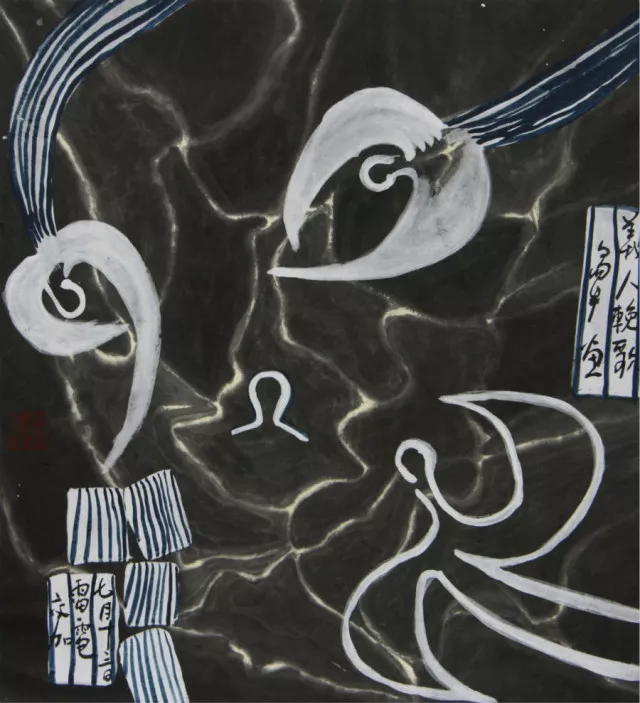
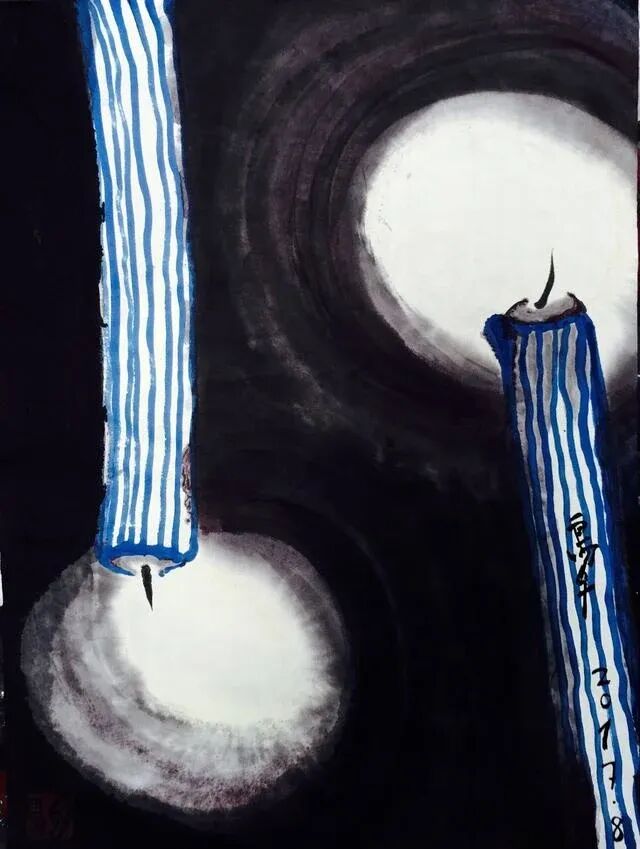
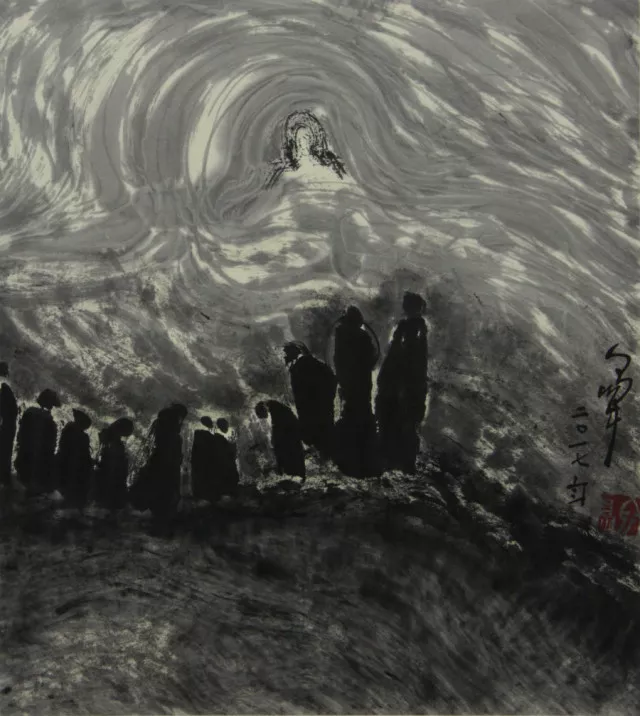
Dao Zi, *The Blind Angel Weaving Lightning into the Captive Skull*, ink on paper, 50 × 28 cm, 2017
2.3 The ‘Metamorphosis of the Concept’ in Chinese Contemporary Oil Painting
Even while attending to Western theory, Dao Zi never took his eyes off the artistic practice of his own country. His 2000 book *Studies in Chinese Contemporary Oil Painting: The Metamorphosis of the Concept* is a penetrating case study.
Though detailed commentary on the book is scarce, its title already reveals its central concern: the ‘metamorphosis of the concept’. This suggests that the author sought to move beyond mere stylistic analysis and formal evolution, in order to capture the deeper thread of transformation of ‘concept’ behind Chinese contemporary oil painting. From the rational painting and life-streams of the ’85 New Wave’ to the political pop and cynical realism of the 1990s, and on to the image-turn of the new century, the development of Chinese contemporary oil painting has been, in essence, a revolution of concept.
In this book Dao Zi very likely continues the problem consciousness of *A Genealogy of Postmodernist Art* — namely, an inquiry into how Chinese oil painters’ ‘concept’ undergoes ‘metamorphosis’ against a backdrop of abrupt social, cultural and economic transition. This ‘metamorphosis’ involves both the active absorption and appropriation of Western artistic concepts and a passive adaptation and distortion under the pressure of local reality. Through a fine-grained depiction of this process, he exposes the complexity, contradiction and profound inner anxiety of Chinese contemporary art on its road toward ‘modernity’.
In sum, as an art critic Dao Zi’s contribution was ground-breaking. He not only systematically introduced postmodern theory, laying a solid theoretical foundation for Chinese contemporary art criticism, but, through a Foucaultian, critically charged ‘genealogical’ method, profoundly reflected upon the challenges and predicaments facing Chinese contemporary art in the context of ‘globalisation’. His criticism aimed not to provide simple answers but to raise genuinely important questions — questions that still interrogate every participant in Chinese contemporary art to this day.
III. Redemption: ‘Holy Ink’ — The Path of Artistic Salvation in a Theological Vision
If Dao Zi’s career as a critic was the ‘deconstruction’ of an old world, then his artistic creation was the ‘construction’ of a new spiritual home. At the heart of this home lies ‘Holy Ink’, the work upon which he poured his whole being in his later years. ‘Holy Ink’ is not merely an artistic style but a worldview — an attempt to combine the medium of traditional Chinese literati painting with the divine revelation of the Christian faith.
3.1 Predicament and Breakthrough: Why ‘Holy Ink’?
The appearance of ‘Holy Ink’ grew from Dao Zi’s dual dissatisfaction with the present state of Chinese contemporary art and of ink painting.
On the one hand, as noted, he was pained by the spiritual loss of contemporary art amid the tide of marketisation. The ‘avant-garde’ spirit of art was dissolved, replaced by flattery of capital and the replication of popular images. Art no longer served the functions of critique and reflection but became a recreational consumer good. Dao Zi once said: ‘We in China live in an age of catastrophe; our future, our basic existence, is in truth dim.’ This deep sense of crisis made him urgently want to find an art capable of resisting nihilism and giving people hope.
On the other hand, he took a reserved attitude toward the ‘modernising’ reforms of Chinese ink painting since the twentieth century. He held that ‘for nearly a hundred years Chinese ink painting has been in constant innovation and experiment, but the great majority of it has remained at the level of language.’ Whether Xu Beihong’s realist reforms, Lin Fengmian’s fusion of Chinese and Western, or the later abstract experiments of new ink, their cores mostly revolved around formal languages such as brushwork and composition. Yet in Dao Zi’s view, the true crisis of ink painting was the loss of its inner spiritual dimension. Traditional philosophical ideals such as ‘the unity of heaven and man’ and ‘clarifying the mind to contemplate the Way’ had declined under the impact of modernity, while no new belief-system capable of sustaining the spiritual height of ink had been established.
Hence the proposal of ‘Holy Ink’ was a fundamental breakthrough. What Dao Zi set out to do was not to tinker with brush and ink but to infuse ink painting with an entirely new ‘Way’ — the ‘Holy Way’ of Christ, in whom he believed. He would ‘lead ink, on a spiritual level, toward a direction running parallel to traditional ink’: a road toward the divine, toward redemption and ultimate concern.
3.2 ‘The Word Made Flesh’: The Theoretical Core of Holy Ink
The theory of ‘Holy Ink’ is rooted in the core theological concepts of Christianity and enters into a creative dialogue with the symbolic language of traditional Chinese culture.
Its core is the concept of ‘the Word made flesh’. In Christian theology, the ‘Word’ (Logos) is the speech and revelation of God. The Gospel of John opens: ‘In the beginning was the Word, and the Word was with God, and the Word was God.’ ‘The Word made flesh’ means that this transcendent Word, through Jesus Christ’s incarnation, entered into concrete, finite human history and flesh.
Dao Zi transformed this theological concept into his artistic philosophy. He held that the black and white of ink are not merely formal elements but the ‘flesh’ that bears the divine ‘Word’. In an interview he said: ‘In Dao Zi’s brush, the black and white of ink manifest solemnity and sanctity — black as an elegy of sorrow, white as a psalm of thanksgiving — simultaneously expressing the suffering and redemption of Christianity.’
Black is the ‘elegy’, representing the suffering of the world, the sin of human nature and the weight of death. It echoes all that Christ bore upon the cross. White is the ‘psalm’, representing the grace of God, the light of resurrection and the hope of redemption. It is the light that illumines the world in darkness.
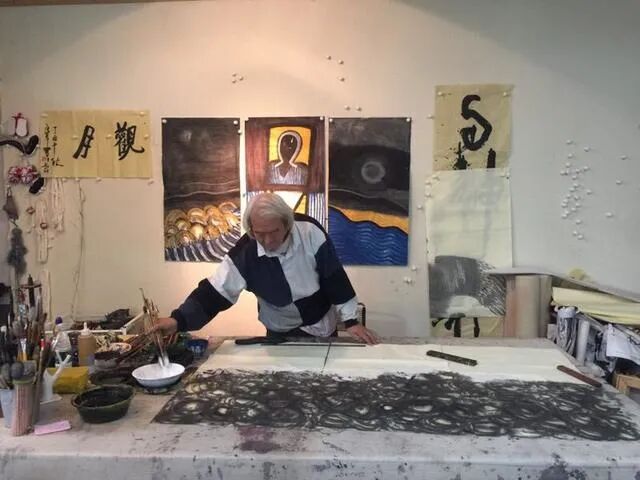
Thus Dao Zi’s ink creation becomes a drama of ‘the Word made flesh’ unfolding on rice paper. The movement of brush and ink is no longer the literati’s ‘casual, sketch-like’ outpouring of personal temperament, but a sacred rite — a process in which the transcendent ‘Holy Way’ manifests itself within a material medium.
Second is the ‘transformative creation’ of traditional Chinese symbols. Dao Zi did not simply take a brush to paint biblical stories. His brilliance lay in injecting the spirit of Christianity into the most central imagery of Chinese literati painting, thereby achieving a profound transformation of the kind ‘new wine in old bottles’.
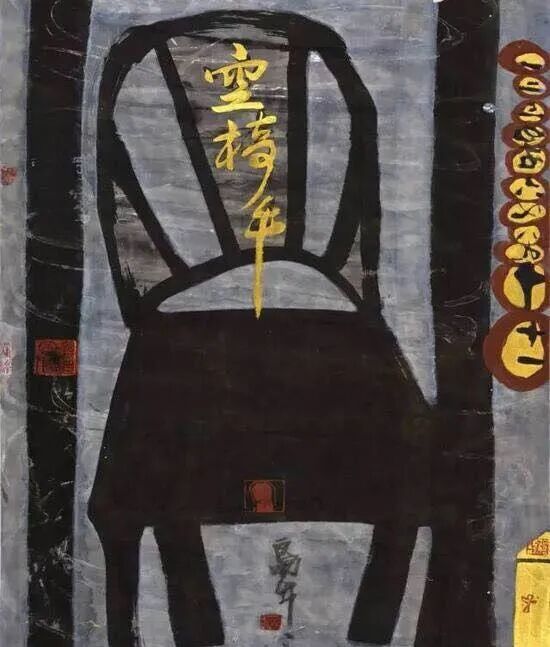
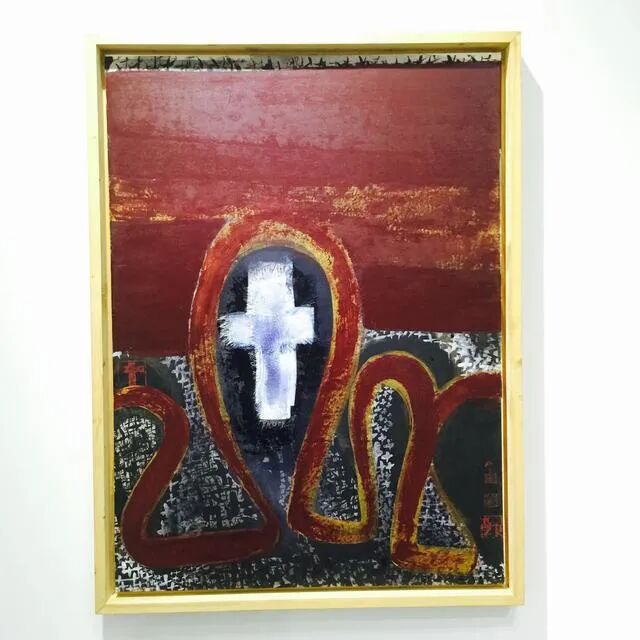
The most typical example is the *Bitter Bamboo* he painted again and again. In traditional Chinese culture, bamboo symbolises the integrity of the gentleman and a humble, lofty purity; from Su Dongpo to Zheng Banqiao it was celebrated by literati for a thousand years. Yet in Dao Zi’s hand the form of bamboo changes fundamentally: it grows into the shape of a cross. The transverse nodes and the vertical stalks together constitute a sign of passion and redemption.
In *Holy Ink in Germany: Interviews with Professor Dao Zi*, he explained the work thus: ‘Bamboo is a metaphorical sign of personality that Chinese literati have used again and again… Here there is a metaphor of personality. But I transformed it, turning it into a divine imago, infusing a divine redemption into it.’ This ‘bitter bamboo’ retains the bamboo’s quality of unyielding resilience while being charged with the meaning of Christ’s passion. It no longer points merely to a secular moral ideal but to a transcendent, sacred sacrifice.
In this way Dao Zi successfully built a bridge connecting the two seemingly distant worlds of Chinese literati tradition and Christian faith. For viewers familiar with Chinese culture his works are at once familiar and strange; for those who know the Christian faith, they convey a unique, Eastern expression of the divine.
3.3 Visual Language: The Passion of Expressionism and the Glow of Abstraction
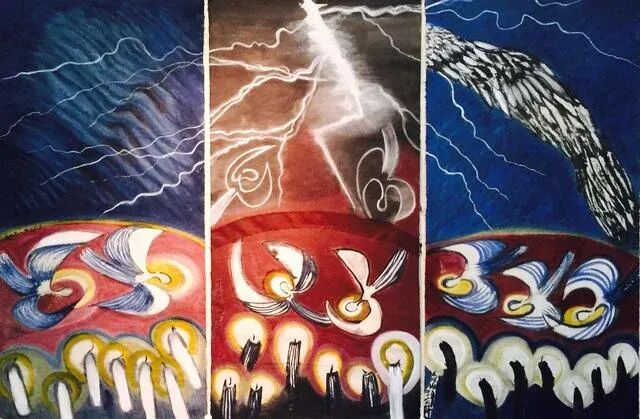
In visual language, Dao Zi’s ‘Holy Ink’ also displays a distinct personal style. He absorbed the passion and power of Western modern Expressionism while retaining the material beauty and calligraphic quality of Eastern ink.
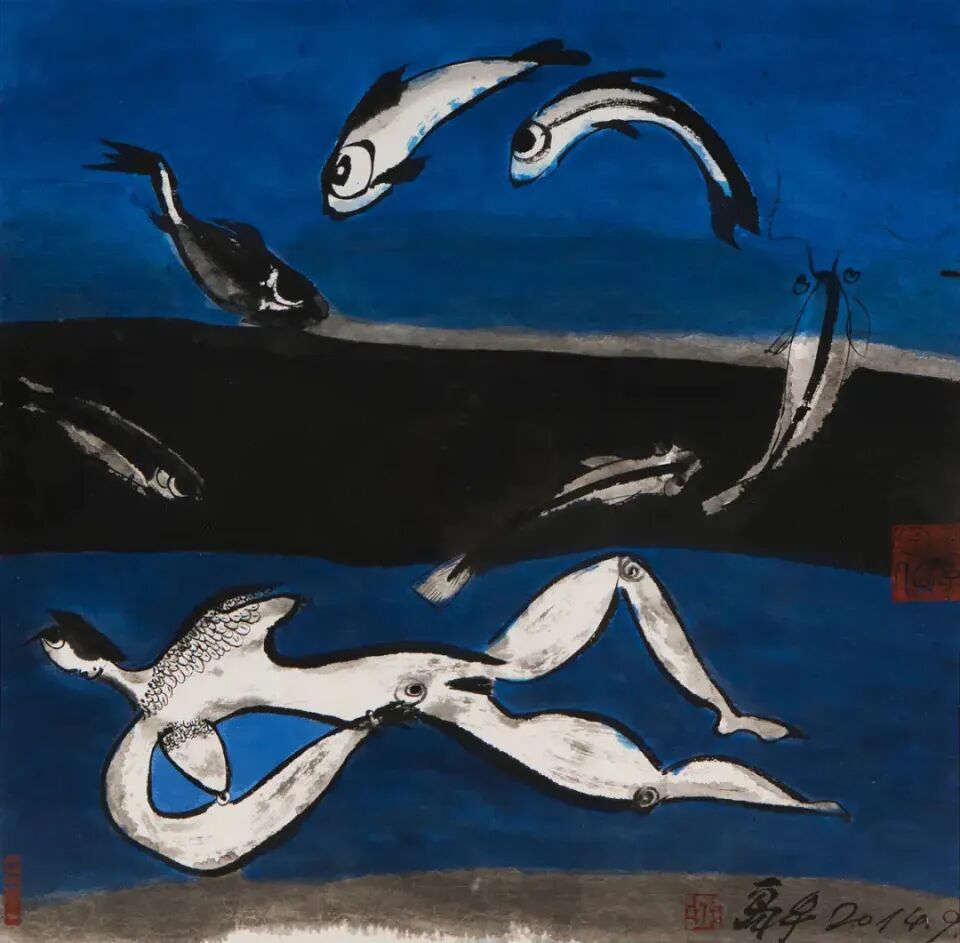
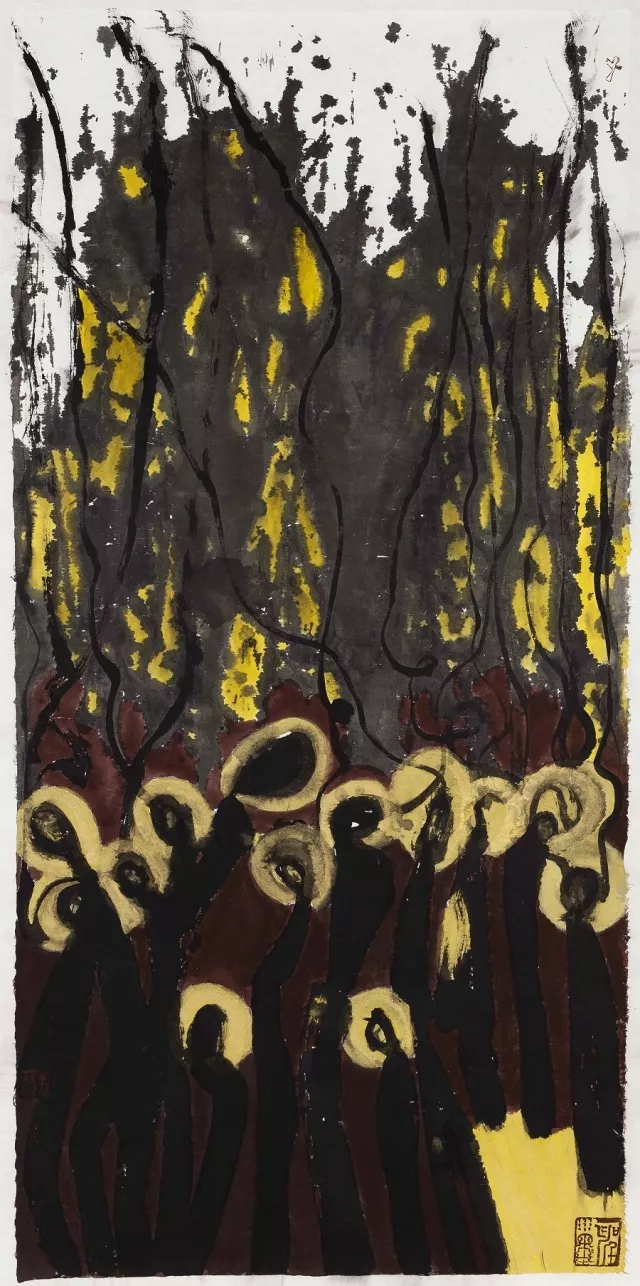
His brushwork is often rough, rapid and full of force — never the mild, restrained touch of traditional literati painting. This tension-laden manner serves precisely to express the struggle, suffering and sacred passion of faith. His pictures frequently set broad expanses of dense ink against blank space in stark contrast, charged with dramatic chiaroscuro, as if a soul were wrestling between darkness and light.
At the same time, his works possess a ‘semi-abstract’ quality. The symbols he depicts — crosses, crowns of thorns, chalices — are often simplified and deformed, dissolved into the drenching textures of ink. What he pursues is not the objective representation of objects but the manifestation of a ‘spiritual dimension’. In an interview he spoke of his abstraction: ‘This abstraction is unlike Western abstraction, and unlike the abstraction now in fashion. I preserve for abstraction a resonance that can be apprehended without words.’ This ‘resonance that can be apprehended’ points precisely toward the invisible, ineffable realm of the divine.
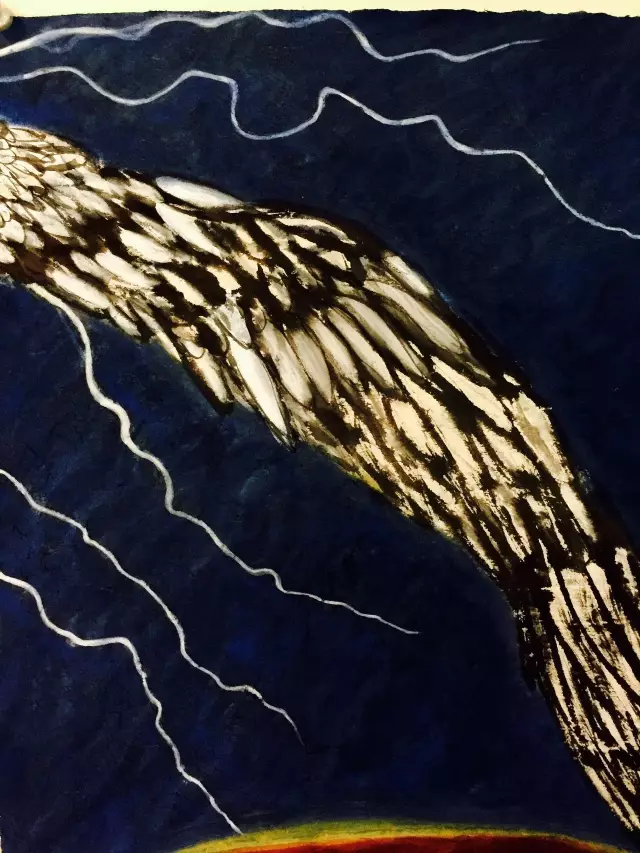
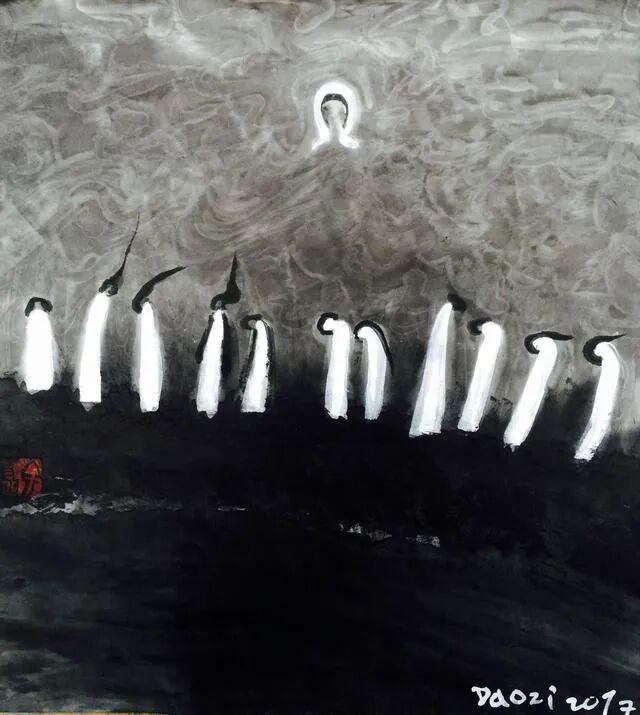
‘White Bird, Black Flight’ — the title of one of his exhibitions — captures with precision the inner contradiction and tension of his art. The ‘white bird’ symbolises the Holy Spirit, light and purity; ‘black flight’ hints at flight and struggle within a suffering world. His art is precisely a soul-stirring dialogue conducted between black and white, between elegy and psalm, between suffering and redemption.
Dao Zi’s ‘Holy Ink’ is a unique and important phenomenon in the history of Chinese contemporary art. With its profound theological reflection, bold cultural grafting and intense visual expressiveness, it opens a wholly new possibility for the contemporary transformation of ink painting, that ancient art. It shows that the vitality of art lies not only in the renewal of language but in whether it can connect to a transcendent spiritual value that offers ultimate consolation.
IV. Measure: ‘Artistic Value’ Sought Beyond the Logic of Capital
Mr Dao Zi was not only an art historian and creator but also a ‘diagnostician’ who reflected deeply on the essence and function of art. In his later years his thought increasingly focused on a central question: in modern society, and especially now that the logic of capital penetrates everywhere, what is the true value of art? Where is the future of art headed? His views are charged with critical edge and deep anxiety.
4.1 Against the Hegemony of Capital: The Responsibility of Art Criticism
Dao Zi’s sharpest criticism of contemporary art points directly at its ‘collusion’ with capital. He held that the greatest crisis facing Chinese contemporary art since the new century is the ‘industrialisation of art’ and the ‘hegemony of capital’.
He stated plainly that ‘art criticism must confront the hegemony of capital’. He said: when the price of an artwork becomes the sole measure of its value, the spirituality of art vanishes completely. ‘What galleries exhibit now are all commodities; the most successful art is simply the piece with the highest hammer price. That is precisely the distorted reflection of a free spirit.’
The ‘hegemony of capital’ he spoke of manifests in several respects:
Standardised production: artistic creation is no longer the free expression of an individual spirit but ‘production’ catering to market demand. Like factory owners, artists ceaselessly replicate their successful styles and image-symbols, leading to an ‘overproduction of images’ and a ‘poverty of spirit’.
The failure of criticism: art criticism should be a system of value-judgement independent of the market, yet many critics have become the market’s ‘drum-beaters’, using ornate rhetoric to package and endorse commodified artworks. Criticism loses its independence and criticality and becomes one link in the chain of capital.
Numbing of the spirit: under this model art can no longer touch the soul or provoke profound thought. It becomes a fashionable ornament, a display of wealth, a numbed and indifferent visual consumption.
Faced with this situation, Dao Zi held that art critics bear an inescapable responsibility. The critic’s mission is to hold fast to an independent spiritual stance, to use the weapons of theory to reveal the truth of art’s alienation by capital, and to defend art’s spiritual value. He practised what he preached, using his writings and words constantly to sound a ‘dissonant’ note amid an art world shrouded by capital.
4.2 The Value of Art: A Return from ‘Humanism’ to ‘Theocentrism’
Then where, in truth, does the value of art lie? Dao Zi’s answer is: spirituality.
He held that the root of modern art lies in the humanist current since the Enlightenment. Humanism liberated the individual from the bondage of theocracy, affirming the dignity and freedom of the person — an undeniable advance. Yet pushed to its extreme, humanism also produces a new predicament — ‘it flattens the subjectivity of the individual, a culture without personality, and ultimately leads to a world without God and without soul. In the end, it is the abandonment of the Holy Way or the Heavenly Way.’
When man becomes the measure of all things and human desire is extolled without limit, art loses its transcendent dimension and ends up as a mere depiction of desire and a worship of man himself — an ‘artistic fetishism’.
Dao Zi therefore advocated a return of value, a turn from ‘anthropodicy’ to ‘theodicy’. He did not seek to negate human value but to reposition it within a vaster, sacred coordinate system. He stressed: ‘The justice of God can never be reduced to the justice of man.’
In his view, the supreme value of art lies neither in gratifying the senses, nor in reflecting reality, nor even in expressing the artist’s personality, but in ‘awakening human spirituality’ and in becoming a bridge between finite man and the infinite God. A work of art is great because it lets us glimpse a divine radiance that transcends us. It can heal ‘the wounds of the psyche and the spirit’ and, amid ‘the poverty of the age and the scarcity of the poetic’, reawaken our longing for the sacred.
This is precisely the goal his ‘Holy Ink’ sought to attain — ‘to create works that glorify God and benefit man’. Here ‘benefit man’ means not material advantage but the salvation and elevation of the soul.
4.3 The Future of Art: Art as ‘Witness’ and ‘Revelation’
On the basis of this theory of value, Dao Zi set out his hopes for the future of art. What he looked forward to was an art of ‘witness’ and ‘revelation’.
Art as ‘witness’: the artist should not be a lofty creator but a humble ‘witness’.
He witnesses the suffering of the age, the struggle of human nature, and — most importantly — the acts of God in history and in individual lives. The work of art is the trace of this witness. It offers no cheap optimism but honestly presents the truth of existence, and within that truth points toward a transcendent hope.
Art as ‘revelation’: art should possess the character of a ‘prophet’. It does not follow fashion but utters a voice that transcends the age, bringing ‘visions never before seen’. In an era when everyone is addicted to the ‘near-at-hand’ of entertainment and consumption, what art must do is remind people of the existence of the ‘far-off’ — those ultimate questions concerning the soul and eternity. Dao Zi’s ‘Holy Ink’ has been praised as ‘bringing a prophetic voice to the cacophonous, speechless contemporary art’, precisely because he sought, through art, to bring redemption and revelation.
This is an exceedingly lofty and exceedingly stringent demand upon art. To many it may seem an untimely ‘elitism’ or ‘moralising’. But for Dao Zi it was precisely the only reason art could survive in an age of nihilism. If art abandons its inquiry into the sacred and its concern for the soul, then in the end it will inevitably drown in the ocean of consumerism.
Mr Dao Zi’s views on the value and future of art are among the most precious intellectual legacies he left us. Like a voice crying in the wilderness, he reminds us that, even as we chase the latest trends and the highest auction prices, we must not forget the original and ultimate purpose of art — to settle that homeless soul of ours, that soul which longs to transcend.
V. Elegy and Psalm
‘White Bird, Black Flight’ is not only the title of one of Mr Dao Zi’s exhibitions but a portrait of his spirit across a lifetime. His life was a life of seeking in two colours, black and white; a life advancing through the interweaving of elegy and psalm.
His life was a profound ‘elegy’.
He lamented the marginalisation of poetry, worried over the loss of the artistic spirit, and burned with anger at the alienation of man by the logic of capital. Like a physician diagnosing the age, he precisely named the maladies of our cultural body — spiritual poverty, the absence of faith, the exile of meaning. His critical essays were as keen as a scalpel, dissecting the vanity and clamour of contemporary art, puncturing without mercy its beautiful bubbles. The heavy black in his ink paintings is the solemn elegy he composed for this ‘age of catastrophe’. He never shrank from suffering; whether the existential predicament of humanity as a whole or the struggle and darkness deep in the individual soul, he set it upon the rice paper with a courage that faced it head-on. This profound tragic consciousness gave his thought and art the weight of a thousand jun.
Yet his life was even more a rousing ‘psalm’.
Beneath a profound pessimistic ground-tone, Mr Dao Zi always held fast to a transcendent hope. This hope came from his faith. He believed that above the boundless darkness there is light; within the heavy suffering there is grace; beyond the perishable flesh there is eternal life. This faith was not cheap optimism but a ‘leap’ of will and soul made after a deep insight into human nature and the world.
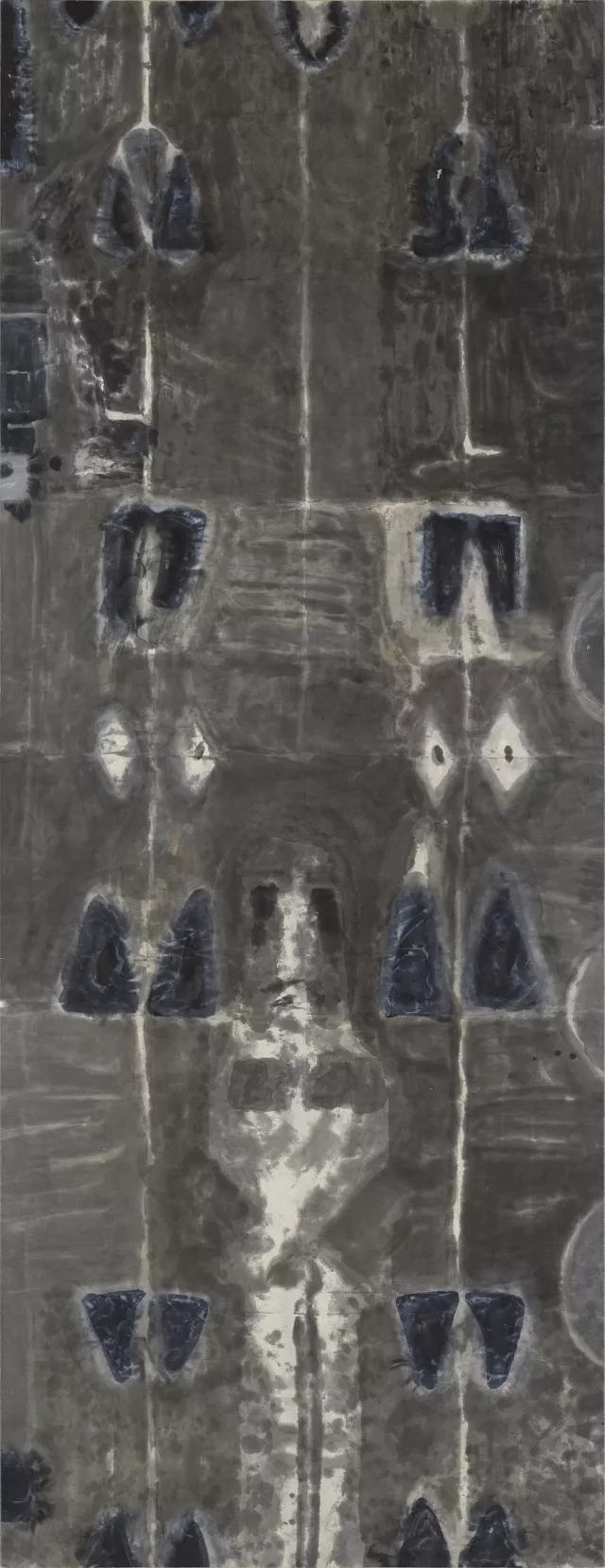
His ‘Holy Ink’ was the ‘psalm’ he offered to God. The blank spaces in his pictures, the lines that break free of dense ink and soar upward, the resilience of life bursting forth upon the cross of ‘bitter bamboo’ — all are a visual proclamation of his firm belief in redemption and resurrection. He joined China’s most native and refined artistic medium to a universal, transcendent faith; this unprecedented artistic venture is itself a psalm to cultural fusion and spiritual creativity.
He left behind a series of important writings, awaiting later scholars’ deeper study. The path of ‘Holy Ink’ he pioneered offers Chinese contemporary art a deeply instructive example oriented toward the spiritual dimension. The sharp questions he raised — about art and capital, about humanism and theocentrism — will long echo across the Chinese art world.
More importantly, he left us the backbone and exemplar of an intellectual. In an age accustomed to jest, deconstruction and value-relativism, with a seriousness and gravity almost ‘untimely’, he relentlessly pursued those eternal questions of ‘life and death’, ‘sin and punishment’, ‘suffering and redemption’. He told us that art can be more than entertainment, commodity or conceptual game; art can, and should, become the refuge of our spirit and the dwelling-place of our soul.
In the preface to his 2015 *Selected Poems of Dao Zi*, he wrote: ‘My poems are love letters to the snowfield, where all unfinished pain is buried and an unfreezable light grows.’ The author’s own note to the final line of ‘Heavy Snow’ captures the core of this ‘love letter’: death is not an end, but a burial into eternal light in a posture of lightness. Today, as we mourn Mr Dao Zi, we believe that the white bird struggling to fly through the dark night has already crossed the shadow of death and reached that place of eternal light. And the deep footprints he left in the human world will be as solemn as an elegy and as resounding as a psalm, stirring, for a long time, a long time, unceasing echoes in the river of time…
Rest in peace, sir!
订阅艺术评论
订阅即赠《2024中国当代艺术关键词》内部思考笔记 PDF
每周免费获取最新当代艺术批评与研究